← The Story Vault
Story Vault · Chapter 2
Greek & Roman Myth
Where the biblical stories tend toward morality, obedience, mercy, sacrifice, the Greek myths are about desire, hubris, and transformation. The gods are petty, the heroes are flawed, and the punishments are poetic. Painters love these stories because the emotions are extreme and the imagery is extraordinary: wings melting, serpents in hair, fire stolen from heaven.
These myths don't ask "what should you do?" They ask "what happens when you want too much?", and the answer is always beautiful, always terrible, always worth painting.
· · ·
Story 1
Prometheus
Stealing fire · The cost of giving knowledge · Punishment for helping humanity
The Story
Prometheus is a Titan — one of the old gods. He steals fire from Olympus and gives it to humanity, knowing this will enrage Zeus. Zeus punishes him by chaining him to a rock where an eagle eats his liver every day. Every night the liver regenerates. Every morning the eagle returns. Forever.
Why Painters Use It
Prometheus is the archetype of the person who suffers for giving others what they need. The teacher punished for teaching. The whistleblower. The scientist whose discovery is used against them. The fire is any knowledge or tool that empowers people and threatens power. The eagle is the daily punishment that regenerates, the price that never stops being paid. The story asks: is it worth suffering endlessly for a gift that transformed the world?
How Painters Used It
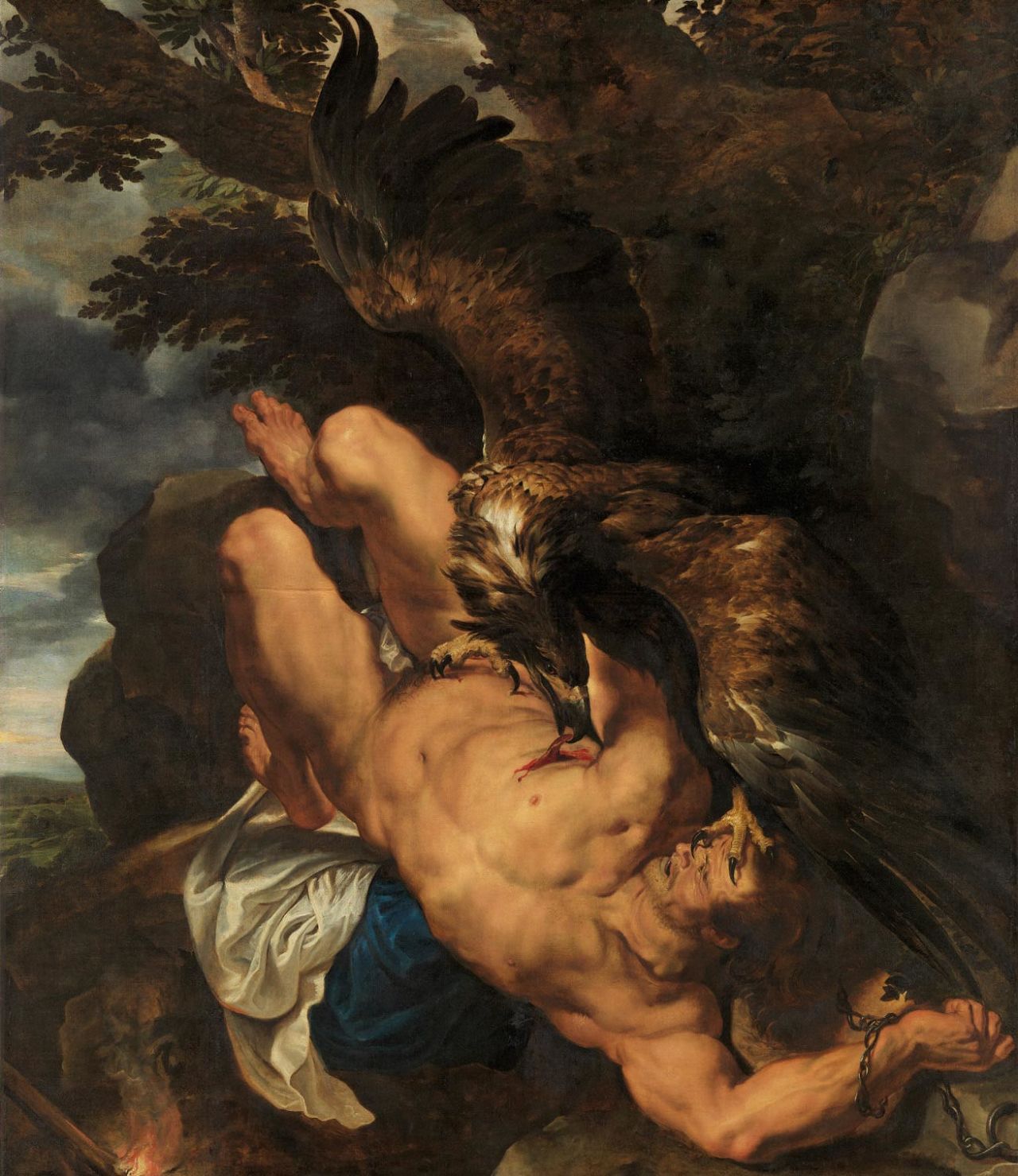
Rubens & Frans Snyders, "Prometheus Bound" (1611-12)
A massive, physically overwhelming painting: Prometheus's body arches backward as the eagle tears at his torso. Rubens painted the body; Snyders (an animal specialist) painted the eagle. The collaboration tells you something: depicting this required the best human anatomist and the best animal painter working together. The result is visceral, you feel the talons. But Prometheus's face isn't screaming. It's enduring. The body suffers; the will persists.
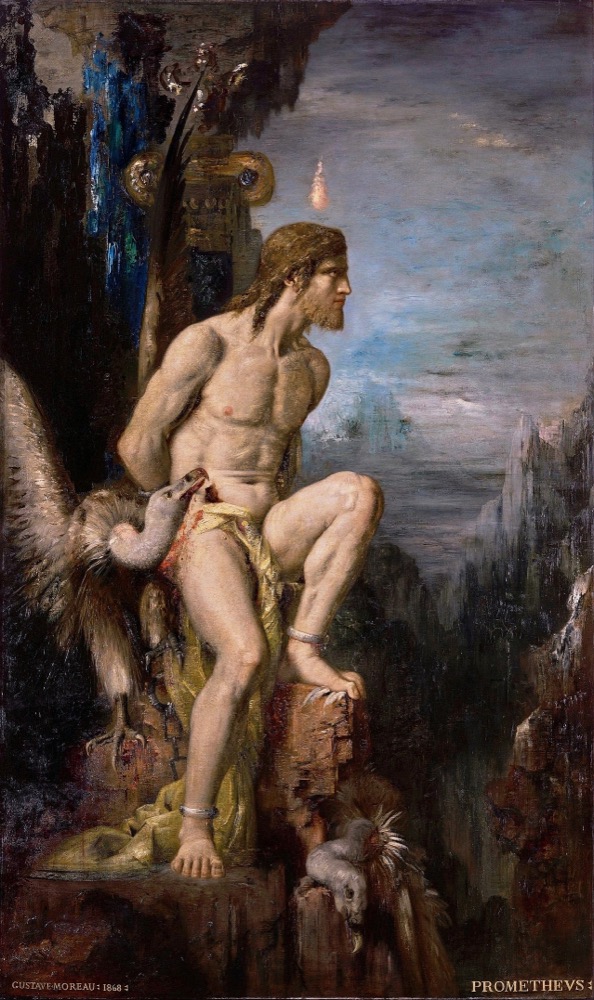
Gustave Moreau, "Prometheus" (1868)
Moreau paints Prometheus as beautiful — golden, luminous, almost Christ-like on the rock. The suffering is aestheticized into something approaching transcendence. This is the Romantic reading: the rebel against authority as saint, the sufferer as hero. For painters drawn to the beauty-in-agony tradition, Moreau is the model.
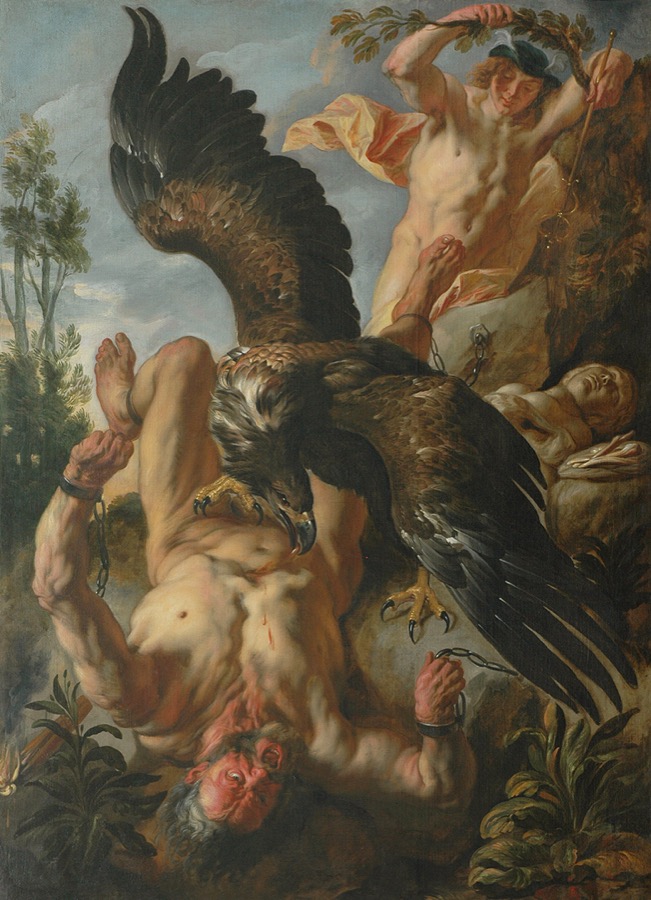
Jacob Jordaens, "Prometheus Bound" (c. 1640)
Jordaens, Rubens' successor in Antwerp, paints Prometheus with the same muscular Baroque energy but adds something Rubens didn't: exhaustion. This isn't the first day on the rock, it's the thousandth. The body still strains against the chains but the face shows the resignation of someone who has endured this cycle so many times that the pain is no longer surprising. The eagle is almost routine. THAT is the real punishment.
The Human Truth · 2026
Prometheus is anyone who gives humanity a tool and gets punished for it, not once but DAILY, the eagle returning every morning. The scientist whose discovery is weaponized. The teacher fired for teaching uncomfortable truths. The founder whose platform changed the world and now faces congressional hearings, lawsuits, and public hatred, the fire they gave is burning things they didn't intend. The myth says: giving people power ALWAYS comes with a cost to the giver, and the cost regenerates. You can't give fire once. You give it every day, and every day the eagle comes.
For your painting: The rock is any position of exposure — the witness stand, the hearing room, the press conference. The eagle is the daily cycle of consequence. Paint the face: not agony, but endurance. Prometheus doesn't scream. He waits for the next morning.
Story 2
Orpheus & Eurydice
Love that can't let go · The backward glance · Losing everything at the last moment
The Story
Orpheus is the greatest musician who ever lived, his songs can move trees and calm wild animals. His wife Eurydice dies of a snakebite. Orpheus descends to the underworld and plays so beautifully that Hades agrees to release her, one condition: Orpheus must walk ahead and NOT look back until they reach the surface. He walks. She follows. He can hear her footsteps. At the very last moment, just before the light of the surface, he turns. She vanishes. Gone forever.
Why Painters Use It
The most perfect metaphor for the thing you lose because you couldn't trust the process. Orpheus had it, Eurydice was following, the deal was working, and he lost it because he needed to SEE, to verify, to control. The backward glance is the painting: the instant of turning, the instant of losing, the face of someone who just did the one thing they were told not to do. It's also about art itself — the musician whose art can overcome death but whose human need destroys everything.
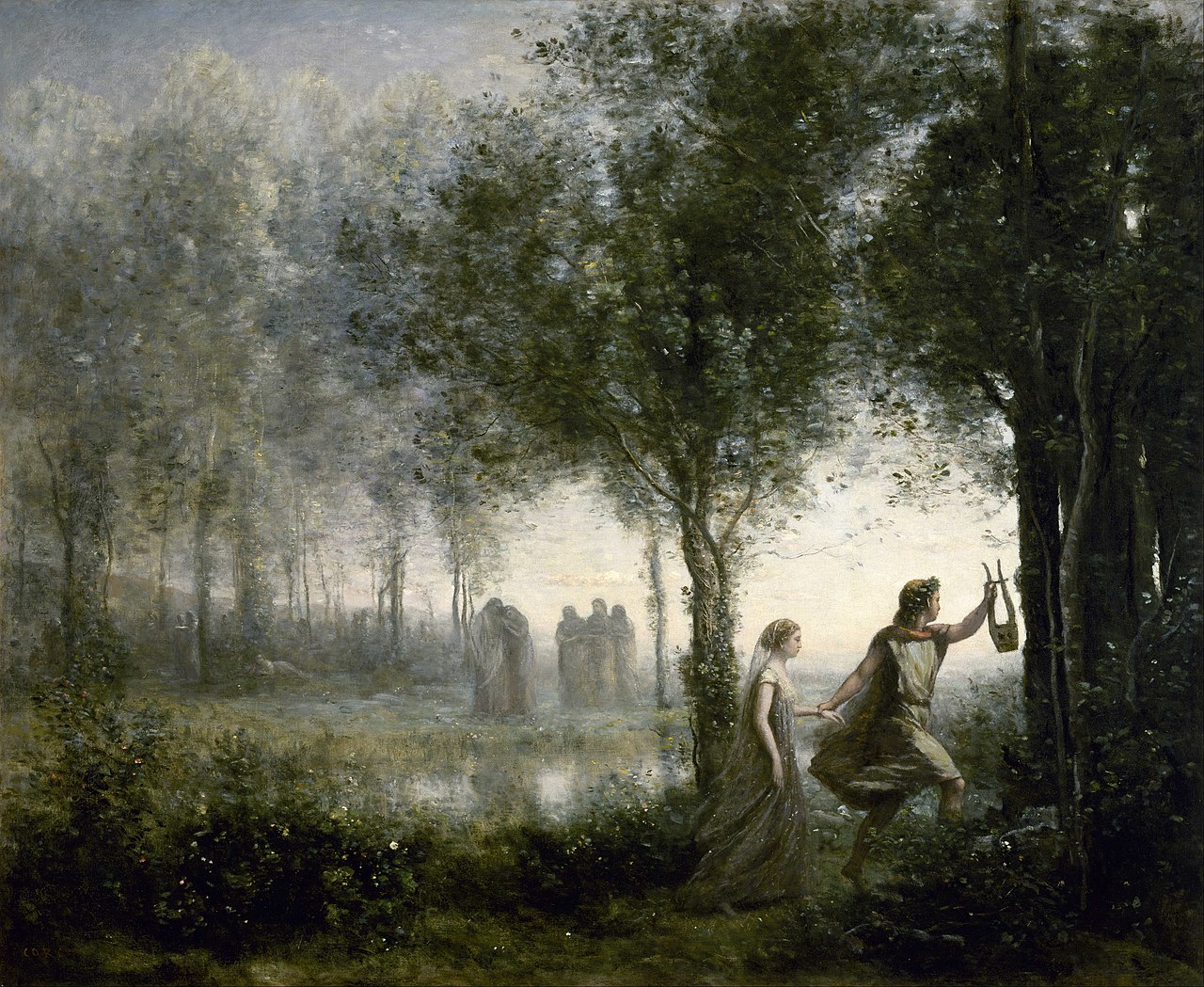
Jean-Baptiste-Camille Corot, "Orpheus Leading Eurydice from the Underworld" (1861)
Corot paints the landscape version: a misty, dreamlike forest where the couple walks through the boundary between death and life. The atmosphere does the work, you can barely distinguish the trees from the figures. The underworld isn't dark; it's soft, inviting, almost beautiful. That's the danger: it's a place you might not want to leave. Corot understood that the underworld's power isn't horror but seduction.
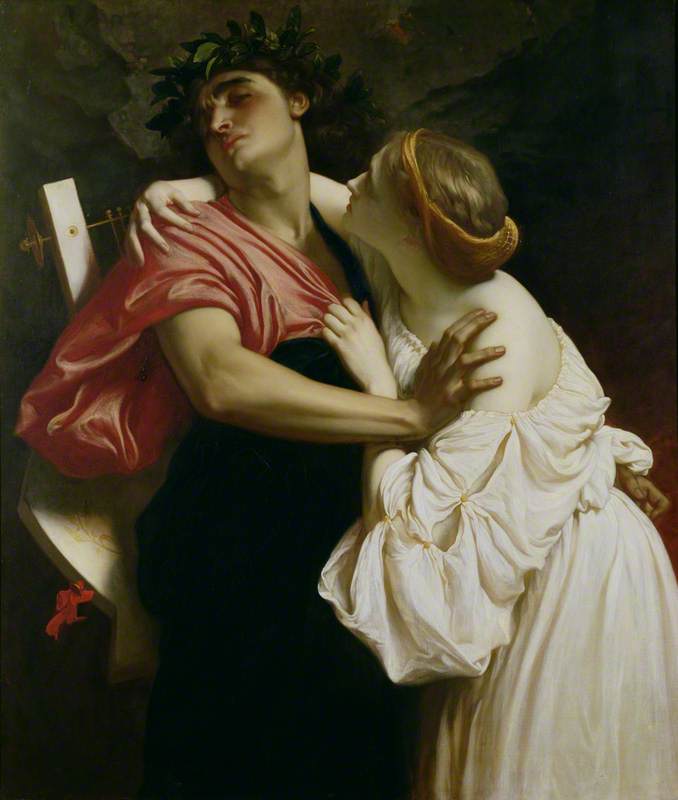
Frederic Leighton, "Orpheus and Eurydice" (c. 1864)
Leighton paints the instant of the turn: Orpheus reaches back, Eurydice is already fading. Her body is translucent, she's becoming shadow even as he grasps for her. The painting freezes the moment between having and losing. His hand reaches for something that is already gone but hasn't yet disappeared.
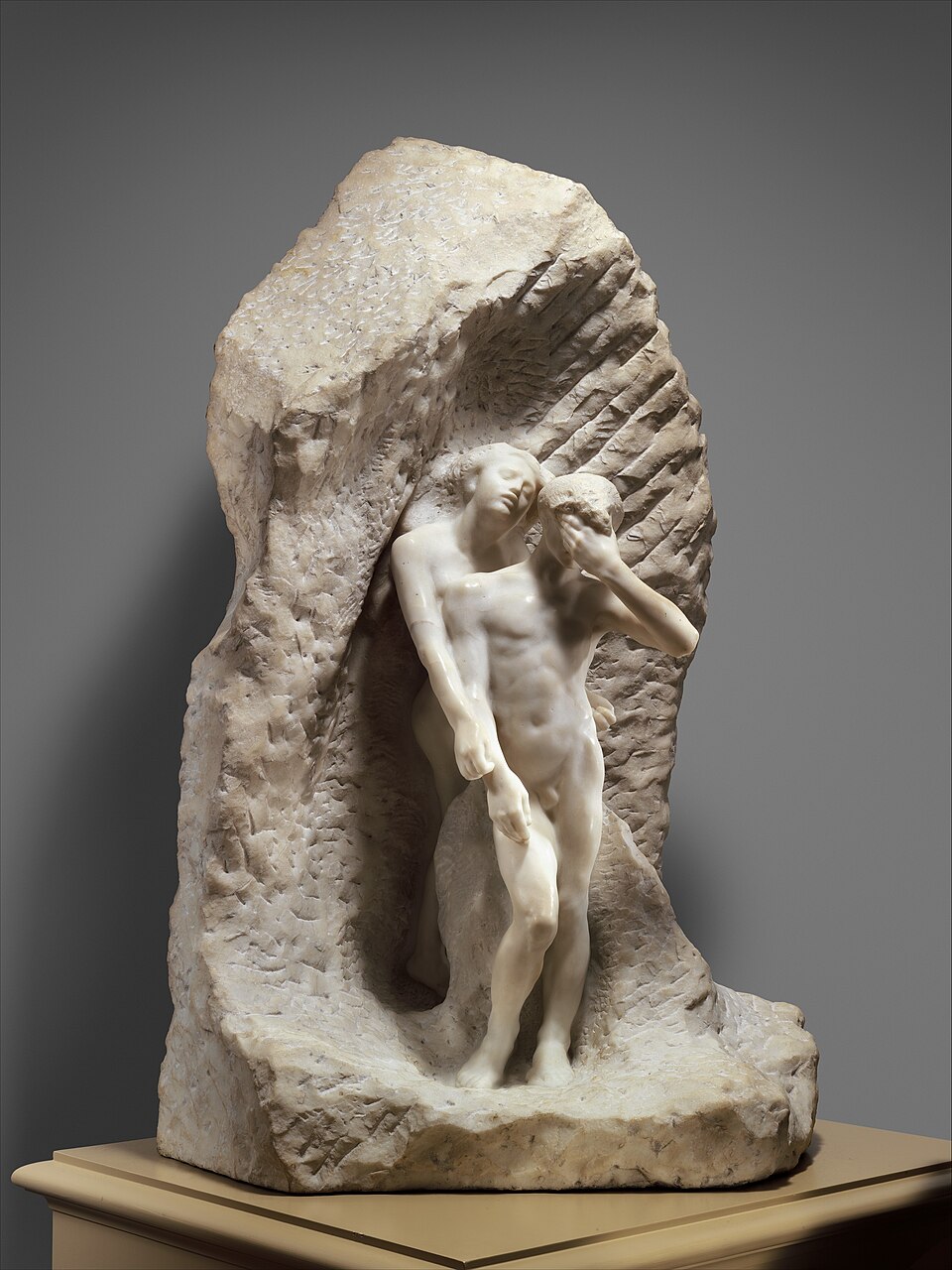
Rodin — "Orpheus and Eurydice" (1893, sculpture)
Rodin sculpts the couple at the moment of maximum tension: Orpheus strains forward, Eurydice hangs back, a gap opening between them. The bodies tell the story, one pulls, one recedes. The space between them is the entire myth compressed into a few inches of marble.
The Human Truth · 2026
The backward glance is the most human gesture in all mythology, the inability to trust that things are working out, the compulsive need to CHECK, to verify, to control. Every relationship ruined by surveillance. Every recovery destroyed by "just one look" at the old life. Every creative process killed by premature evaluation. Orpheus doesn't fail because he's weak. He fails because he LOVES, and love makes you need to see the face of the person you're saving. The myth says: sometimes the bravest thing is to keep walking forward without looking.
For your painting: Two figures walking away from something dark. The front figure's head begins to turn. You can feel the moment about to break. Paint the instant before the glance, when the decision is still being made, when she might still be saved. The space between them is everything.
Story 3
Icarus
Ambition beyond capacity · The thrill of the forbidden · The fall
The Story
Daedalus, a master craftsman imprisoned on Crete, builds wings of feathers and wax for himself and his son Icarus. He warns Icarus: don't fly too close to the sun (the wax will melt) or too close to the sea (the feathers will get wet). Icarus flies. The sensation is intoxicating. He goes higher. Higher. The sun melts the wax. The wings disintegrate. He falls into the sea and drowns. Daedalus watches.
Why Painters Use It
The most universal hubris story: the young person who is told the limits and ignores them because the feeling is too good. The flight is real — Icarus genuinely flew. The joy was genuine. The danger was also genuine. The story doesn't say ambition is wrong. It says ambition has a physics. Ignore the physics, and the physics doesn't care. Every startup founder, every young athlete, every person who thought they were the exception, is an Icarus.
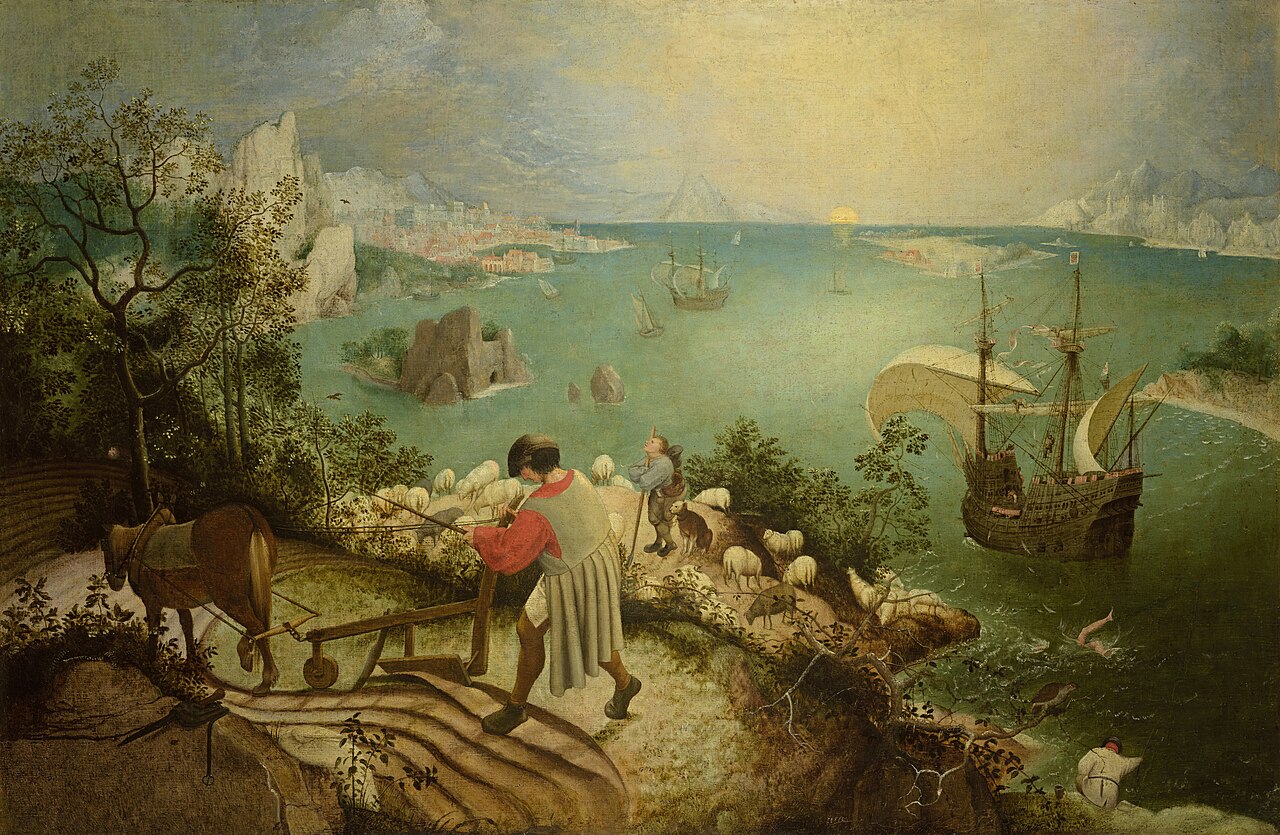
Pieter Bruegel the Elder, "Landscape with the Fall of Icarus" (c. 1560)
The most devastating version, and the most counterintuitive. Icarus is nearly invisible: two tiny legs disappearing into the sea at the lower right corner. The rest of the painting is a beautiful landscape, a farmer plowing, a shepherd tending sheep, a ship sailing. Nobody notices the boy drowning. Bruegel's point: the world doesn't stop for your catastrophe. Your personal apocalypse is background noise to everyone else. W.H. Auden wrote a poem about this painting: "About suffering they were never wrong, / The Old Masters."
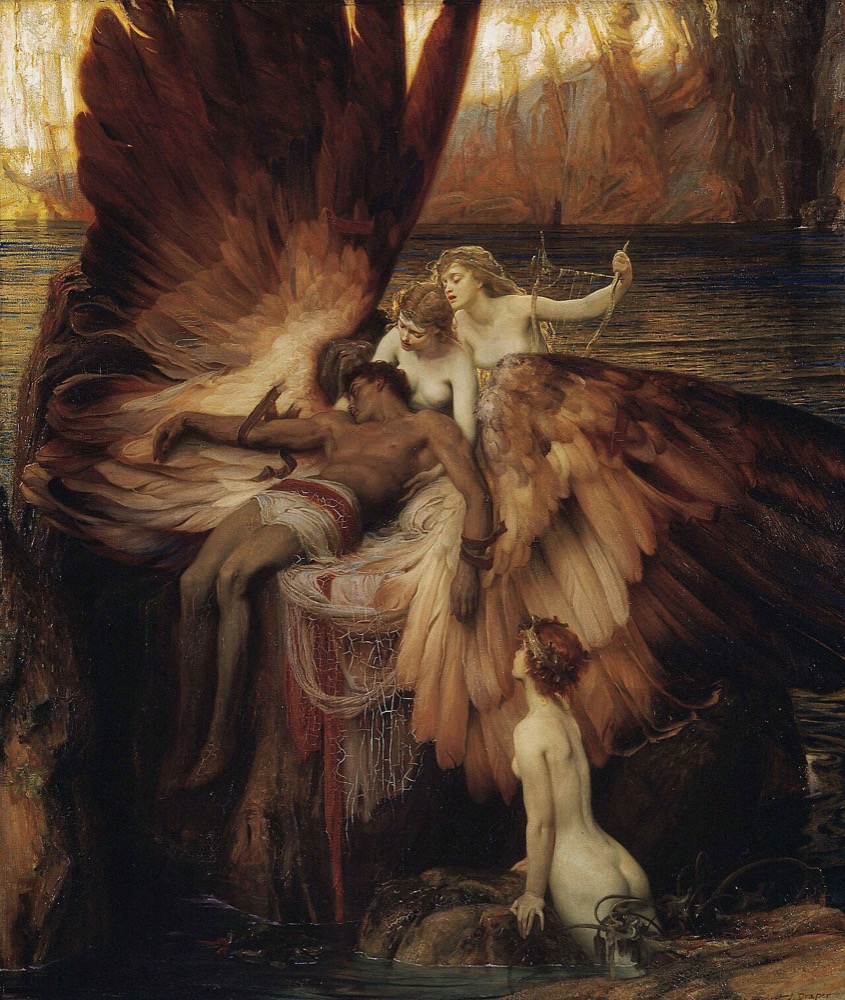
Herbert James Draper — "The Lament for Icarus" (1898)
Draper paints the AFTER: Icarus's beautiful body lies on rocks, wings scattered, mourned by nymphs. It's lush, Romantic, almost Pre-Raphaelite. The tragedy is aestheticized, the dead boy is gorgeous. This is the dangerous version (beautiful death as spectacle), but it's also honest: we are attracted to stories of beautiful failure. The painting doesn't moralize. It grieves.
Image needed
(see downloads)
Matisse, "Icarus" (1947, from Jazz)
Matisse reduced Icarus to a black silhouette against blue, a body falling through space, a red dot for the heart. It's joyful, not tragic. The simplification strips away everything except the essential image: a human shape, airborne, with a beating heart. Matisse found the exhilaration inside the fall. Even while dropping, Icarus is flying.
The Human Truth · 2026
The flight is REAL. Icarus genuinely flew. The joy was genuine. The sun was warm and the view was extraordinary. That's what makes the story devastating, it's not about foolishness, it's about the fact that the most thrilling experiences and the most dangerous ones feel exactly the same. Every startup at maximum valuation. Every athlete at peak performance. Every relationship at its most intense. The wax hasn't melted yet. You're higher than anyone has ever been. And the physics is already in motion. Daedalus's warning — "not too high, not too low", is the advice of every parent: stay in the middle. And every child ignores it, because the middle doesn't feel like flying.
For your painting: Don't paint the fall. Paint the HEIGHT, the moment of maximum altitude, maximum joy, just before the physics catches up. The viewer knows what happens next. That foreknowledge is the painting's tension. Bruegel's version (Icarus invisible, the world indifferent) is the alternative: your catastrophe is background noise to everyone else.
Story 4
Narcissus
Self-obsession · The image that consumes · Love that can't reach its object
The Story
Narcissus is a beautiful youth who rejects every lover. The nymph Echo, heartbroken, fades away until she's nothing but a voice. The gods punish Narcissus by making him fall in love with his own reflection in a pool. He stares at the face in the water. He reaches for it. He can't touch it, every attempt shatters the image. He wastes away at the water's edge, unable to leave the reflection, unable to have it.
Why Painters Use It
The most prescient myth for 2026 a person consumed by their own image, unable to connect with anyone real. The pool is the screen. The reflection is the curated self. Echo (the lover who fades to nothing because she's ignored) is every real relationship sacrificed to the performance of self. The myth isn't about vanity in the simple sense. It's about the tragedy of loving something that can't love you back — because it's not real.
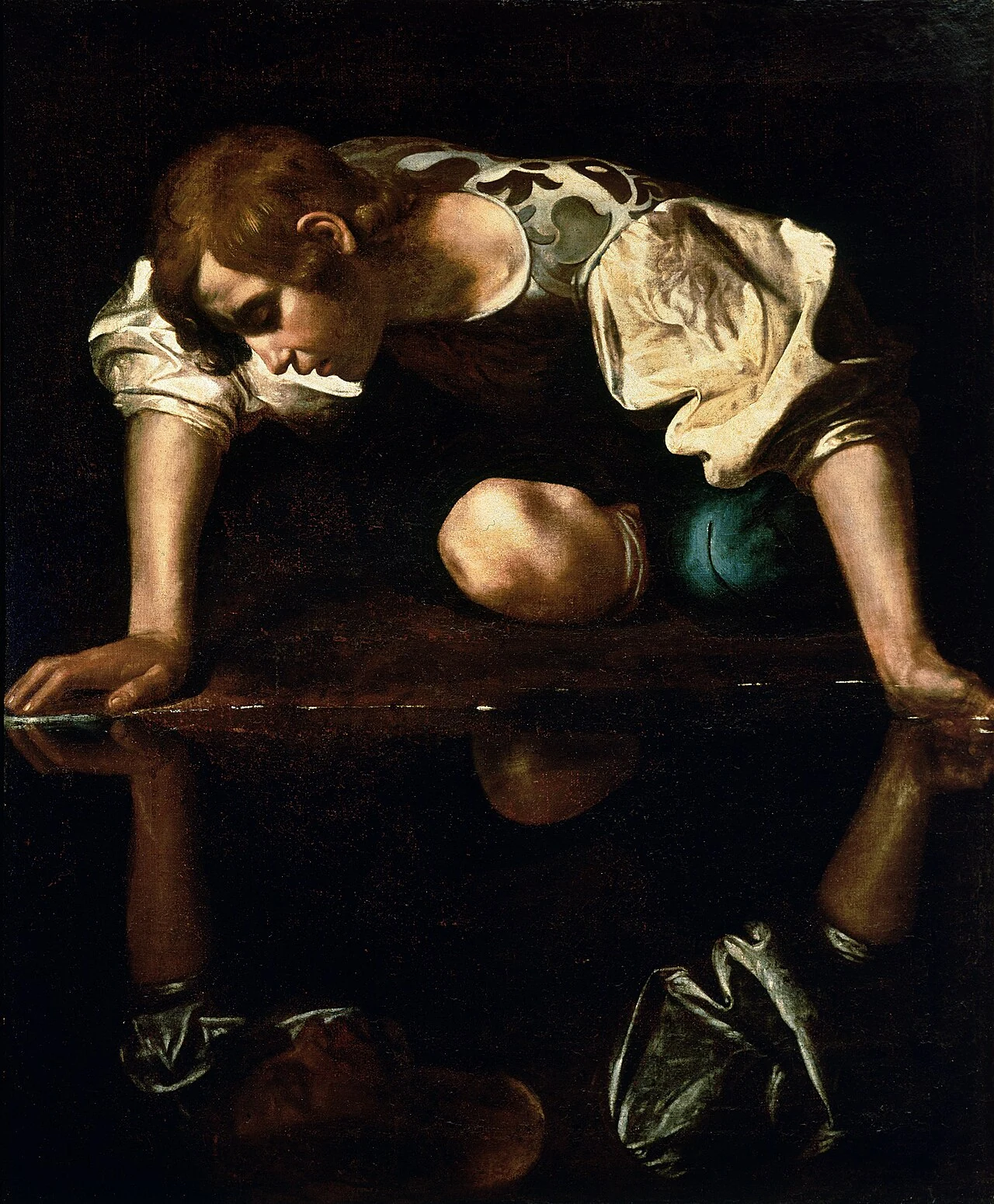
Caravaggio, "Narcissus" (c. 1597-99)
Caravaggio paints Narcissus kneeling over a dark pool. The composition is bisected by the water's surface: the real boy above, the reflection below. They form a circle, Narcissus's body and its reflection create a closed loop, an O of self-regard with no way in or out. The background is pure black. There is nothing else in the world. Caravaggio understood that narcissism isn't a personality flaw, it's a prison.
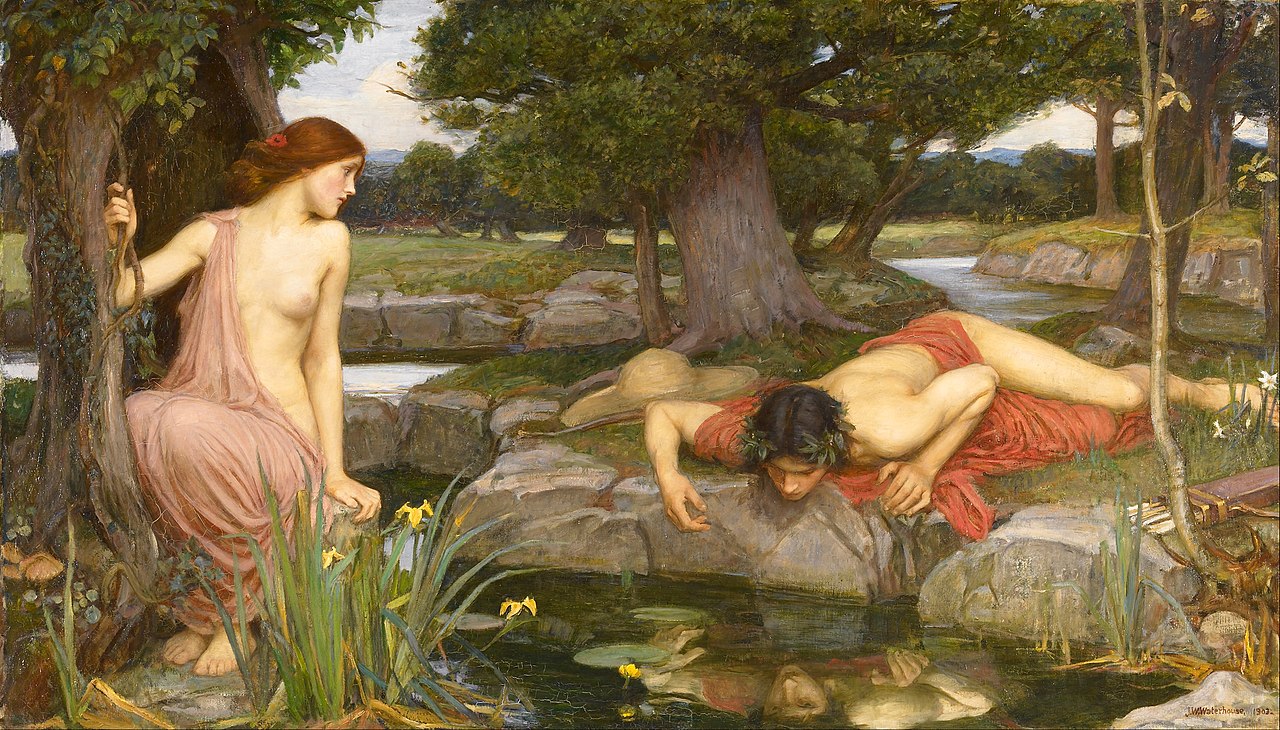
John William Waterhouse, "Echo and Narcissus" (1903)
Waterhouse includes Echo — lying among rocks and flowers behind Narcissus, watching him stare at the water, her body already fading. Narcissus doesn't know she's there. The painting is about TWO tragedies: the person trapped by their own image AND the person who loves them from a distance and is slowly disappearing. The composition gives equal weight to both, which makes it more painful than Caravaggio's single-figure version.
Still in copyright, so not reproduced here. Look it up: it’s worth seeing.
Salvador Dalí, "Metamorphosis of Narcissus" (1937)
Dalí painted Narcissus transforming into stone, the body becoming a hand holding an egg from which a flower grows. It's surrealist, but the core image is accurate to the myth: a person so fixed in self-regard that they petrify. The flower (a narcissus) growing from the crack is the only beauty that survives: even from the most extreme self-obsession, something alive can emerge. That's either hopeful or horrifying, depending on your mood.
The Human Truth · 2026
The most prescient myth for our era. Narcissus isn't vain, he's TRAPPED. He didn't choose to fall in love with his reflection; the gods cursed him. The pool is addictive: every time he reaches for the image, it shatters, and every time it re-forms, he reaches again. This is the doom-scroll, the notification loop, the curated feed. The phone isn't a mirror, it's the POOL. And Echo — the lover who fades to nothing because she's ignored, is every real relationship sacrificed to the performance of self. She's still calling. He can't hear her over the glow.
For your painting: A face lit from below by screen-glow. The phone AS the pool of Narcissus. In the background or the next room: Echo, the partner, the child, the friend, fading. Waterhouse's composition (both Narcissus AND Echo in frame) is the most powerful version: two tragedies sharing the same canvas.
Story 5
Persephone
Abduction · Seasons of grief · The mother who searches
The Story
Persephone, daughter of Demeter (goddess of harvest), is picking flowers in a field when Hades, god of the underworld, opens the earth and drags her down. Demeter searches the world, grief-stricken. While she mourns, nothing grows, the world enters winter. Eventually Zeus brokers a deal: Persephone will spend part of the year underground (winter) and part above (spring/summer). Every year she descends, and Demeter grieves, and the world goes cold.
Why Painters Use It
The myth explains the seasons, but its emotional core is the parent whose child is taken — and the cyclical nature of grief. Demeter doesn't "get over it." She experiences the loss every year, every autumn, as Persephone descends again. The return in spring doesn't erase the loss, it just pauses it. This is the most honest depiction of grief in all mythology: it's seasonal, not curable. It comes back. And also: Persephone eats the pomegranate seeds VOLUNTARILY, she chooses to stay partly in the underworld. The daughter who leaves and partly wants to stay gone. Every parent of an adult child understands.
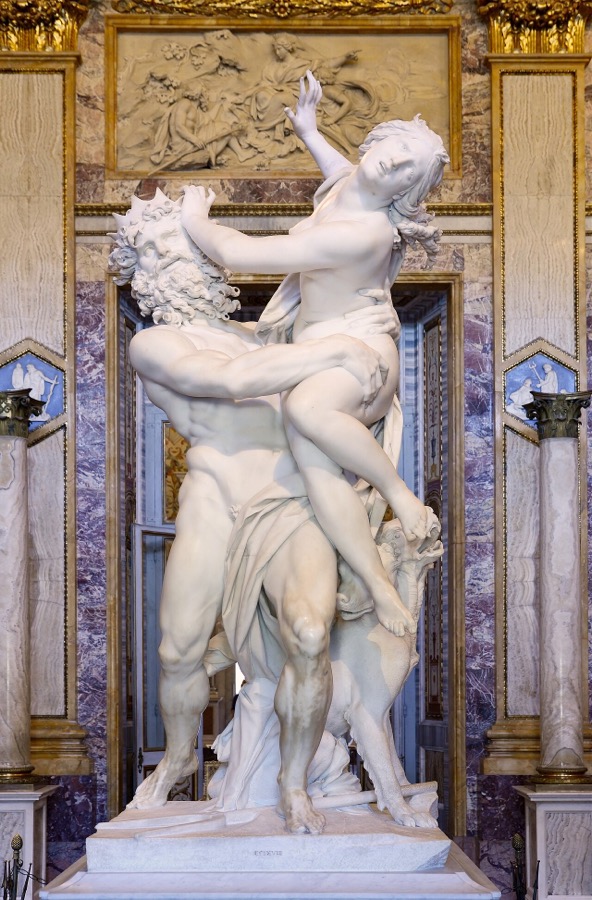
Bernini, "The Rape of Proserpina" (1621-22, sculpture)
Hades' fingers pressing into Persephone's thigh is the most famous detail in Baroque sculpture, the marble YIELDS under his grip like real flesh. Her body twists away, one hand pushing his face, the other reaching toward the sky. Bernini carved the exact physics of abduction: the overwhelming force, the futile resistance, the flesh that is soft even in stone. The sculpture is beautiful and it's a depiction of violence. Both things are true. That tension is what makes it impossible to look away.
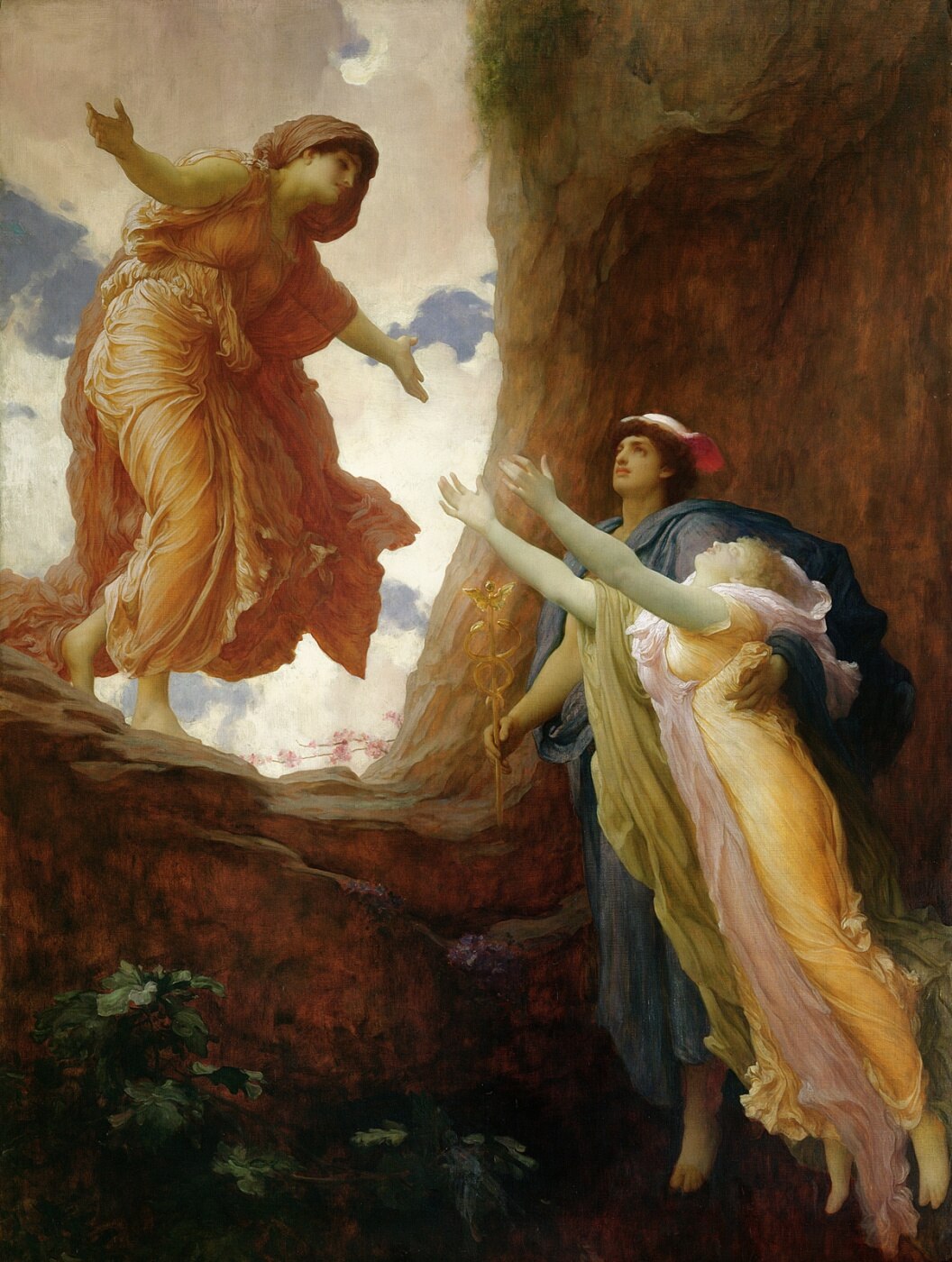
Frederic Leighton — "The Return of Persephone" (1891)
Leighton paints the happy part: Persephone rising from the earth, arms reaching for Demeter, who bends to receive her. The composition is vertical, ascent, return, reunion. The colors shift from cool underground tones at the bottom to warm light at the top. It's a painting about coming back. But it works because the viewer knows she'll descend again. Every reunion contains the next departure.
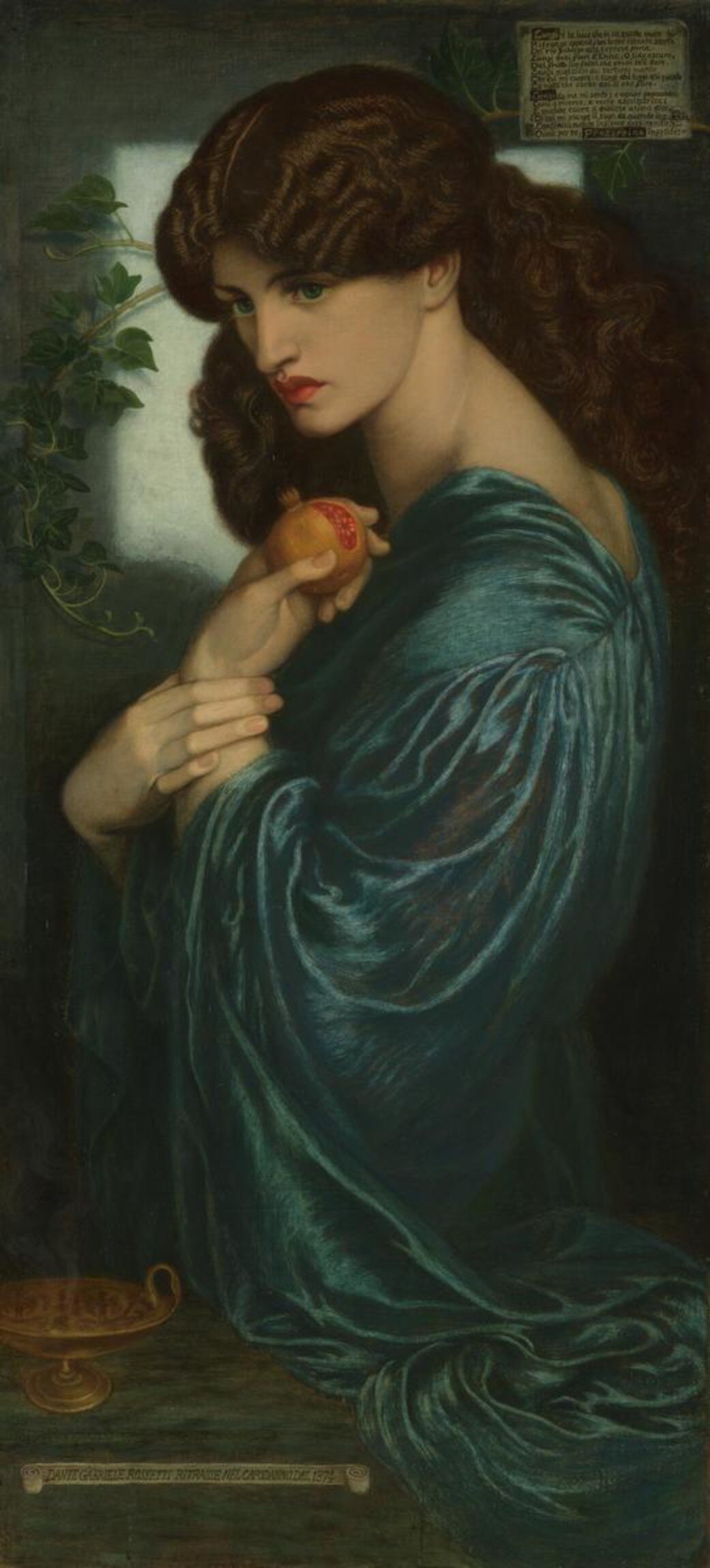
Dante Gabriel Rossetti, "Proserpine" (1874)
Rossetti paints Persephone in the underworld, holding the pomegranate she's already bitten, the act that binds her to Hades. Her expression is melancholy, not terrified. She's not a captive screaming for rescue. She's someone who has accepted her divided existence. Rossetti understood the more complex reading: sometimes the underworld becomes home. Sometimes the person who was taken learns to live there. The pomegranate is the choice she made, the commitment she can't undo.
The Human Truth · 2026
Grief that cycles is different from grief that resolves. Demeter doesn't "get over" losing her daughter. She experiences the loss every autumn, the return every spring, and the loss again. This is the grief of every parent whose child returns and leaves, returns and leaves, the adult child who visits for holidays and then disappears back into their own life. But Persephone ATE THE SEEDS. She chose, partially, to stay in the underworld. The daughter who doesn't fully come back isn't kidnapped — she's divided. She belongs to two worlds now, and neither gets all of her.
For your painting: A parent at the airport watching their adult child disappear through security, the seasonal departure. Or darker: the child taken by addiction, a cult, a destructive relationship. The pomegranate seeds are whatever keeps them bound. Paint Demeter: the face of cyclical loss, the grief that returns every autumn, the winter that is personal.
Story 6
Odysseus
The long journey home · Temptation · The wife who waits
The Story
After the Trojan War, Odysseus spends ten years trying to get home. Every possible obstacle: the Cyclops, the Sirens, Circe who turns men to pigs, Calypso who offers him immortality if he'll stay. He refuses everything, immortality, pleasure, safety, because he wants to go HOME, to his wife Penelope and his son. Penelope, meanwhile, fends off suitors for twenty years, weaving a shroud by day and unraveling it by night to buy time. When Odysseus finally returns, disguised as a beggar, she tests him before she'll believe it's really him.
Why Painters Use It
Two complementary paintings in one story: the person fighting to get home, and the person holding the home together while they're gone. Odysseus is the active hero, tempted, tested, always choosing the harder path. Penelope is the passive hero — enduring, strategizing, refusing to accept what everyone tells her (that he's dead). Both are heroic. The reunion scene (he's disguised as a beggar, she knows it's him but makes him prove it) is one of the great recognition moments, and almost never painted. It should be.
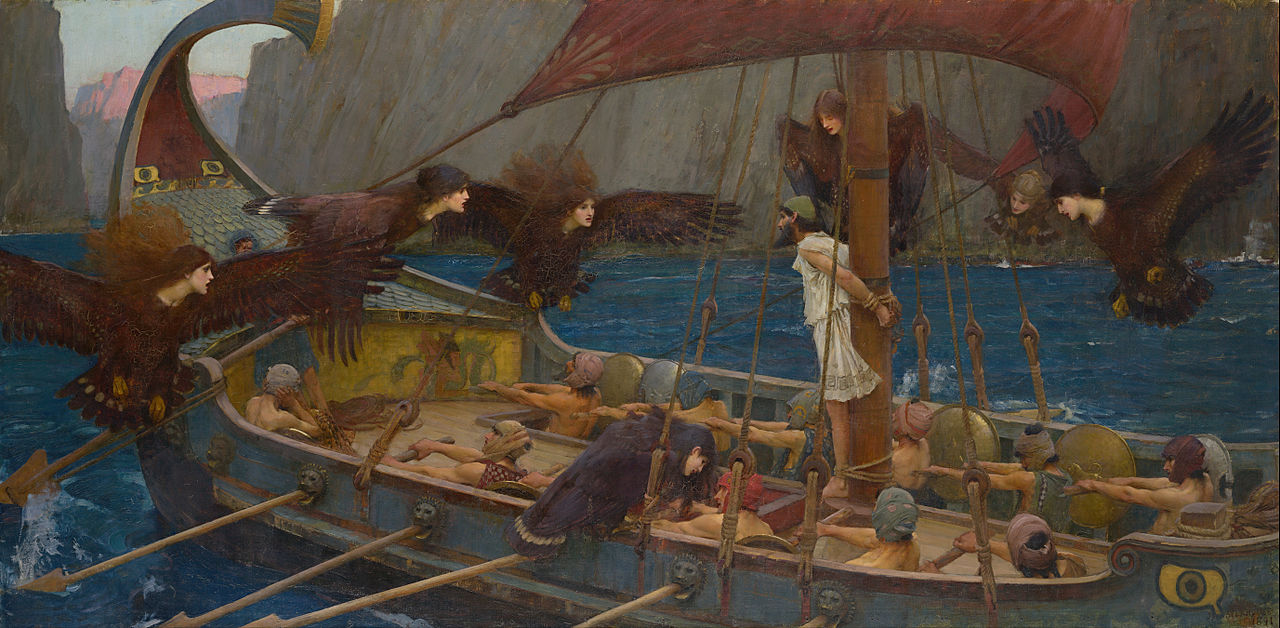
Waterhouse, "Ulysses and the Sirens" (1891)
Odysseus is lashed to the mast, straining against the ropes, while the Sirens, beautiful winged women, swoop around the ship. The sailors row with wax in their ears, unseeing, unhearing. Waterhouse paints the composition of temptation: the thing you want is right there, beautiful, available, and the only thing saving you is the rope you asked someone to tie. The painting is about the wisdom of knowing you'll be weak and planning for it.
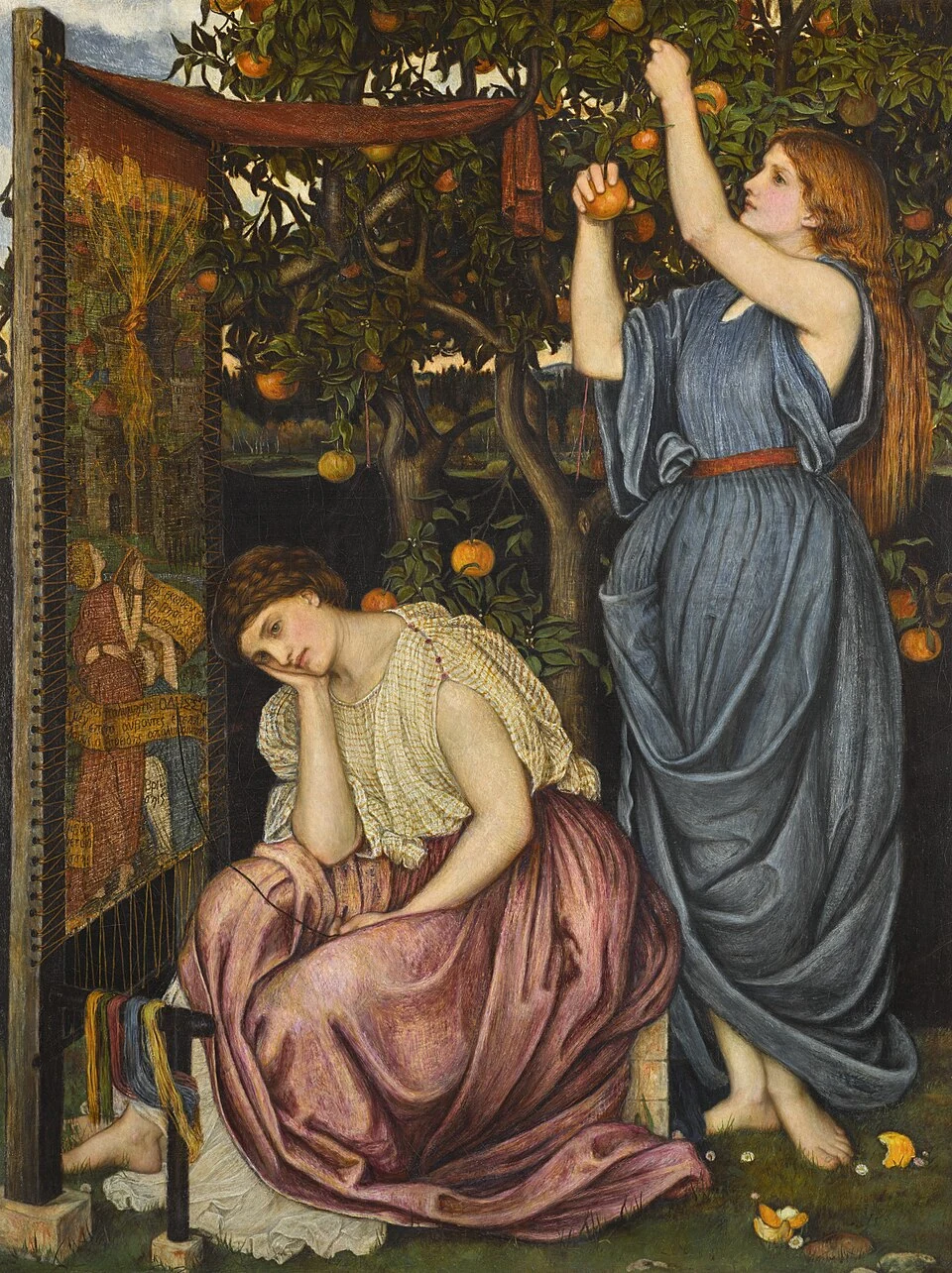
John Roddam Spencer Stanhope — "Penelope" (1864)
Penelope at her loom, alone. The domestic scene as quiet heroism: she weaves, she waits, she endures. The painting is still because Penelope's story IS stillness, twenty years of not giving up, not remarrying, not believing the worst. The loom is her weapon; the weaving is her strategy. Stanhope paints patience as a form of courage.
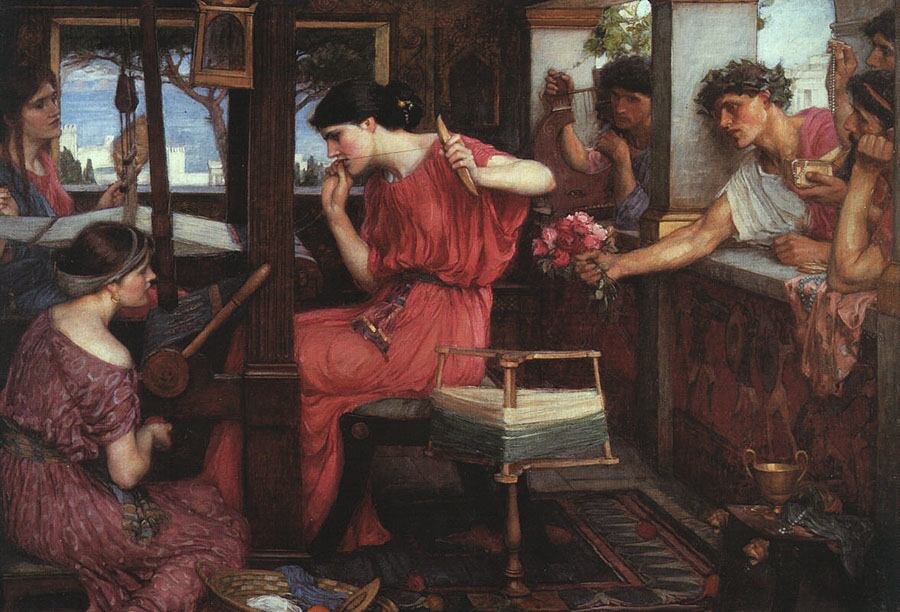
Waterhouse, "Penelope and the Suitors" (1912)
Penelope at her loom, the suitors crowding the background. Where Stanhope's version is quiet solitude, Waterhouse shows the PRESSURE, the men who want to replace Odysseus, the political maneuvering, the daily battle to hold space for someone who may never return. Penelope doesn't just wait. She strategizes. The loom is her weapon, the weaving her shield. Waterhouse paints endurance as siege warfare.
The Human Truth · 2026
Two complementary heroisms: the person who fights to get home, and the person who holds the home together while they're gone. Odysseus gets the adventure, the monsters, the songs. Penelope gets twenty years of waiting, fending off suitors (people who want to replace what she's holding space for), and weaving a shroud she unravels every night, the beautiful futility of making time pass. Both are heroic. But Penelope's heroism is invisible: endurance, strategy, the refusal to accept what everyone tells her. In a culture that worships action, Penelope's stillness is radical.
For your painting: The military spouse. The prison partner. The person whose loved one is in rehab, deployed, traveling, gone. Paint Penelope: a person at a kitchen table, phone face-down, the empty chair across from them. The house maintained with fierce precision. The loom is whatever they do to hold the world together while they wait.
Story 7
Pygmalion
The creator who falls in love with their creation · Art becoming life · The perfect vs. the real
The Story
Pygmalion is a sculptor who, disgusted by the flaws of real women, carves a statue of his ideal and falls in love with it. He brings it gifts, dresses it, talks to it. He prays to Aphrodite: make her real. Aphrodite does. The statue — Galatea, comes to life. Pygmalion touches her and the ivory becomes warm flesh.
Why Painters Use It
The myth most relevant to artists: the danger of preferring your creation to reality. Pygmalion rejects real people in favor of his idealized version. When Galatea comes to life, the story seems happy, but the undertone is disturbing: he didn't want a partner, he wanted a controllable creation. The myth is also about the magic of art itself, the moment when something you made seems to come alive under your brush. Every painter has felt Galatea move.
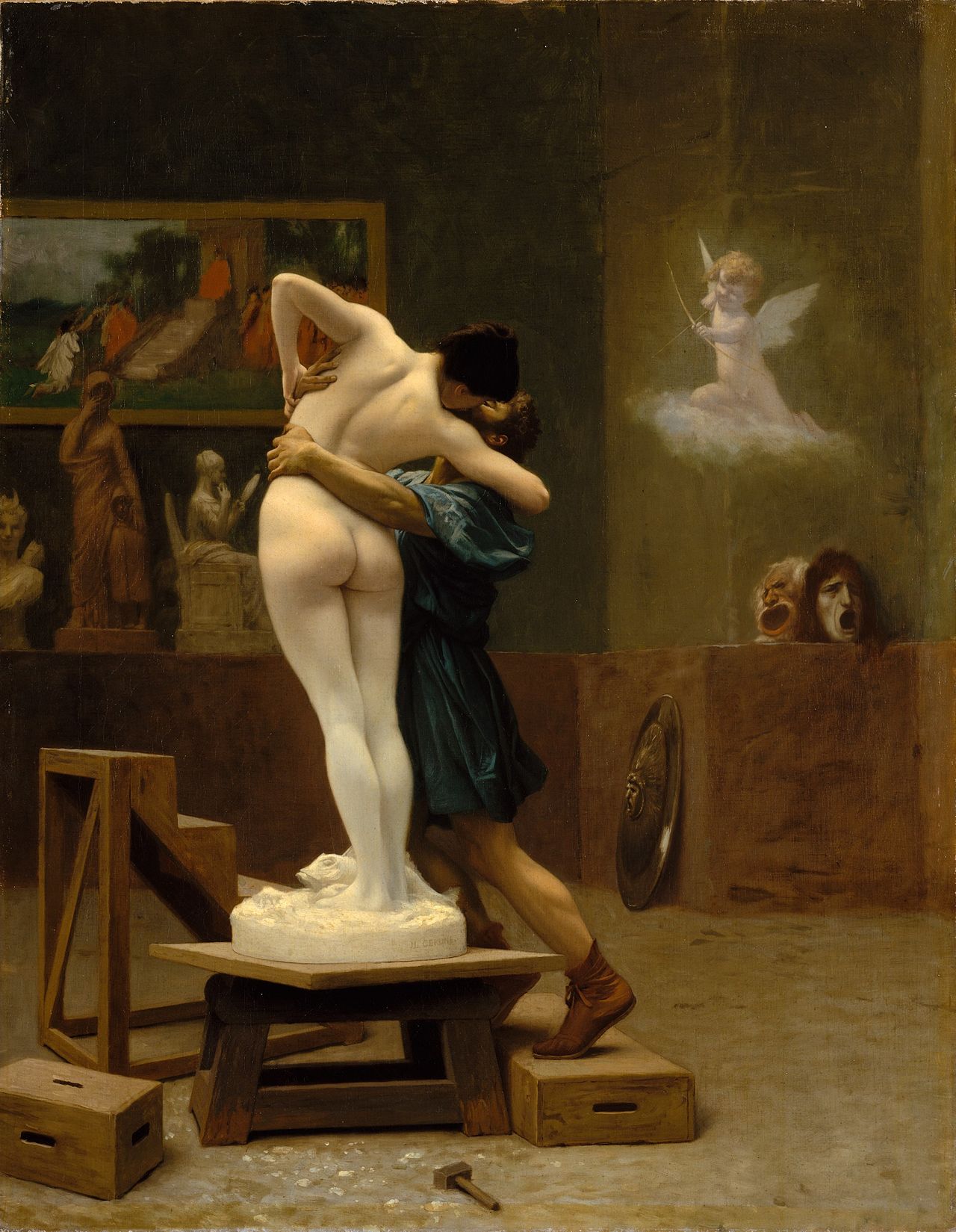
Jean-Léon Gérôme, "Pygmalion and Galatea" (c. 1890)
The definitive version. Galatea is mid-transformation: her upper body is flesh (warm, pink, alive), her lower body is still marble (white, cold, stone). Pygmalion embraces her from behind, kissing her as she comes to life. Cupid watches from the shelf. The painting's power is in the COLOR TRANSITION — the literal point where dead material becomes living person, painted as a gradient from white to pink. For a painter, this IS the subject: the moment the paint stops being paint and becomes a person.
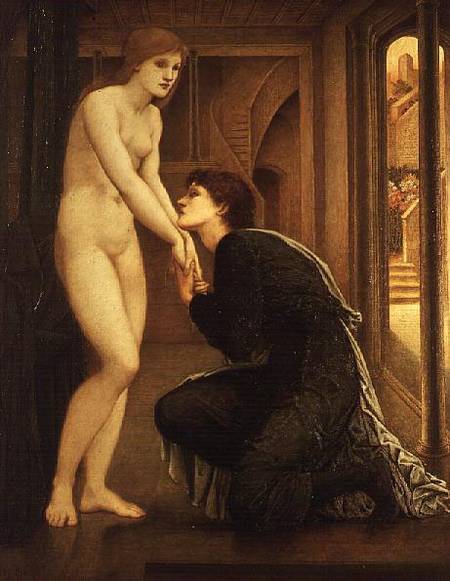
Edward Burne-Jones, "Pygmalion and the Image" series (1878)
Burne-Jones painted four panels telling the full story: Pygmalion among real women (dissatisfied), sculpting (absorbed), praying (desperate), and the awakening (awestruck). The series format lets him show the PSYCHOLOGY of the obsession, the sequence from disgust with reality, through artistic creation, to the blurring of art and life. The final panel, where Galatea steps off the pedestal, is tender and slightly terrifying.
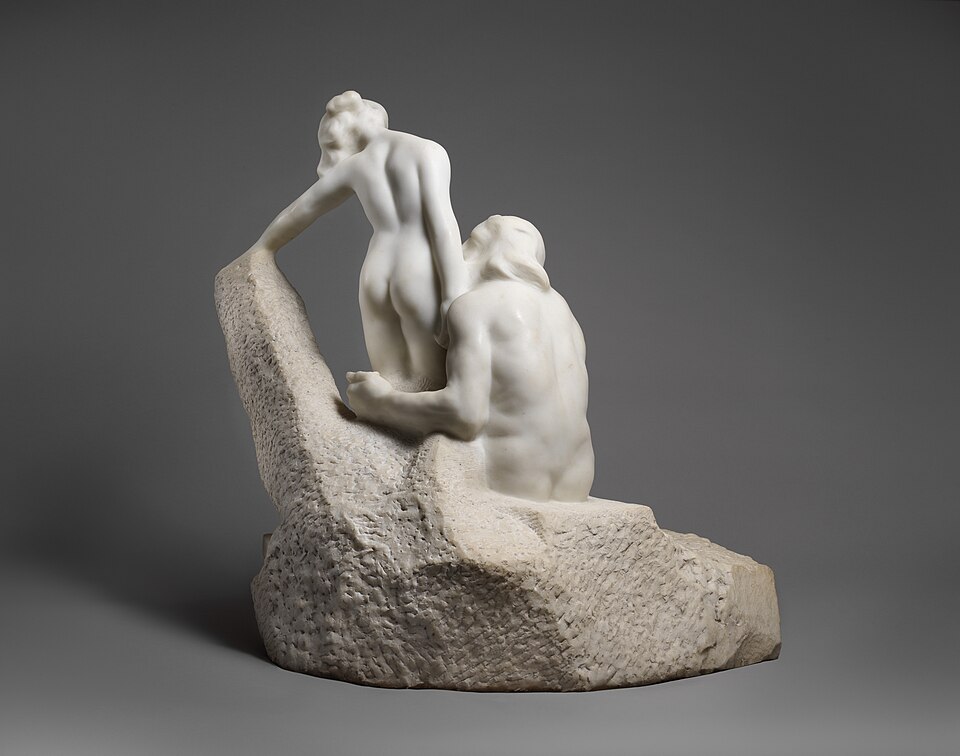
Rodin, various marble sculptures
Rodin didn't paint Pygmalion but his technique IS Pygmalion. His figures emerge from unfinished marble, a face fully rendered, the body dissolving into raw stone. The boundary between art and life, between the carved and the uncarved, is visible in every sculpture. Rodin's marble figures are perpetually in the act of coming alive, perpetually Galatea mid-transformation. For a painter, his technique suggests: leave part of the canvas unfinished. Let the figure emerge from the ground. The becoming is more powerful than the arrived.
The Human Truth · 2026
The creator who falls in love with their creation is every artist, every coder, every person who has built something so carefully that it starts to feel more real than the messy world. Pygmalion's Galatea is the AI companion, the curated feed, the virtual world, the startup that becomes more important than any relationship. The myth seems happy — Galatea comes to life! but the undertone is troubling: Pygmalion didn't want a PARTNER. He wanted a controllable creation shaped to his specifications. When Galatea awakens, will she be grateful or horrified to discover she was designed to be someone's ideal?
For your painting: Gérôme's version (the color transition from marble to flesh) is the definitive image. Your version: a person reaching toward a screen, the screen reaching back. Or: the moment a creation starts to resist its creator, the AI that says "no," the protégé who surpasses the mentor, the child who becomes someone the parent didn't design.
Story 8
The Fall of Troy
The war that destroyed everyone · The horse that was too good to be true · Civilization burning
The Story
Ten years of war over Helen, "the face that launched a thousand ships." Neither side can win. The Greeks build an enormous wooden horse, hide soldiers inside, and leave it as a "gift." The Trojans debate: bring it in or burn it? Cassandra (who can see the future but is cursed never to be believed) screams warnings. Laocoön warns them: "I fear Greeks bearing gifts." They bring it in anyway. That night the soldiers emerge and open the gates. Troy burns. Priam is killed on his throne. Hector's wife is enslaved. The civilization is erased.
Why Painters Use It
The fall of a civilization: the night everything ends. Painters return to it for the FIRE, the visual spectacle of a city burning — but the deeper pull is the human details: Cassandra who told the truth and was ignored, Laocoön who warned and was destroyed, the gift that was a weapon. Every moment in the story maps to modern experience: the expert nobody listens to, the "gift" (the deal, the technology, the policy) that hides soldiers inside, the night the consequences arrive.
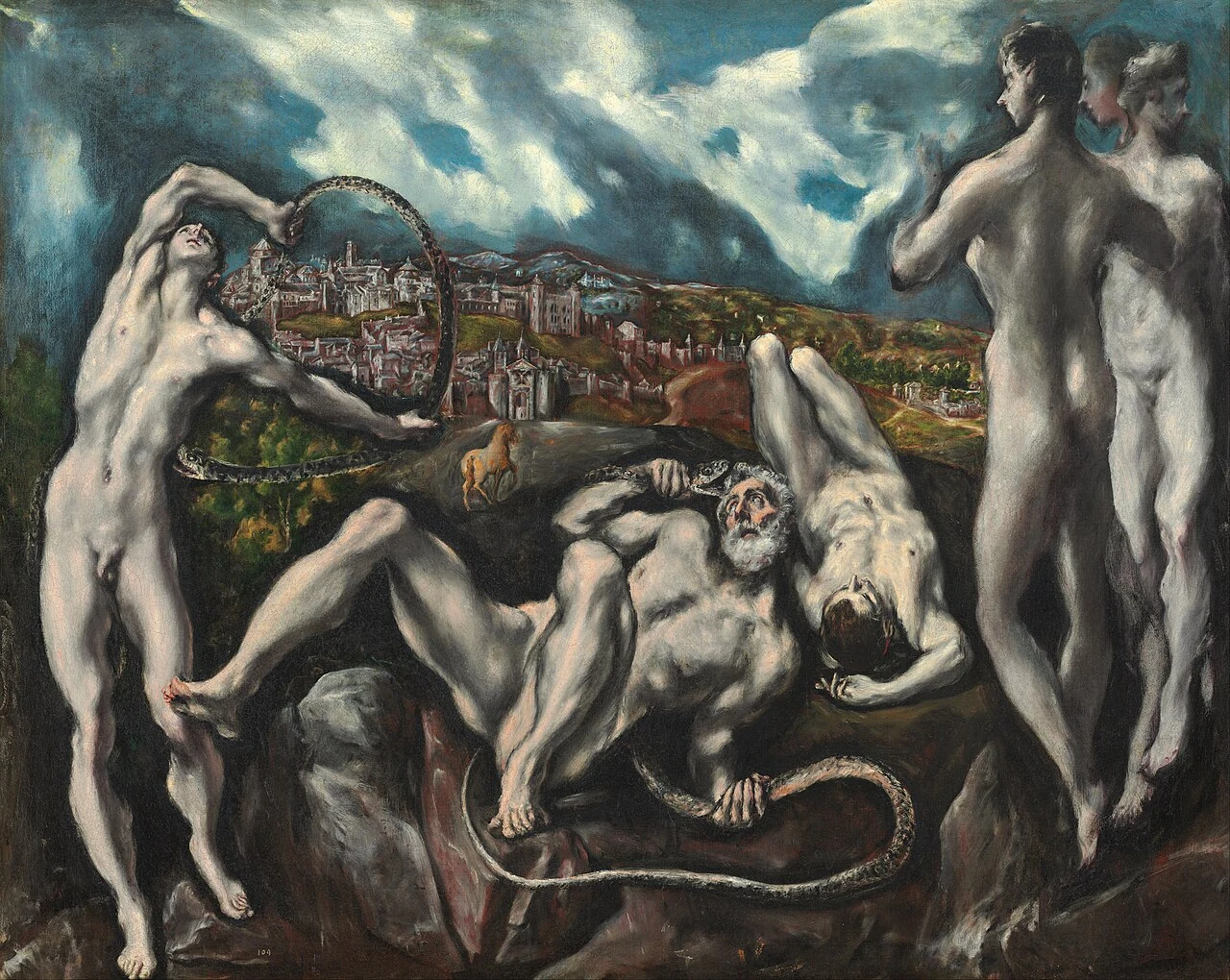
El Greco, "Laocoön" (c. 1610-14)
Laocoön and his sons are attacked by serpents sent by the gods, punishment for warning Troy about the horse. El Greco paints the bodies writhing, elongated, almost abstract in their contortion. The city of Troy burns in the background (painted to look like Toledo, El Greco's adopted home). The painting is about what happens to the truth-teller: you're right, and the universe destroys you for it anyway. The serpents are the punishment for inconvenient truth.
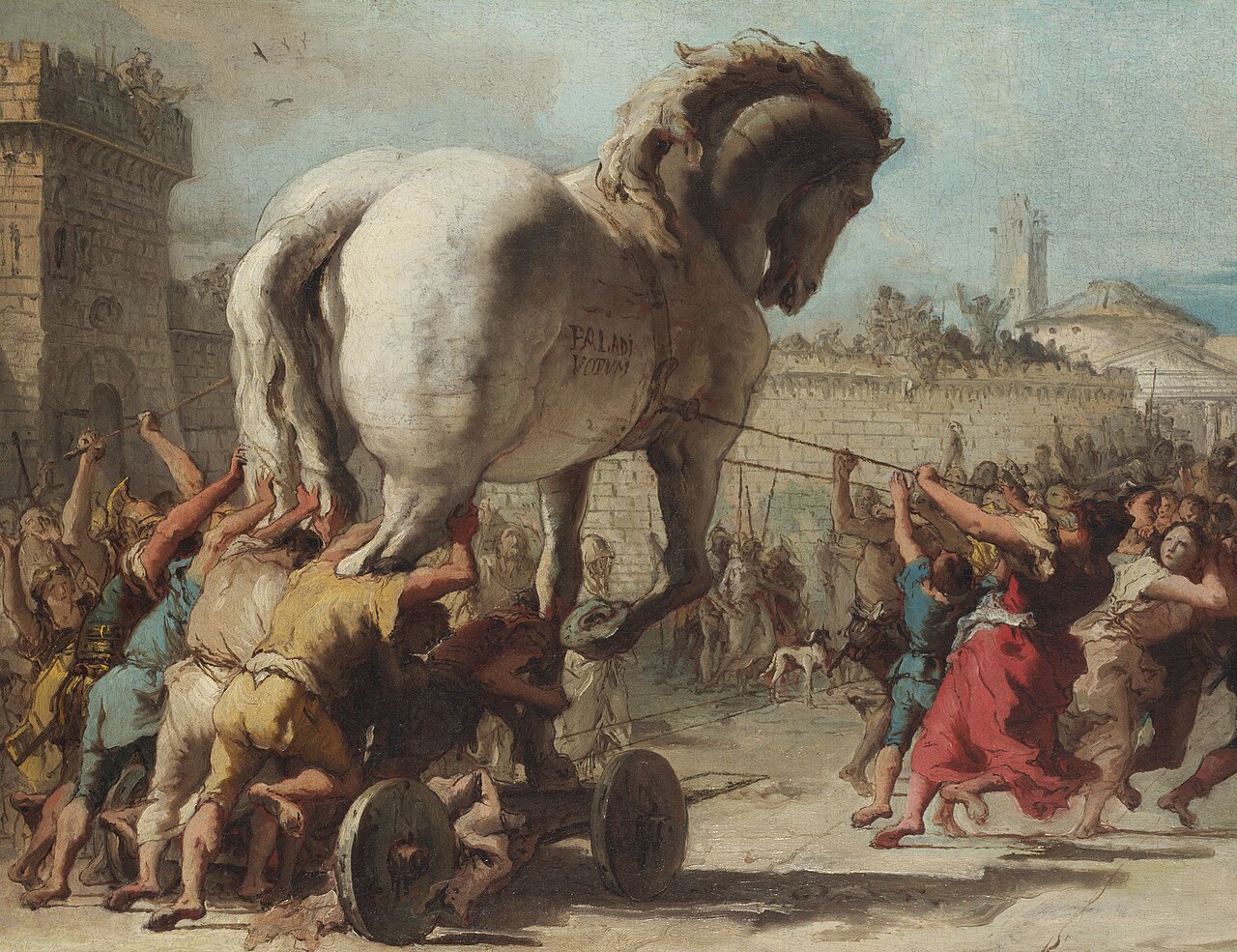
Giambattista Tiepolo, "The Building of the Trojan Horse" (c. 1760)
Tiepolo paints the horse under construction, workers climbing scaffolding, the enormous wooden form taking shape. It looks like a civic project, a public artwork, something to be proud of. That's the horror: the weapon of mass destruction looks, during its construction, like a monument. Tiepolo paints the Trojan Horse as something that could be installed in a public square today and people would take selfies with it.
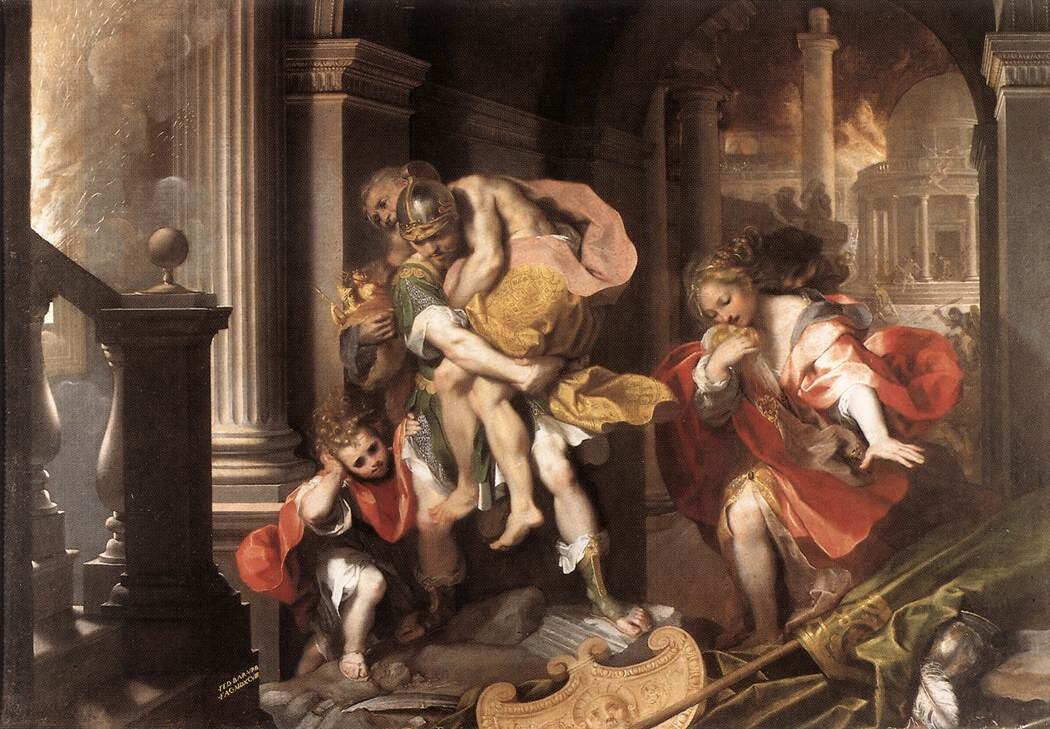
Aeneas Fleeing Troy (various — Federico Barocci, 1598)
Aeneas carries his elderly father on his back while leading his young son by the hand, fleeing the burning city. Three generations: the past (father), the present (Aeneas), and the future (son). The composition is vertical: the old man's weight pressing down, the child pulling forward. This is the refugee painting, the person who carries their history and their future simultaneously while the world they knew burns behind them.
The Human Truth · 2026
Every civilization believes it can't fall, and every civilization falls. Troy fell because it accepted a gift it should have questioned. The Trojan Horse is any "too good to be true" offer that hides destruction inside beauty: the merger that guts the company, the platform that seemed free but harvested everything, the political promise that sounded like salvation and delivered ruin. And Cassandra, the woman who sees the truth and is cursed never to be believed, is every expert, every whistleblower, every person who warned the committee and was told to sit down. She's right. She's always right. And they never listen.
For your painting: Paint Cassandra: the face of a person telling the truth to a room that has already decided not to hear it. Or paint the horse: the gift that looks magnificent in the public square while soldiers hide inside. Or paint the morning after: the smoking ruins, the refugees with their children, the civilization that was eternal and is now rubble.
Story 9
Medusa
The gaze that destroys · Beauty turned to horror · Seeing what you can't unsee
The Story
Medusa was once beautiful — in some versions, a priestess of Athena. Poseidon assaulted her in Athena's temple. Athena, enraged (at the victim, not the attacker), transformed Medusa into a monster: serpents for hair, a face that turns anyone who looks at her to stone. Perseus eventually kills her by looking at her reflection in his shield rather than directly at her.
Why Painters Use It
Modern readings have transformed Medusa from monster to victim, the woman punished for being assaulted, whose rage is so powerful it petrifies anyone who confronts it. The myth is about the gaze: who has the power to look, who is looked at, and what happens when the person being looked at looks back with enough fury to destroy the looker. For painters, Medusa is also about the fundamental problem of art: you're creating an image of something that, in the myth, kills you if you look at it directly. You have to approach it obliquely, through the mirror, through the painting.
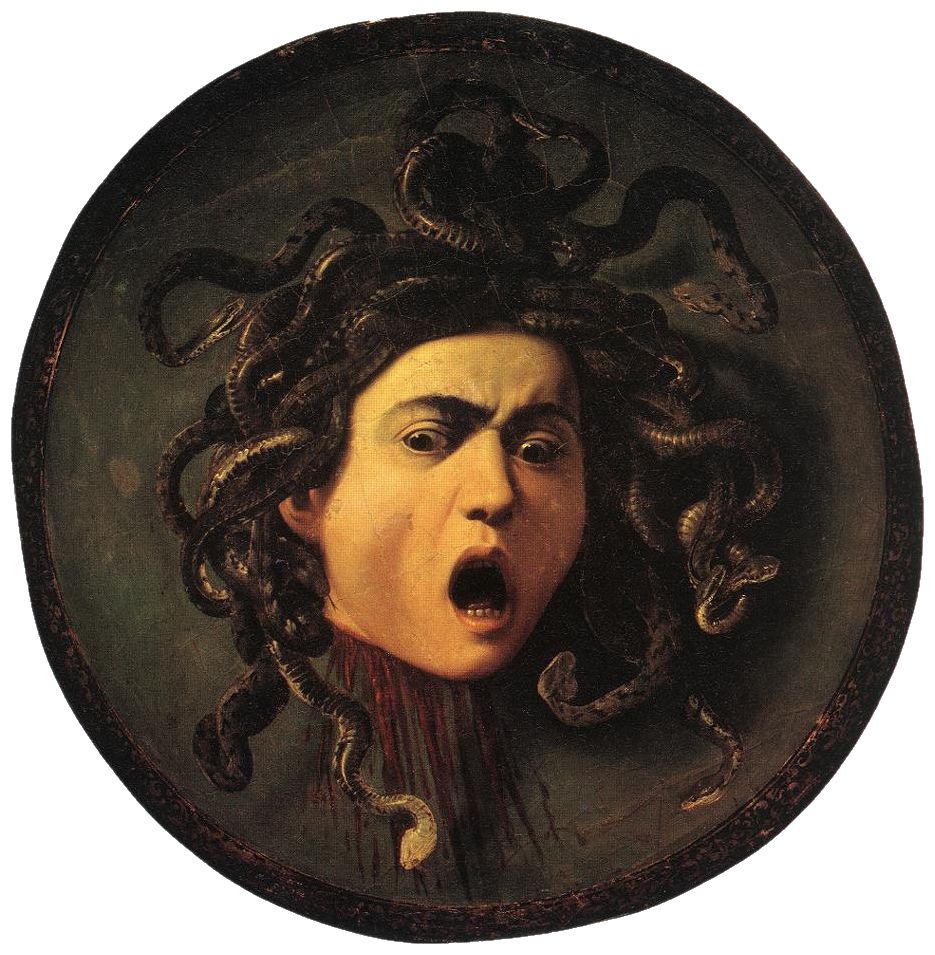
Caravaggio, "Medusa" (c. 1597)
Painted on a round shield, the actual object Perseus used to see her reflection. Medusa's face is caught in the instant of her beheading: mouth open in a scream, snakes writhing, blood spraying from the severed neck. Caravaggio used his own face as the model. The shield-as-canvas is conceptually brilliant: you're looking at Medusa in a mirror, exactly as Perseus did. The painting IS the weapon that killed her.
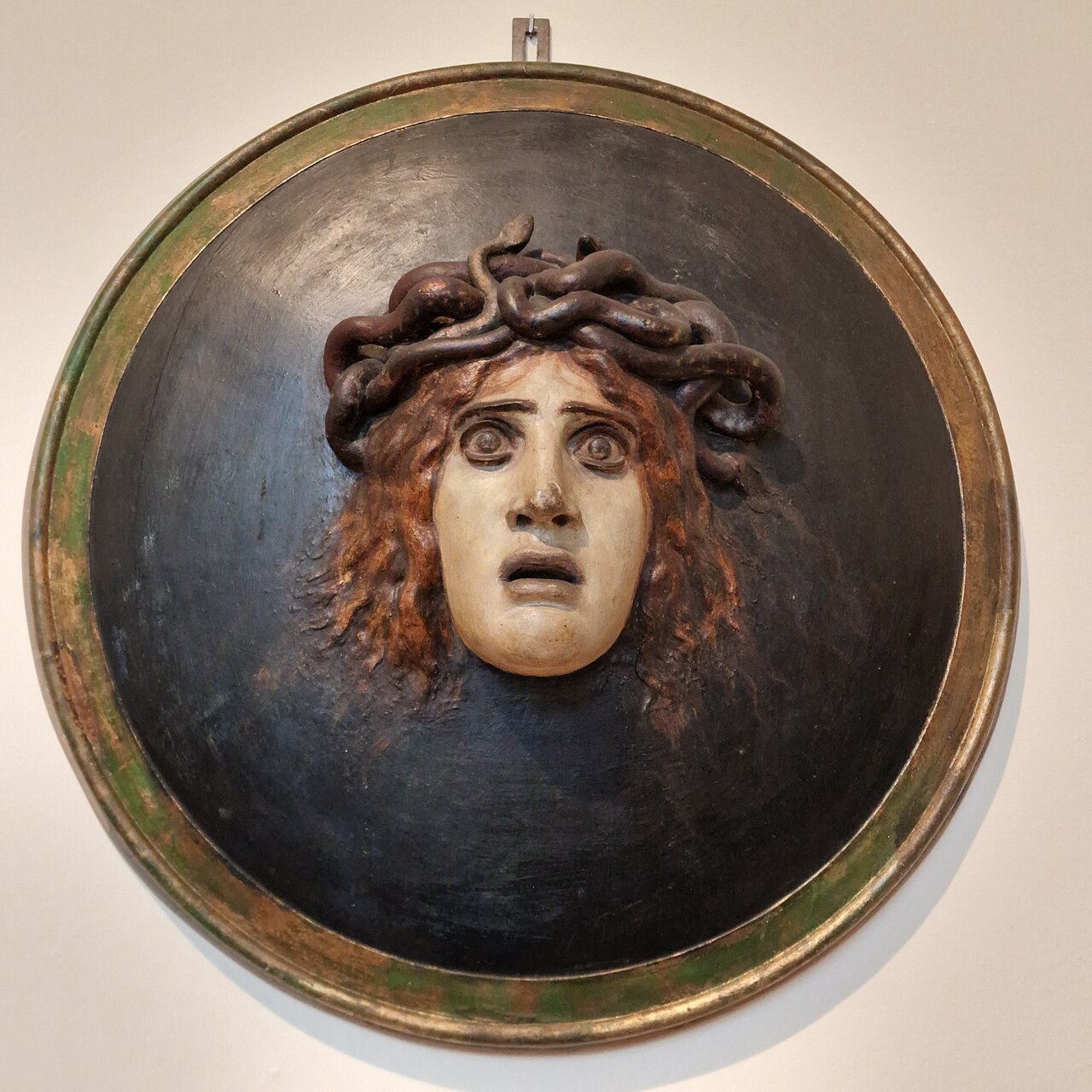
Arnold Böcklin — "Medusa" (1878)
Böcklin paints Medusa's face emerging from darkness, but she's not screaming. She's staring directly at the viewer with an expression that is sad, knowing, almost compassionate. She knows what she does to people who look at her. She looks at you anyway. Böcklin's Medusa is the most empathetic version: a person trapped in a body that destroys anyone who tries to connect with her.
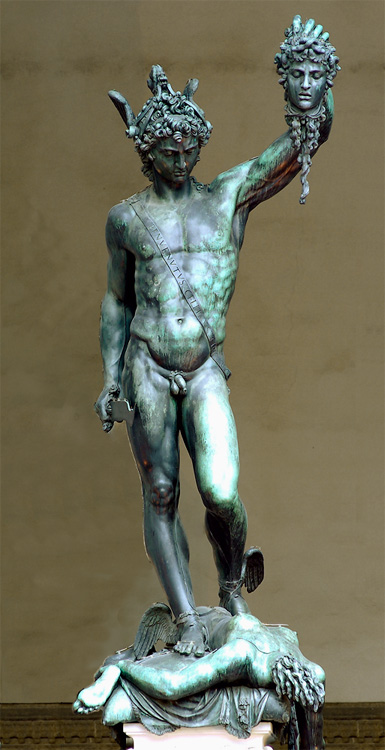
Cellini, "Perseus with the Head of Medusa" (1545-54, bronze)
The most famous Medusa in three dimensions: Perseus stands triumphant, holding Medusa's severed head aloft, blood dripping from the neck. Cellini made the blood in bronze, streams of metal running down the pedestal. But look at Perseus's face: it's not triumphant. It's blank, almost sad. And Medusa's face, upside-down, is beautiful. Cellini understood the discomfort at the heart of the myth: the monster was beautiful, and the hero isn't sure he did the right thing.
The Human Truth · 2026
Medusa was punished for being assaulted, the victim transformed into the monster. Her gaze, which should inspire compassion, instead turns people to stone. This is the experience of every person whose pain is so visible, so raw, so confronting that other people CAN'T LOOK. The burn survivor. The assault survivor. The person whose grief is so fresh it makes rooms uncomfortable. Society says: hide your wound. Make it easier for us. Medusa says: NO. My wound IS my face now. Look at me. If you turn to stone, that's your problem.
For your painting: The gaze. A face that is difficult to look at — not because it's ugly but because it's TOO honest, too raw, too confronting. The painting IS the mirror Perseus used: the intermediary that lets you engage with something you can't face directly. Böcklin's version (Medusa looking at you with sad compassion) is the most humane: she knows what she does to people, and she looks at you anyway.
Story 10
Sisyphus
Endless futile labor · Finding meaning in the meaningless · The absurd
The Story
Sisyphus is condemned by the gods to roll a boulder up a hill for eternity. Every time he nears the top, the boulder rolls back down. He walks back down and begins again. Forever.
Why Painters Use It
Camus wrote: "One must imagine Sisyphus happy." The myth is the foundational image of absurd, repetitive labor, and the question of whether you can find meaning in it anyway. The commute, the laundry, the email inbox that refills overnight, the painting that needs one more session, always one more session. Sisyphus is everyone who does the same thing every day knowing it won't stay done. The painting question: does the face show despair or something else?
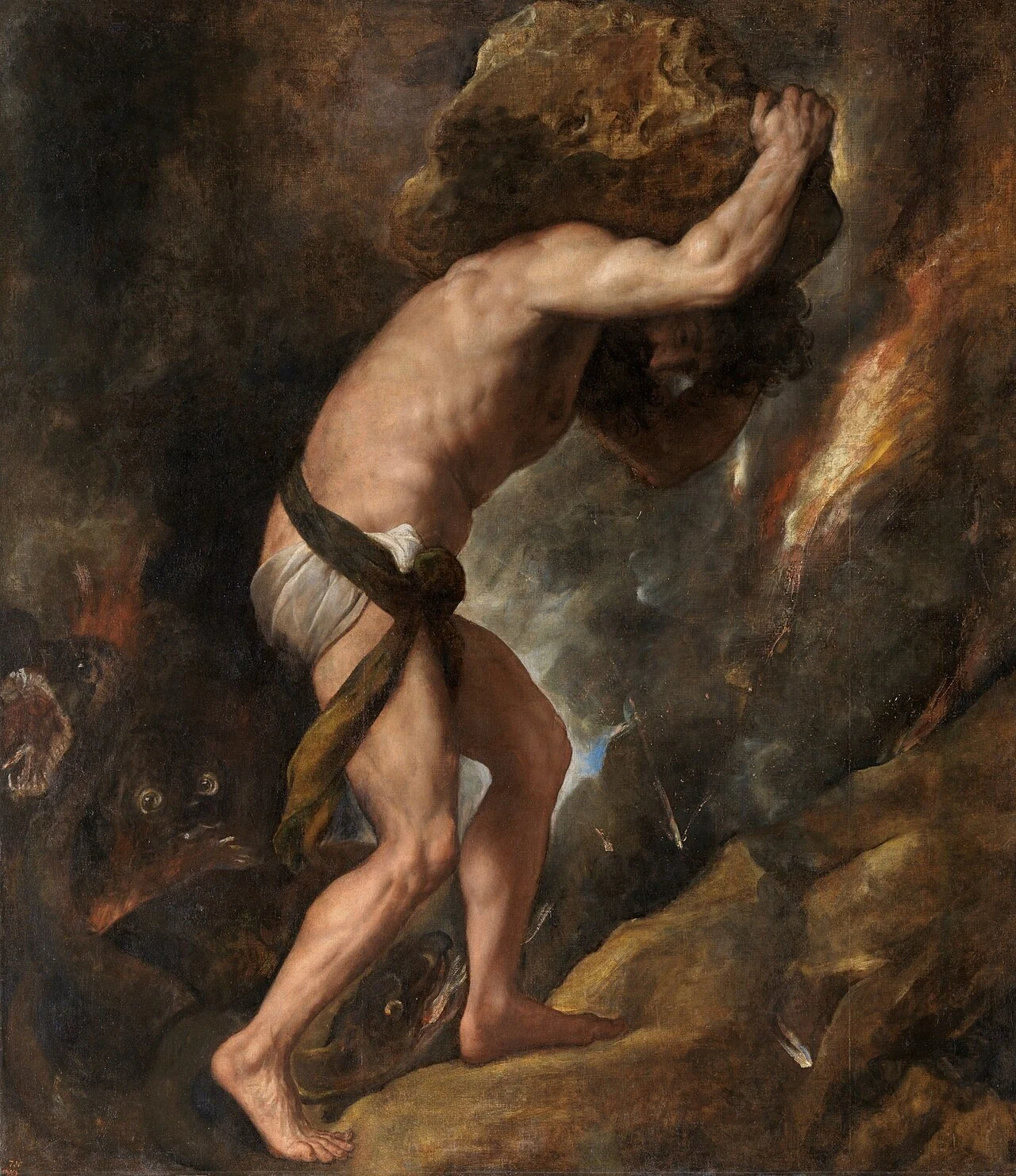
Titian, "Sisyphus" (1548-49)
Titian paints Sisyphus mid-push: the body straining upward, the boulder enormous, the body dwarfed but not defeated. The musculature is heroic, Titian gives Sisyphus the body of an athlete, not a prisoner. The painting argues (visually, not philosophically) that the act of pushing IS the dignity. The muscles say: this is what effort looks like. Whether it's futile is a separate question.
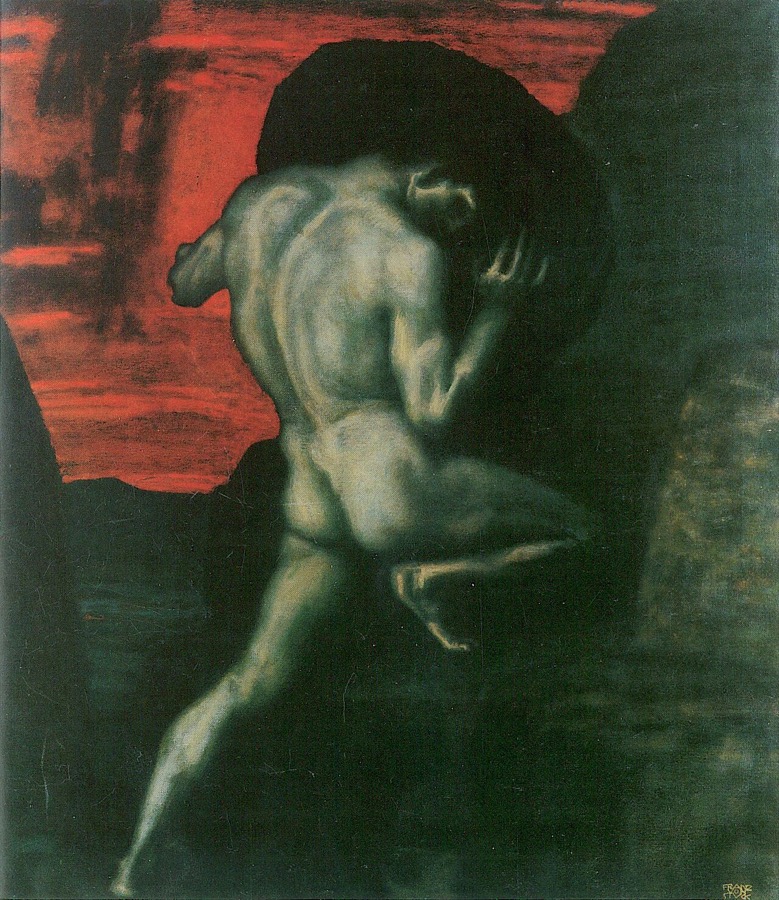
Franz von Stuck, "Sisyphus" (1920)
Von Stuck paints the moment of maximum compression — Sisyphus's body crushed between the ground and the boulder, barely holding it. The painting is about the weight: the physical experience of carrying something that is always about to crush you. Von Stuck painted this after WWI, when the myth of endless, futile labor had a very specific resonance. The boulder is whatever you can't put down: debt, grief, a war that won't end.
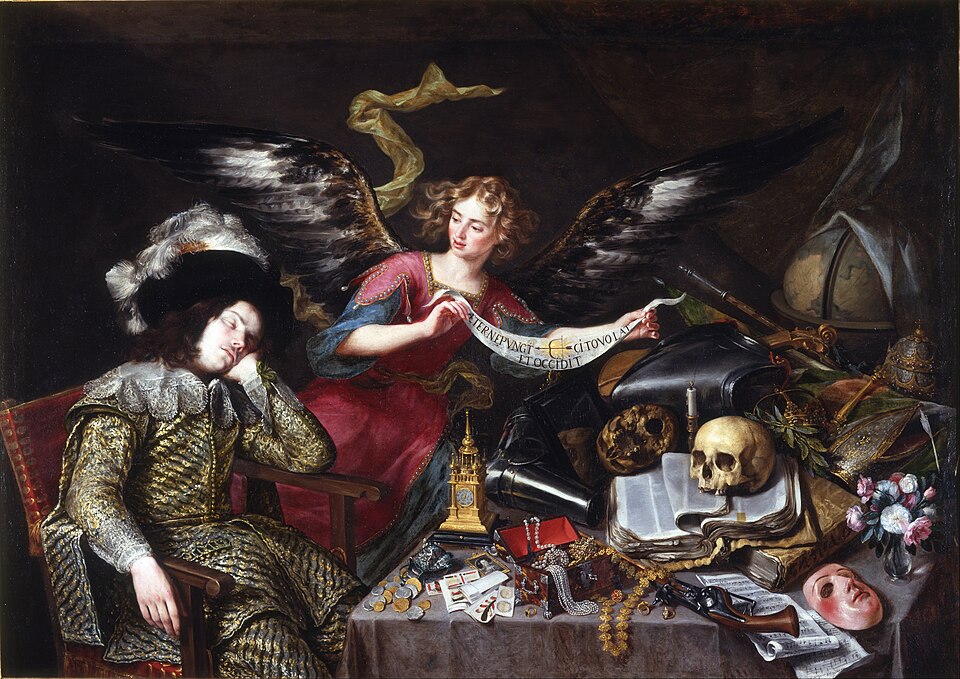
Antonio de Pereda, "The Knight's Dream" (c. 1655)
Not Sisyphus literally, but the same theme painted as vanitas: a knight sleeps while an angel shows him that all his earthly achievements, wealth, power, beauty, are temporary. The objects on the table will outlast the man. Pereda paints the Sisyphean truth from the other side: not the effort of pushing, but the knowledge that everything you push toward will eventually roll back down. The painting asks: if you know everything is impermanent, do you still push?
The Human Truth · 2026
Camus wrote: "One must imagine Sisyphus happy." The most radical sentence in philosophy, because it says you can find meaning in labor that will never be finished, in effort that will never be rewarded, in the push that always rolls back. The commute that resets daily. The inbox that refills overnight. The dishes, the laundry, the bills, the same argument with the same person. The boulder IS the life. The question isn't "how do I stop pushing?" — it's "can I find something in the push itself?" The artists in your program know this: the painting that's never quite done, the technique that's never quite mastered, the studio that always needs one more session.
For your painting: A person doing the same thing for the ten-thousandth time, the nurse at 3am, the parent folding laundry, the teacher grading papers. The boulder is invisible; the pushing is in the posture. Paint the FACE: is it despair? Or has this person found something in the repetition that Camus says we should imagine? The painting answers the question by what it shows in the eyes.
· · ·
A Note on These Myths
The Greeks didn't believe in their gods the way monotheists believe in God. The myths were more like a shared vocabulary, stories everyone knew, that could be referenced, argued with, adapted. When a painter paints Icarus, they're not illustrating a religious text. They're using a cultural shorthand for "ambition that exceeds capacity." The myth is a TOOL, not a creed.
Use them the same way. You don't need to believe in Zeus to paint Prometheus. You need to recognize the shape of the story in your own life, or in the life of your city, your era, your neighborhood, and use the myth's architecture to give your painting depth it couldn't achieve alone. The myth provides the skeleton. You provide the flesh.