These are the 20 pain points your team ranked highest, the things people struggle with most right now. For each one, we translate the abstract feeling into specific, paintable scenes. Not prescriptions, starting points. Your painting will come from taking one of these and making it yours.
Each entry gives you: what the person looks like, where they are, and what else is in the frame. Several options per entry — different scales, different moods, different moments. At least one master painting reference that solved a version of the same problem.
· · ·
#1, Score: 4.45
Isolation & Loneliness
The epidemic of disconnection in modern society
The most common pain point of our era, and one of the most paintable, because loneliness is visible. It lives in the body. It's in the space around a person. It's in the gap between where they are and where connection is possible.
The trap: painting loneliness as a person looking sad and alone. That's an illustration, not a painting. The paintings that actually hit are the ones where connection is visible but not reached the distance between what could be and what is.
The Party Check
A person at a crowded gathering, birthday party, holiday dinner, wedding reception — standing slightly apart, phone in hand. Everyone around them is talking, laughing, touching. The figure is physically present and emotionally absent. The phone screen glows blue-white on their face; everything else is warm candlelight or tungsten.
The body: Weight on one leg, slightly turned away from the group. One hand holding a drink they haven't sipped. The other hand on the phone. Eyes down. The place: Somewhere warm and social, kitchen, living room, restaurant. The warmth of the setting makes the isolation worse, not better. The tension: The warm light of human connection is literally three feet away. The cool light of the screen is chosen instead.
Reference: Degas, "L'Absinthe" (1876), two people at a café, surrounded by the buzz of Parisian life, completely alone. The space between the figures and the space around them do all the work.
Dinner for One
A table set for one in a kitchen clearly designed for a family. There are other chairs. The fridge has photos on it. A calendar on the wall with nothing written on it. The person is eating, not dramatically sad, just... eating. Alone. On a Tuesday. The ordinariness is the point.
The body: Seated, slightly hunched, fork in hand. Looking at the plate, not at anything else. Not performing sadness, just absent. The place: A kitchen with evidence of previous togetherness — the second placemat still in the drawer, family photos, a table too big for one person. The tension: The room remembers companionship. The figure doesn't expect it anymore.
Reference: Vilhelm Hammershøi's interiors (1890s-1910s), empty rooms that feel like someone just left. Also Hopper, "Automat" (1927), a woman alone in a late-night restaurant, the dark windows reflecting infinite empty tables.
The Video Call
A person FaceTiming someone. The phone shows a laughing face, connection, warmth, a friend or parent. But the person holding the phone is in a dark apartment, still in the clothes they slept in. Their expression, seen from our side, is nothing like the performed smile they're showing the camera. The screen is the only light source.
The body: Sitting on a couch or bed, legs tucked under. One hand holding the phone up, performing. The other hand hidden, maybe clutching the blanket, maybe wiping an eye. The place: A small apartment. Messy but not dramatically so. The kind of mess that says "nobody's coming over." The 2026 detail: The screen as the only light in the room. The physical body and the digital performance existing in the same frame.
Reference: This is genuinely new territory — no master painting directly addresses the split between digital performance and physical reality. But Rembrandt's self-portraits are the ancestor: a face showing the viewer one thing while the eyes reveal another.
The Dog Walker
A person walking a dog in a park at golden hour. Other people walk past, couples, families, groups of friends. The dog strains toward other dogs. The person lets the leash go slack but doesn't follow. They stand still while the world flows around them. The dog is their only connection to the living world.
The body: Standing, arm extended by the leash, body slightly behind. Not moving with the flow of people. A rock in a river of human traffic. The place: A park at the most social hour, late afternoon, golden light, the hour when everyone is out. The beauty of the setting and the sociality around the figure make the aloneness more acute. The tension: The dog WANTS connection (straining toward other dogs). The person has stopped wanting it.
Reference: Gustave Caillebotte, "Paris Street; Rainy Day" (1877), figures in a city moving past each other, each in their own world. The umbrella as isolation device (now: the phone).
· · ·
#2, Score: 4.18
Tragedy, Grief & Loss
Coping with death and the cycle of life
The most dangerous subject for a painter — because it's the easiest to get wrong. Grief painted sentimentally is unbearable. Grief painted honestly is among the most powerful things art can do. The difference: sentiment shows you what you're supposed to feel. Honest grief shows you what grief actually looks like, which is often nothing dramatic at all.
The key insight: grief is most visible in the ordinary things that continue. Not the funeral. The day after. Not the crying. The making of coffee for one instead of two. Not the empty bed. The alarm clock that still goes off at the same time.
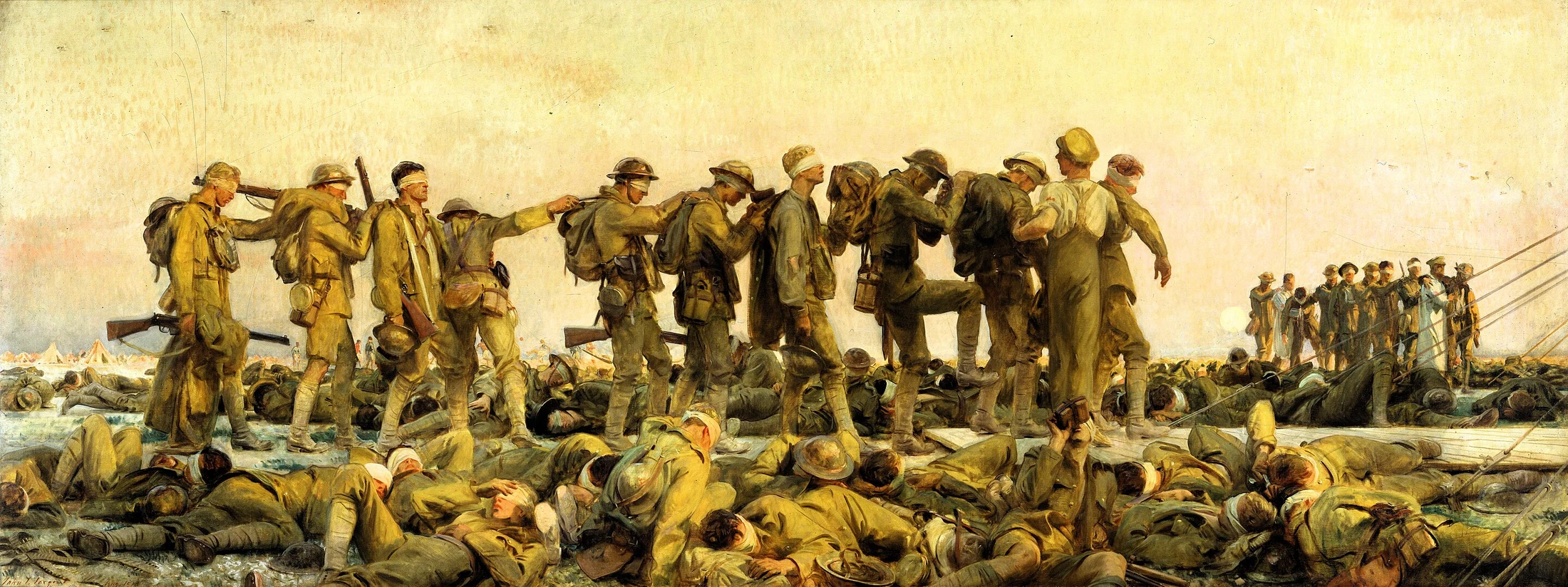
Sargent, "Gassed" (1919). Not the explosion. The aftermath. Men helping men walk. The sunset is beautiful. The blindness is permanent. Both are true.
The Empty Chair
A family dinner, Thanksgiving, Christmas, Sunday supper. Everyone is present except one person. The chair is there. The place may or may not be set. The family is eating, talking, living, but there's a gravity well at that empty seat that bends the whole composition. Nobody is looking at the chair. Everyone is aware of it.
The body: The family is slightly off-center, the composition has a gap. One person (the spouse? the parent?) is seated nearest the empty chair. Their body is subtly turned toward it even while talking to someone else. The place: A specific dining room — real dishes, real clutter, a specific tablecloth. The specificity makes it real. The tension: Life continues. The loss doesn't stop dinner. That's worse than if it did.
Reference: The Last Supper tradition, every version uses the empty space around a figure (or the space where a figure should be) to create psychological weight. Also Luke Fildes, "The Empty Chair" (1870), literally Dickens' chair after his death, still warm.
The Belongings
No figure at all. A still life of someone's things, reading glasses on a nightstand, a half-read book with a bookmark, a glass of water, a bottle of pills. Or: a workbench with tools arranged the way the person left them. Or: a closet, one side full, the other side empty, the clothes donated, the hangers bare.
The body: Absent. That's the point. The body was HERE — you can see its traces in how the objects are arranged. The glasses still hold the shape of the face that wore them. The place: A bedroom, a workshop, a closet, a space that was shaped by a person who is no longer in it. The tension: The objects are perfectly still. They'll never be moved by those hands again. A still life that is, literally, a nature morte.
Reference: The entire vanitas tradition. Also Wyeth's interiors, rooms where the absence of the person IS the subject. And Van Gogh, "A Pair of Boots" (1886), two shoes that tell a whole life story.
The First Morning
A person making coffee in the early morning, the first morning after. Not the funeral, not the hospital, not the phone call. The morning after ALL of that. The world starts again. The sun comes up. The coffee machine makes the same sound. And they stand in the kitchen and don't know what to do with their hands because the routine assumed two people and now there is one.
The body: Standing at the counter. Hands on the counter edge, not doing anything. Looking at nothing — or at the second mug they almost reached for. The posture of someone who has stopped mid-gesture because the gesture no longer makes sense. The place: A kitchen at dawn. Blue-gray pre-dawn light through the window. The overhead light not turned on yet. The liminal hour. The 2026 detail: The phone on the counter, face down. They could scroll. They can't move.
Reference: Hammershøi's interiors again, the specific quality of northern light in a quiet room where something essential is missing. Also Munch, "The Sick Child" (1885-86), grief as stillness, not drama.
The Scroll
A person in bed at night, scrolling through photos of someone who died. The phone illuminates their face, the only light. On the screen: the person alive, laughing, from a trip or a party. The contrast between the lit, alive image on the tiny screen and the dark, grieving face holding it. The past lives in pixels. The present is unbearable.
The body: Lying on their side or propped against pillows. The blue-white phone glow on half the face. The other half in darkness. The place: A bed, at night. The specific loneliness of nighttime grief, the house quiet, the world asleep, the scrolling endless. The tension: The dead person is more alive on the screen than the living person is in the room.
Reference: Genuinely new territory — the phone as portal to the dead. But ancestrally: any painting of a person holding a letter or a miniature portrait of someone absent. Vermeer's women reading letters are the same gesture: a tiny object that contains a whole person who isn't here.
· · ·
#3, Score: 3.91
Desire to Be Loved
The universal longing for acceptance and affection
This is the deepest pain point, underneath almost every other item on the list. Isolation is the symptom; the desire to be loved is the disease. It's also the hardest to paint because the most powerful version isn't someone RECEIVING love, it's someone WANTING it. The wanting is the painting.
The Window Watcher
An elderly person at a window, watching the street. Not waiting for anyone specific, they've stopped expecting visitors. Just watching. Across the street, something ordinary and warm: neighbors talking, a parent pushing a stroller, kids playing. The glass is between the figure and the life outside. They could open the door. They don't.
The body: Seated near a window, one hand resting on the sill or holding a curtain back slightly. The posture of habitual watching. Not dramatic — settled. The place: An apartment or house, interior. The window frames the outside world like a painting within a painting. The tension: Connection is visible through the glass. The glass is the thinnest possible barrier and the thickest possible wall.
Reference: Wyeth's many window paintings. Hopper's windows. Hammershøi's figures who face away from the viewer toward light they can see but can't seem to reach.
The Rehearsal
A person alone, practicing something they'll say to someone, a confession, an apology, an "I love you." They're in a bathroom mirror, or sitting in a car in a driveway, or standing outside a door with their hand not yet on the handle. The rehearsal of vulnerability. The moment before risking rejection.
The body: Mouth slightly open, mid-word or just about to speak. Hands either gripping something (steering wheel, sink edge) or loose at the sides. The body in tension between going forward and pulling back. The place: A car in a driveway (engine off, lights still on). A bathroom mirror. A hallway outside a closed door. Liminal spaces, between the decision and the act. The tension: The person needs love. Getting it requires risking everything. They haven't risked it yet.
Reference: Bastien-Lepage, "Joan of Arc", the moment of hearing the call, before answering it. The figure suspended between the safe known and the terrifying unknown.
The Holding Pattern
Two people on a couch — partners, maybe. Not touching. Not fighting. The TV is on. Both are looking at it, or at their phones, or at nothing. The distance between them is 18 inches. It might as well be 18 miles. This isn't the drama of a breakup. It's the slow erosion of intimacy that happens when two people stop reaching for each other.
The body: Both facing forward. No eye contact. Bodies parallel but not oriented toward each other. One may have a blanket; the other doesn't. Small territorial markers. The place: A living room at night. The TV glow. The domestic setting that's supposed to mean "home" and instead means "habit." The tension: They're together. They're not together. Both are true.
Reference: Degas, "Interior" (1868-69, also called "The Rape"), two figures in a room, the space between them charged with everything unsaid. The most psychologically violent painting ever made, and nobody is touching anybody.
The Offering
A child holding something out, a drawing, a flower, a found rock, to an adult who isn't looking. The adult is on the phone, or typing, or talking to another adult. The child's arm is extended. The offering is patient. It could wait forever. It shouldn't have to.
The body: The child: arm extended, head slightly tilted up, expectant. The adult: turned away, engaged in something "important," unaware. The place: A kitchen, an office, a park. Anywhere adults are busy and children are small. The tension: The most pure form of the desire to be loved, a child asking for attention — and the most common modern failure to give it. Not cruelty. Distraction.
Reference: Cassatt's mother-and-child paintings, but this is the INVERSE. Cassatt paints the moment of connection. This paints the moment of missed connection. Same figures, opposite story.
· · ·
#4, Score: 3.91
Nostalgia
Longing for a past that can never return
Nostalgia is tricky because it's sweet-poisoned. It feels like love but it's actually grief, grief for a version of life that existed (or that you THINK existed) and is gone. The paintings that work aren't sentimental ("remember the good old days"). They show the bittersweet truth: the past was real, and going back is impossible, and knowing both things at once is the human condition.
The Childhood Room
An adult standing in their childhood bedroom, visiting parents for the holidays, or cleaning out the house after a parent's death. The room is exactly as it was: posters on the wall, a bedspread they chose at age 12, a shelf of trophies. The adult is too big for the space now. They don't fit. The room is a museum of someone they used to be.
The body: Standing, slightly stooped in a room with low ceilings or small furniture. Touching something — running a hand along the desk, picking up an old object. The body of a 35-year-old in a 12-year-old's room. The place: A specific bedroom with specific details, the specific posters, the specific bedspread pattern. Generality kills nostalgia; specificity creates it. The tension: The room hasn't changed. The person has. The gap between who they were here and who they are now is the painting.
Reference: Wyeth, "Her Room" (1963), an interior that holds the memory of its inhabitant. Also the entire tradition of the period room as emotional space.
The Photograph on the Fridge
A kitchen, modern, functional. On the fridge: a curling photograph from another era. A family at the beach in the 1990s. A wedding snapshot. A Polaroid of friends at a bar. The photo is sun-faded, held by a magnet from a place that no longer exists. Around it: takeout menus, appointment reminders, the detritus of present life. The past is literally stuck to the present with a $2 magnet.
The body: This could be a still life, no figure needed. The fridge itself is the portrait. Or: a figure passing by, glancing at the photo without stopping, the way you look at something you've stopped seeing. The place: A kitchen. The most lived-in room. The place where the past and present physically overlap. The tension: The photo is fading. Nobody has moved it in years. It's both the most important thing on the fridge and the most ignored.
Reference: Dutch still life tradition — objects arranged to tell a story about time, value, and impermanence. Also Chardin's domestic still lifes, ordinary objects elevated by the quality of attention.
The Last Store
A small shop, a hardware store, a bookshop, a diner, that's clearly been there for decades. The owner is old. The inventory is dusty. A "CLOSING" sign is in the window. Next door: a chain store or an empty storefront with a "FOR LEASE" sign. The owner stands behind the counter, waiting for a customer who probably isn't coming.
The body: The shopkeeper behind a counter, hands resting on it. Not busy. Not dejected. Just... there. The body of someone who has stood in this spot for 40 years. The place: The interior of a small, specific shop. Details matter: the hand-lettered prices, the wooden shelves, the bell above the door that nobody rings. The 2026 detail: Through the window: a delivery truck or an Amazon locker across the street. The thing that replaced the thing.
Reference: Hopper's storefronts. Vermeer's interiors. Any painting where a figure exists inside a space that defines them, and the space is about to disappear.
· · ·
#5 — Score: 3.91
Disconnect from Nature
Losing touch with the natural world and each other
Every generation has painted nature. Ours is the first that needs to paint the ABSENCE of it, or more precisely, the strange condition of being surrounded by nature's beauty while being unable to access it because our attention is captured by screens, schedules, and the built environment.
The Hiker with a Phone
A person on a beautiful trail, mountains, forest, wildflowers. They've stopped at a viewpoint. But they're looking at their phone, not at the view. Or: they're photographing the view, framing it, filtering it, but never actually SEEING it. The landscape is extraordinary. The person is somewhere else.
The body: Standing at a viewpoint, phone raised. The body oriented toward the landscape but the eyes on the screen. Or: hunched over the phone, the landscape behind them, unseen. The place: Somewhere genuinely beautiful — the kind of place people travel hours to reach. The irony requires real beauty, not just trees. The tension: They're here. They're not here. The experience they wanted is happening inches from their face and they're capturing it instead of having it.
Reference: Caspar David Friedrich, "Wanderer Above the Sea of Fog" (1818), the original figure-in-nature painting. But Friedrich's figure is LOOKING. Ours isn't. The comparison is the commentary.
The Office Plant
A fluorescent-lit office. Rows of desks, screens, gray carpet. On one desk: a single potted plant, the only living thing in the frame besides the human. The plant is straining toward the window. The person is straining toward their screen. Two organisms in the same room, one of them still remembers what it needs.
The body: Seated, leaning forward into a screen. The classic modern-work posture, shoulders up, neck forward, spine curved. The body shaped by the chair and the screen, not by gravity and ground. The place: An open-plan office. The light is flat and artificial. The window exists but it's behind the figure, they're facing away from it. The tension: The plant leans toward the light. The person leans toward the screen. Same room, opposite instincts.
Reference: This is a contemporary vanitas — the office as memento mori. The plant is the skull on the desk. It's alive, but barely, and it's the only thing in the room that remembers the sun.
The Yard They Don't Use
A suburban backyard seen through a sliding glass door. The yard is green, sunlit, possibly beautiful. A swing set. A garden that's gone to seed. Inside the house: a family on devices. The kids on tablets. The parents on laptops. The door is closed. The yard is six feet away and completely inaccessible, not physically, but attentionally.
The body: Multiple figures, all oriented toward screens, all in the same room but in different digital worlds. The place: A living room or family room, looking out through glass to the yard. The glass door as barrier between inside (artificial, screen-lit) and outside (natural, sunlit). The tension: Nature is RIGHT THERE. It's free. It's beautiful. And it's losing the competition against pixels.
Reference: Sorolla's beach paintings, children in direct contact with nature, bodies alive with light and water. The INVERSE of that joy is what this painting depicts. Also Hammershøi's closed-door interiors.
· · ·
#6, Score: 3.91
Destruction of Things You Love
Watching what matters most be taken away or ruined
This is different from grief, grief is about LOSS (it's gone). This is about WATCHING it happen (it's going). The painting's power comes from the simultaneity: the thing still exists AND it's being destroyed. You see both at once.
The Demolition
A building being torn down — a childhood home, a neighborhood church, a local theater. Heavy equipment in the foreground. In the middle ground: the building mid-collapse, one wall still standing, a room exposed to the sky like a dollhouse. Wallpaper visible. A light fixture still hanging. In the foreground or to the side: a person watching. Maybe holding a phone up to document it. Maybe just standing.
The body: The watcher stands still while everything around them moves. Dust, debris, machinery. Their stillness against the violence of demolition. Arms at sides or crossed. The place: A specific building in a specific neighborhood. The more recognizable the better, this was a PLACE, not just a structure. The tension: The interior life of the building (the wallpaper, the fixtures, the private rooms) is now public, exposed, about to disappear. Intimacy destroyed in real time.
Reference: Turner's paintings of fires, destruction rendered with terrifying beauty. The light of the flames is gorgeous. What's burning is irreplaceable. Both true.
The Clearcut
A forest, or what was a forest. The left half of the canvas: dense, old-growth trees. The right half: stumps and mud and a single machine. The dividing line is razor-sharp. A person stands at the edge, a hiker, a local, someone who came here as a child — looking at the line between what remains and what's gone.
The body: At the border between the two halves. Facing the destruction, back to the surviving forest. The posture of witnessing. The place: Pacific Northwest, or any forest region. The scale matters, the stumps should show how large the trees were. The tension: The composition itself is the story: one canvas, two worlds, the line between them absolute.
Reference: Frederic Edwin Church and the Hudson River School, painters who documented the American landscape as it was being destroyed by the same expansion that made their patrons rich. The beauty was the eulogy.
The Yard Sale
A lifetime of possessions spread across a lawn. Furniture, kitchenware, children's toys, framed photos. Price stickers on everything. Strangers picking through it. In the background: the house with a "SOLD" sign. In the scene somewhere: the person whose life this was, elderly, seated, watching strangers touch their history and haggle over the price.
The body: Seated in a lawn chair, peripheral to the action. The world is dismantling around them and they're sitting still. Hands in lap. The place: A suburban front lawn on a Saturday. Bright daylight, the cheerful light of yard sales makes the emotional content worse. The tension: A life reduced to objects. Objects reduced to prices. The owner watching it happen with the passivity of someone who has already lost the fight.
Reference: Courbet's realism — ordinary people in ordinary situations rendered with the gravity usually reserved for mythology. The yard sale IS an epic; we just don't recognize it.
· · ·
#7, Score: 3.82
Purposelessness & Search for Meaning
The existential crisis of finding one's place in the world
The hardest pain point to paint, because purposelessness doesn't look like anything dramatic. It looks like a person sitting in a room. The challenge is making the viewer FEEL the emptiness of a life without direction. The key: show what SHOULD be there but isn't. The absence is the subject.
The Sunday
A person in their apartment on a Sunday afternoon. The day stretches in all directions. No plans. No urgency. No one expecting them anywhere. The apartment is clean enough. There's food. The TV could be on. The phone could be scrolled. But the person is just... sitting. On the couch. Looking at the wall. Or the ceiling. The radical emptiness of free time with nothing to fill it.
The body: Sunk into a couch. Not dramatically slumped, just settled. The body of someone who has been in this position for a while and has no reason to change it. Legs extended or curled. One hand maybe on the phone, not really using it. The place: An apartment that's fine. Not depressing, just neutral. Nothing wrong, nothing right. The specific flatness of a space with no project, no visitor, no purpose. The tension: They have everything — shelter, food, health, technology, and feel nothing. The abundance is the emptiness.
Reference: Hopper, "Sunlight in a Cafeteria" (1958), two people in a bright, clean space, utterly disconnected from each other and from any sense of purpose. The light is beautiful. The vacancy is total.
The Diploma on the Wall
A young person, mid-20s, in an apartment. Behind them on the wall: a framed diploma, maybe a master's degree. In front of them: a laptop open to a job search, or a delivery app (they're driving for Uber/DoorDash). Or they're in a uniform — barista apron, retail vest, that doesn't match the frame on the wall. The gap between training and reality.
The body: Standing or seated, the diploma BEHIND them, they're not looking at it. It's part of the background now. Their posture is functional, not defeated, they're working. But the work doesn't match the preparation. The place: An apartment or workplace where the diploma is visible but irrelevant. The 2026 detail: The specific modern symbols, the gig economy app on the phone, the delivery bag, the name tag. The credentials of one world worn in another.
Reference: Millet's workers — people doing labor that is beneath their human dignity, rendered with a dignity the work itself doesn't provide. The painter's job is to give the figure the respect the economy doesn't.
The Volunteer
The RESOLUTION of purposelessness, someone who has found meaning through service. A figure at a soup kitchen, a community garden, a tutoring session, a beach cleanup. Not heroically, ordinarily. Wearing old clothes. Tired. But PRESENT in a way the figures in the previous two concepts aren't. Their body is oriented toward another person or toward the earth. They've stopped asking "what is my purpose?" because they're too busy being it.
The body: Active. Hands doing something. Body bent toward the task. Eye contact with another person. The posture of engagement, the opposite of the Sunday couch. The place: Somewhere unglamorous. The church basement. The muddy garden plot. The specificity of the place and the ordinariness of the work make the meaning more credible. The tension: This painting is the answer to the previous two. Same person, different day. Purpose found not in grand ambition but in simple usefulness.
Reference: Millet, "The Angelus", two people who have found their purpose (the land, the prayer, each other). Nothing dramatic. Just people who know what they're for.
· · ·
#8 — Score: 3.82
Fleeting Time
Life passing too quickly, moments slipping away
The oldest subject in painting, the vanitas, the memento mori, the skull on the desk. But our version of fleeting time is different from the Renaissance version. We don't fear death in the abstract. We fear the SPEED, the sense that childhood was yesterday and retirement is tomorrow and the present keeps slipping through before we can hold it.
The Growth Chart
A doorframe in a family home with pencil marks, the growth chart. Names and dates going up the frame. At the bottom: a mark at knee height with a child's name and a date from ten years ago. At the top: the most recent mark, nearly at adult height. A parent stands nearby, maybe touching one of the lower marks. The child, now a teenager — is elsewhere in the frame, or out of it entirely.
The body: The parent's hand on the doorframe at a low mark. Their head tilted down, looking at the marks rather than up at the current child. The posture of measuring the distance between then and now. The place: A hallway or kitchen doorway. Domestic. The growth chart as accidental time-lapse. The tension: Each mark was a celebration when it was made. Now it's evidence of speed. The child they measured is gone; the person who replaced them is taller than the top mark.
Reference: Chardin's still lifes, ordinary objects elevated to meditation on time. Also the vanitas tradition: objects that measure time (clocks, hourglasses, candles) replaced here by pencil marks on wood.
The Timelapse
A single figure shown at multiple ages in the same space, a Cubist-like layering of time. A child, a teenager, a young adult, a middle-aged person, an elder, all occupying the same chair, the same window, the same room. Semi-transparent, overlapping. The room doesn't change. The person does. The painting IS the timelapse, frozen.
The body: The same posture repeated at different scales and with different levels of weight, strength, curvature. The chair holds each version. The place: A single, specific room that has remained constant while the person changed. A grandmother's house. A family kitchen. The technique: This demands formal invention, transparency, layering, or sequential placement. It's a painting that uses the medium's ability to show multiple truths at once.
Reference: Duchamp's "Nude Descending a Staircase" (motion through time). Also Francis Bacon's triple portraits — the same face, fractured by the impossibility of capturing a person in one instant.
The Last Summer
A family at the beach or a lake, the last summer before the oldest child leaves for college, or the last summer in a house before they sell it, or the last summer with a grandparent. Nobody in the painting knows it's the last. They're just having a day. The painter knows. The viewer knows. The figures don't. That's the devastation.
The body: Everyone relaxed. Normal summer behavior, swimming, reading, eating. The bodies are casual, unguarded, happy. Nothing dramatic. The place: A beach, a lake, a backyard pool. Golden afternoon light. The most beautiful, ordinary kind of day. The tension: The beauty of the day is the painting's knife. If you know this is the last one, every detail becomes unbearable. The painting doesn't SAY it's the last summer. It just paints the day with such tenderness that the viewer understands: this painter knew.
Reference: Sorolla's beach paintings, families in light and water, the specific ecstasy of summer rendered with a skill that makes you grieve even though the scene is joyful. Renoir, "Luncheon of the Boating Party", an afternoon so perfect it's already a memory.
· · ·
#9 — Score: 3.82
Lack of Spirituality
Disconnection from something bigger than oneself
This isn't about religion. It's about the experience of the sacred, moments when the ordinary world briefly reveals something larger, and you feel connected to it. Most people used to get this from churches, temples, rituals. Now those structures are fading, and the hunger remains. The painting doesn't need to provide the answer. It needs to make the HUNGER visible.
The Empty Church
An interior, a church, a chapel, a cathedral. Beautiful architecture, stained glass, light falling on stone. Completely empty except for one person sitting in a pew. They're not praying in any formal sense. They're just sitting. They came for the silence, or the beauty, or because they didn't know where else to go. They don't belong to this tradition. They need what it once provided.
The body: Seated, hands in lap or on the pew in front. Head slightly bowed, not in prayer, in thought. Or head tipped back, looking up at the ceiling, the light, the height. The place: The architecture should be specific and beautiful. The emptiness of the space is the point, this was built for hundreds, and one person sits in it. The tension: The building was designed to connect people to transcendence. The person needs that connection. The mechanism (faith, community, ritual) is broken. The building remains. The need remains. The bridge is gone.
Reference: Pieter Saenredam's church interiors (17th century) — vast architectural spaces that dwarf the tiny figures in them. The scale itself evokes the sacred. Also Vilhelm Hammershøi, the secular version: rooms that feel like cathedrals of absence.
The Sunrise Nobody Sees
A rooftop, a hilltop, or a high window. The sky is doing something extraordinary, one of those sunrises that, for 90 seconds, makes the entire world sacred. Below the sky: a city waking up. Lights turning on. Commuters emerging. Nobody looking up. One figure, on the rooftop, at the window, is looking. They're the only one who sees it. The sacred moment happens whether or not anyone witnesses it. This person chose to witness.
The body: Standing or sitting, face tipped up, bathed in the extraordinary light. Still. The body of someone who has stopped everything to be present. The place: Somewhere high — a rooftop, a fire escape, a hilltop park. Below: the indifferent city. Above: the transcendent sky. The figure is between the two. The tension: The sacred is free and available. Almost nobody accesses it. This person does, and the painting makes the viewer want to be that person.
Reference: Turner's skies, the sacred rendered in pure light and color. Caspar David Friedrich's figures before sublime landscapes. Also: Millet's "Angelus", two people who stop working to acknowledge something larger.
The Makeshift Altar
A person's private sacred space, not a church or temple, but whatever they've assembled: a shelf with candles, photos of loved ones, a few objects that mean something, maybe a plant, maybe a book. It's in a corner of a bedroom or on a windowsill. Humble. Handmade. The spiritual impulse expressed without institutional support — assembled from need, not tradition.
The body: Optional, this could be a still life. If a figure is present, they're doing something quiet near the altar: lighting a candle, placing a photo, or just sitting nearby with their eyes closed. The place: A specific, ordinary room. The contrast between the sacredness of the corner and the secularity of the rest of the room is the composition. Laundry on the bed AND candles on the shelf. The tension: Institutional spirituality is gone. The need isn't. This is what people build when they have to build it themselves.
Reference: Spanish bodegón tradition, humble objects rendered with the reverence usually reserved for sacred art. Zurbarán's still lifes. Also: any devotional painting where the sacred object is central and modest.
· · ·
#10, Score: 3.73
Addiction
Trapped by substances, behaviors, dopamine, constant stimulus
The obvious painting of addiction, needle in arm, bottle on the floor — is a cliché. The real experience of addiction in 2026 is quieter, more pervasive, and more universal than substance abuse: the phone you can't put down, the scroll you can't stop, the notification that triggers a dopamine hit. Nearly everyone alive is addicted to something. The painting should make the viewer see their own addiction, not someone else's.
The 3am Scroll
A bedroom at 3am. Dark except for the phone screen. A person on their side in bed, face lit by the screen, scrolling. They should be asleep. They know they should be asleep. They can't stop. The face is slack, not entertained, not informed, not connecting. Just consuming. The thumb moves. The eyes don't blink. This is the most common form of addiction on earth and it looks exactly like this.
The body: On their side, phone inches from face. The body wants to sleep, the posture is of someone lying down. But the hand and eyes are locked. The specific muscle tension of "I should stop" combined with the specific relaxation of "I can't." The place: A dark bedroom. A partner asleep beside them, or an empty other half of the bed. The dark is total except for the rectangle of light. The tension: The person is imprisoned by a device they could set down. The prison door is unlocked. They don't leave.
Reference: Goya, "The Sleep of Reason Produces Monsters", the figure slumped at a desk while dark creatures swarm. Update: the figure slumped in bed while the algorithm feeds them content designed to prevent exactly the sleep they need.
The Clean Counter
A kitchen counter. On it: a bottle of whiskey, or pills, or a pack of cigarettes, the specific substance. Next to it: a glass of water, a banana, a note that says something practical ("call Mom," "meeting at 9"). The person stands between the two groups of objects. Hands on the counter edge. Looking at one, then the other. The choice between the thing that destroys and the thing that sustains, repeated every day, multiple times a day, forever.
The body: Standing at the counter, hands gripping the edge. Head down. The body in the physical stance of someone bracing themselves. Not dramatic — the quiet endurance of making the right choice for the ten-thousandth time. The place: A clean kitchen. The cleanliness is the point, this person is TRYING. The counter is a battlefield that looks like a countertop. The tension: The substance is RIGHT THERE. The healthy alternative is right there too. The distance between them is 12 inches and a lifetime of recovery.
Reference: Chardin's kitchen still lifes, ordinary objects arranged with a gravity that transforms the domestic into the philosophical. Also any temptation-of-St.-Anthony painting, the saint surrounded by what could destroy him, choosing not to reach for it.
The Group
An AA meeting, an NA meeting, a support group circle. Folding chairs in a church basement or community center. Fluorescent light. Bad coffee in Styrofoam cups. People who don't look like they have anything in common, different ages, different races, different economic backgrounds — sitting in a circle, listening to one person speak. The speaker's face is visible. They're saying something true for the first time. Everyone else recognizes it.
The body: The speaker: leaning forward, hands possibly clasped or open, face vulnerable. The listeners: still, attentive, some nodding slightly. Nobody on their phone. The physical posture of people choosing to be present with each other's pain. The place: An ugly room. Fluorescent lights, institutional tiles, folding chairs. The ugliness of the setting makes the beauty of the human connection more powerful. The tension: These people are here because something almost killed them. The room is a lifeboat. It's the least beautiful room in the world and the most sacred thing happening tonight.
Reference: Rembrandt's group portraits, specifically "The Anatomy Lesson" and "The Syndics", people gathered around a central event, each face responding differently. The circle composition from Last Supper traditions. Ribera's philosopher paintings, ugly rooms, transcendent human dignity.
· · ·
#11, Score: 3.73
Mental Health
Struggling with depression, anxiety, and psychological wellbeing
Depression doesn't look like crying. Anxiety doesn't look like panic. The actual experience of most mental illness is much quieter and more pervasive — a fog, a weight, a volume knob turned down on everything. The paintings that capture this aren't dramatic. They're flat. The flatness IS the illness.
The Unmade Bed
A bedroom at 2pm. Daylight coming through blinds that haven't been opened. The bed is unmade, not dramatically, just the ordinary shape of a body that got up, maybe, or hasn't yet. On the nightstand: a phone, a glass of water from last night, maybe medication. The person may be in the bed still, or may be sitting on its edge, feet on the floor, not yet standing. The day is half over. Getting vertical is the day's achievement.
The body: Sitting on the bed's edge. Feet flat on the floor. Hands on knees. Head slightly forward. Not slumped, just heavy. The posture of someone gathering the energy to stand up. The place: The bedroom in afternoon light that shouldn't be there, the time-of-day wrongness signals that something is off. Blinds closed but light leaking. The tension: The body is capable of standing. The will hasn't arrived yet. The gap between physical ability and psychological capacity is the illness made visible.
Reference: Lucian Freud's bedroom paintings, bodies in beds rendered without sentimentality or romance. The bed as site of vulnerability. Also Munch, "The Sick Child" — illness as stillness, not as drama.
The Mask
A person at work or at a social event, performing normalcy. Smiling, engaging, upright. But something is slightly wrong, the smile doesn't reach the eyes, the hand under the table is gripping the chair, the posture is held rather than natural. The painting shows both the performance and the reality underneath it, simultaneously. The viewer sees what the other people in the scene don't.
The body: The face and upper body perform one thing (composure, cheer). The hands or lower body reveal another (tension, exhaustion, gripping). The split runs through the figure, public above the table, private below it. The place: Somewhere social, office, dinner party, family gathering. The setting demands performance. The tension: The viewer is given the privileged position of seeing through the mask. Everyone in the painting is fooled. The viewer is not. This creates complicity, and compassion.
Reference: Sargent's society portraits — many of his subjects maintain a public face while the painting reveals the private one. He painted people's real character through their "composed" expressions. Also Ensor's masked figures, the mask as permanent condition.
The Walk
A person walking outside, early morning or late evening, the hours when depressed people sometimes move. Not exercising. Just walking. No destination. The act of putting one foot in front of the other as the minimum unit of coping. The world around them is ordinary, a sidewalk, trees, parked cars. They're not seeing any of it. But they're moving, and that counts.
The body: Walking, but not with purpose. Slightly slower than the natural pace. Hands in pockets or arms at sides. Head level, eyes focused on the middle distance, not looking at anything specific. The walk of someone who was told "just go outside" and is doing exactly that, with no conviction that it helps. The place: An ordinary neighborhood at an odd hour. The emptiness of the street at 6am or 9pm. The tension: Movement as the alternative to not-moving. Not healing. Not hopeful. Just: still going.
Reference: Hammershøi's figures seen from behind, walking through rooms — the back turned to the viewer, the face hidden, the direction unknowable. Also Lowry's walking figures, the mechanized shuffle of people who move without destination.
· · ·
#12, Score: 3.73
Lack of Mystery & Wonder
Everything explained, nothing left to discover
We live in the age of the explained. Google any question, get an answer in 0.3 seconds. Every mystery demystified, every process documented, every magic trick debunked on YouTube. The cost: a world without wonder. The painting's job here isn't to be mysterious, it's to create the CONDITIONS for wonder. To slow the viewer down enough that they start seeing again.
The Child and the Puddle
A small child, two or three years old — crouched over a rain puddle. Completely absorbed. What are they seeing? Reflections. Ripples. A leaf floating. A sky mirrored. The most ordinary thing in the world, and to this child it's the ocean. Around them: adults walk past, phones in hand, stepping OVER the puddle. The child is the only one in the frame who is actually present.
The body: The child: squatting, face inches from the water, one hand extended to touch. The total absorption of a body that hasn't learned to be elsewhere. The adults: upright, fast, looking at screens or straight ahead. Bodies in transit, not in place. The place: A sidewalk after rain. Mundane. Gray. The beauty of the reflected sky in the puddle is the surprise. The tension: The child sees everything. The adults see nothing. The painting asks: when did you stop looking at puddles?
Reference: Sorolla's children, bodies in total engagement with the physical world. Also Chardin's genre scenes, ordinary moments rendered with such attention that they become miraculous.
The Night Sky You Can't See
A suburban or urban landscape at night. Streetlights, porch lights, the glow from windows. Above: a sky that SHOULD have stars, and does, technically, but the light pollution washes them out. The Milky Way is there. Nobody can see it. Maybe one figure is looking up, squinting, trying to see through the orange haze. The ancient source of wonder — the night sky, rendered invisible by the thing we built to feel safe.
The body: One figure, head tilted back, looking up. Or no figure, just the landscape and the washed-out sky. The emptiness above is the subject. The place: A recognizable suburb or city. The specific lights of modern life, LED streetlights, blue TV glow from windows. The tension: We traded the stars for safety. Was it worth it? The painting doesn't answer. It makes you feel the trade.
Reference: Van Gogh, "Starry Night", but inverted. Van Gogh's sky is overwhelming, alive, sacred. This painting shows the same sky, dead. The comparison is the commentary.
· · ·
#13 — Score: 3.73
Self-Censorship
Silencing your true thoughts and authentic voice
The political valence here is real but the pain is universal, left and right both feel they can't say what they think, just in different rooms. The painting that works isn't partisan. It shows the ACT of self-silencing, which everyone recognizes regardless of which truths they're suppressing.
The Dinner Table Silence
A family dinner, three generations. Someone has just said something. A beat of silence. One person at the table has opened their mouth to respond, then closed it. Their hand may have started to gesture, then returned to the table. Everyone else continues eating. The moment of swallowed speech. The thing that will be said in the car on the way home, or never.
The body: The self-censoring figure: lips pressed together, jaw slightly set. A micro-gesture frozen, the hand that started to rise and stopped. Eyes looking down at the plate. The body performing "I'm fine" while the posture screams "I have something to say." The place: A specific dining table with specific food, specific people. The warmth of the setting (family, food, tradition) makes the silence more painful. The tension: The room is full of conversation. One person is full of silence. The silence is louder.
Reference: Degas, "Interior", the unsaid thing filling a room. Also Norman Rockwell's "Freedom of Speech" — but this is the INVERSE. Not the person standing up to speak. The person sitting down and choosing not to.
The Typed and Deleted
A person at a computer or phone, composing a message. On the screen: a long, carefully written response to something, an email, a social media post, a text. Their finger is hovering over "send." Or: the message has been selected, and the finger is over "delete." The most 2026 version of self-censorship: the thought fully formed, the words chosen, the send button never pressed.
The body: Leaning forward, face lit by screen. One hand on keyboard/phone, the other maybe covering the mouth or touching the chin, the unconscious gesture of holding words in. The place: Anywhere, office, bedroom, café. The specificity of the setting matters less than the screen and the finger. The 2026 detail: We write more unsent messages than any generation in history. The phone's "drafts" folder is a graveyard of truths.
Reference: Vermeer's letter-writers, women composing words in private. The parallel: same gesture, same privacy, same weight of what's being said. The difference: Vermeer's women sent the letter.
· · ·
#14 — Score: 3.73
Empathy
Cultivating compassion and understanding for others
Empathy isn't a pain point, it's the CURE for most of the other pain points on this list. But it's on the list because people hunger for it and feel it slipping away. The painting's job: show empathy IN ACTION. Not as a concept but as a visible, physical act between two humans.
The Listening
Two people. One is talking, you can tell from the open mouth, the gestured hand. The other is listening. Really listening. Not waiting to talk, not checking their phone, not formulating a response. LISTENING. The listener's body is oriented toward the speaker. Slightly leaned in. Eyes on the speaker's face. Hands still. The rarest act in modern life, rendered with the attention it deserves.
The body: The listener is the painting's subject, not the speaker. Their stillness, their orientation, their openness. The physical posture of a person who has made themselves a vessel for someone else's experience. The place: Somewhere intimate, a kitchen table, a park bench, a car (facing forward, talking without eye contact, the way men often confide). The tension: The listener is doing nothing. And yet what they're doing is the most valuable thing one person can do for another.
Reference: Fildes, "The Doctor" — the doctor ISN'T doing anything medical. He's watching. He's present. That presence is the entire painting's power. Also Rembrandt's later portraits, the quality of attention in the painter's gaze is itself an act of empathy.
Across the Divide
Two people who shouldn't be connecting, by political allegiance, by class, by age, by every demographic sorting mechanism, having a real conversation. Not debating. Not convincing. Talking. Maybe at a diner counter, or on a bus, or in a waiting room. The accidental intimacy of strangers who discover their shared humanity in the twenty minutes before one of their appointments.
The body: Two bodies oriented toward each other. The specific posture of genuine interest, leaned slightly in, faces open, one perhaps gesturing while the other nods. No phones visible. The place: Somewhere neither person chose — a waiting room, a laundromat, a bus stop. The setting that FORCES proximity, which sometimes forces connection. The tension: These two people would never choose each other. Circumstance put them together. Something real is happening. It will end when the bus comes.
Reference: Renoir, "Luncheon of the Boating Party", people from different social strata in genuine conviviality. The painting doesn't sort them by class. It sorts them by who's leaning toward whom.
· · ·
#15, Score: 3.67
Pain as Growth & Transformation
Suffering as teacher, catalyst for becoming stronger
The most dangerous version of this subject is the inspirational poster: "What doesn't kill you makes you stronger." That's a lie, some pain just damages. The honest version: sometimes, unpredictably, suffering transforms a person into someone deeper. Not stronger. Deeper. The scar tissue isn't pretty. But the person who carries it sees things other people can't.
The Scar
A figure, seen from mid-distance, not a close-up portrait — with a visible scar. Surgical, accidental, or self-inflicted. The scar is not hidden. Not displayed either. Just THERE, part of the body's geography now. The figure is doing something ordinary: cooking, gardening, reading. Living with the scar, not defined by it. The scar is a feature of the landscape, like a river that cut a canyon. It changed the terrain. The terrain kept going.
The body: Active, functional, engaged in ordinary life. The scar visible but not centered, it's not the subject, it's part of the subject. The body has integrated the wound. The place: Somewhere domestic and ordinary. The normalcy of the setting is the point, this person has returned to life. The tension: The scar tells one story (something terrible happened). The activity tells another (life continued). Both are true. Neither cancels the other.
Reference: Frida Kahlo's self-portraits, the body as map of survival. Also Ribera's saints — figures whose suffering is visible on their bodies but whose dignity is undiminished.
The Second Chance
A person doing something for the first time AGAIN, walking after an injury, cooking after a breakdown, painting after giving up. The first attempt at re-entry. Their technique is rusty. Their confidence is uncertain. But they're doing it. The quality of this moment, the fragile courage of trying again when you know what failure costs, is one of the most beautiful things a human body can show.
The body: Tentative. Careful. The movements of someone who used to do this fluently and is now relearning. Maybe a slight tremor. Maybe an expression of concentration that borders on fear. The place: A studio, a kitchen, a physical therapy room, a track. Somewhere the person used to be competent and is now a beginner again. The tension: They know how good they used to be. They can feel how far they've fallen. They're doing it anyway.
Reference: Degas' ballet rehearsal paintings, bodies in the process of becoming, not yet arrived. The effort visible. The grace emerging.
· · ·
#16 — Score: 3.67
Objectivity & Science vs. Myth
Tension between rational and mythic, loss of story
The Planetarium
A child in a planetarium, head tilted back, mouth open, the projected stars reflected in their eyes. They're experiencing the same awe humans felt looking at the real sky for 200,000 years, but mediated through technology, in a dark room, sitting in a chair. The stars are explained. The wonder persists anyway. Science killed the gods but it couldn't kill the gasp.
The tension: We know exactly what stars are (nuclear fusion). We still feel exactly what ancient people felt looking at them (awe). The explained and the inexplicable coexist in the same upturned face.
Reference: Wright of Derby, "A Philosopher Lecturing on the Orrery" (1766), faces lit by science, expressions indistinguishable from religious ecstasy.
#17, Score: 3.64
Loss of Childlikeness
Forgetting how to play, imagine, and experience joy
The Playground at Dusk
An empty playground at the golden hour. The swings still moving slightly, children just left. A single adult sits on a bench nearby, watching the empty equipment. They used to play here. Or their children did. The playground is designed for joy. It's empty. The adult doesn't get on the swings. They could. They won't. Something was lost between then and now and they can feel the exact shape of it.
Reference: De Chirico's empty piazzas — the haunted quality of spaces designed for human activity when the humans are gone. Hopper's empty rooms.
#18, Score: 3.56
Pockets of Light in Dark Times
Fellowships forming during collapse, beauty amid crisis
The Neighborhood Table
After a power outage, a storm, an emergency, neighbors who've never spoken are gathered around a folding table in someone's driveway. Candles or a Coleman lantern. Sharing whatever was in the fridge before it went warm. The most diverse group of people on the block, eating together for the first time, because the grid that kept them separate went down. The crisis is terrible. The fellowship is real. Both are true.
Reference: Georges de La Tour's candlelit scenes, faces gathered around a single light source, the darkness pressing in, the human warmth holding it at bay. Also Rockwell's community scenes, but earned by crisis rather than nostalgia.
The Flowers Through Concrete
A still life — or a landscape detail. Wildflowers pushing through a crack in a concrete parking lot. Or a single tree growing out of an abandoned building. Or a bird's nest in a broken traffic light. Nature persisting where it has no right to. Beauty refusing to stop. Not a metaphor imposed on nature, nature actually doing this, documented with the attention of a Dutch master.
Reference: The entire tradition of botanical illustration, observation as devotion. Also Albrecht Dürer, "The Large Piece of Turf" (1503), an ordinary patch of grass rendered with enough attention to become transcendent.
#19, Score: 3.55
Automation & Dehumanization
Loss of human connection in an increasingly automated world
The Self-Checkout
A grocery store. The checkout area has ten self-checkout machines and one human cashier. A long line at the human cashier — mostly elderly, mostly alone. They're waiting fifteen minutes to have a 30-second interaction with another person. The machines are empty. The people want the PERSON. The most expensive thing in the store isn't the food, it's the eye contact.
Reference: Hopper's nighttime commercial interiors, "Nighthawks" as the ancestor. Spaces designed for efficiency where humans come seeking connection.
The Handmade Thing
A craftsperson's hands making something, a potter at a wheel, a woodworker planing a board, a painter mixing pigment. Close-up on the hands. The material and the skin and the tool in physical contact. Behind them, slightly out of focus: a screen showing the machine-made version of the same object, available for 1/10th the price. The hands keep working. The hands are the point.
Reference: Chardin's kitchen still lifes, the dignity of objects made by hand. Also Vermeer, "The Lacemaker" — the intensity of manual craft as a form of prayer.
#20, Score: 3.55
Violence (Domestic & Global)
Harm inflicted in homes and across the world
The rule for painting violence: never show the act. Show the before or the after. The act itself, frozen in a painting, becomes spectacle, the viewer gawks instead of feels. The moment before violence (the raised hand, the clenched fist, the flinch) or the moment after (the bruise, the silence, the broken object) gives the viewer space to feel rather than just see.
The Morning After
A kitchen in morning light. Everything is normal, coffee maker, cereal box, backpack by the door. Except: a chair is overturned. Or a cabinet door is open at a wrong angle. Or there's a dent in the wall at fist height that's been there for a while. A child sits at the table eating cereal, eyes on the bowl. A parent moves through the background, careful, quiet. Nothing is said. The child's posture is the painting: too still, too small, too careful with the spoon.
The body: The child: eating with exaggerated care. Shoulders slightly raised, the body's flinch response, now permanent. Eyes down. The parent: background figure, moving normally, the violence invisible on them. The tension: The kitchen looks normal. The child's body tells the truth.
Reference: Goya, "The Third of May 1808" — but the AFTERMATH version. The bodies on the ground, not the firing. Degas, "Interior", violence implied entirely through spatial relationships and body language, never depicted.
The News Scroll
A person, could be anyone, watching news coverage of violence on a phone or TV. Their face lit by the screen showing something terrible (we don't see the screen, we see the FACE watching it). The face is the record of the violence. Shock that has become numbness. Horror that has become routine. The specific modern experience of witnessing atrocity daily, from a couch, and being unable to either help or look away.
The body: Seated, phone or remote in hand. Face slack — not horrified (horror implies it's new). Something flatter: the fatigue of people who have seen too much. The tension: They're watching real violence. They're sitting in a safe room. The distance between the two is the moral condition of our era.
Reference: Picasso, "Guernica", the viewer's face painted as the subject, not the bombing itself. The screaming figures are US watching, not the victims. Also Goya's "Disasters of War" etchings, the subtitle for the whole series: "I saw this."
· · ·
That's the Top 20. Over 60 painting concepts for the 20 things people feel most acutely right now. Take one. Make it yours. Make it specific. Make it matter.