← The Story Vault
Story Vault · Chapter 1
Judeo-Christian Stories
These are the stories that shaped Western painting for 500 years. You don't need to believe them to use them. What you need to understand is why painters kept coming back to them — because each one encodes a human experience so universal that it transcends the religion it came from. A parent asked to sacrifice their child. A person transformed overnight. A woman who says yes to something terrifying. A man who doubts. These aren't doctrines. They're feelings you've had, dressed in ancient clothes.
For each story: what happens (no theology, just the narrative), why it matters for painters, master paintings that used it, and a prompt for painting it now.
· · ·
Story 1
The Creation & The Fall
Innocence lost · The price of knowledge · The world before and after
The Story
God creates the world, then creates Adam and Eve and places them in a garden where everything is provided. One rule: don't eat from one specific tree, the tree of knowledge of good and evil. A serpent persuades Eve that the fruit will make them "like God." She eats. Adam eats. Immediately they feel shame (they realize they're naked), and God expels them from the garden. They enter a world of labor, pain, and death. The door to paradise closes behind them.
Why Painters Use It
Because everyone has a "before and after." A moment when innocence ended, when you learned something you couldn't unlearn, saw something you couldn't unsee, made a choice that closed a door permanently. The Fall isn't about apples and snakes. It's about the irreversibility of knowledge. Every teenager leaving home, every relationship that crossed a line, every diagnosis, is a version of the Fall.
How Painters Used It
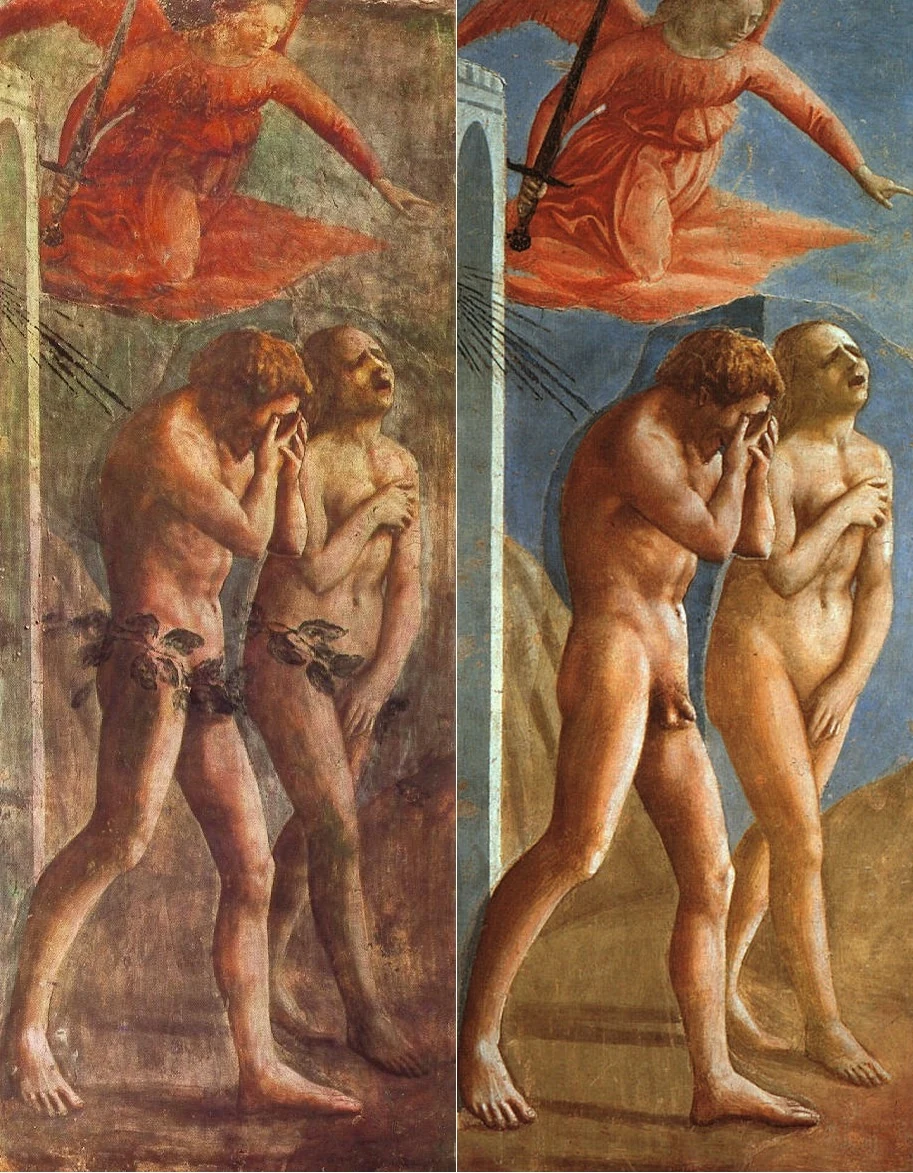
Masaccio, "Expulsion from the Garden of Eden" (c. 1427)
The rawest shame in art history. Adam covers his face with both hands — he can't even look at himself. Eve covers her body and screams, mouth open, eyes dark hollows. Masaccio stripped away every decorative element: no garden, no gate, just two naked, wrecked people walking into nothing. The angel above them isn't gentle, it's a sword. The power comes from the bodies: hunched, contracted, trying to disappear. This is what shame looks like before it learns to hide.
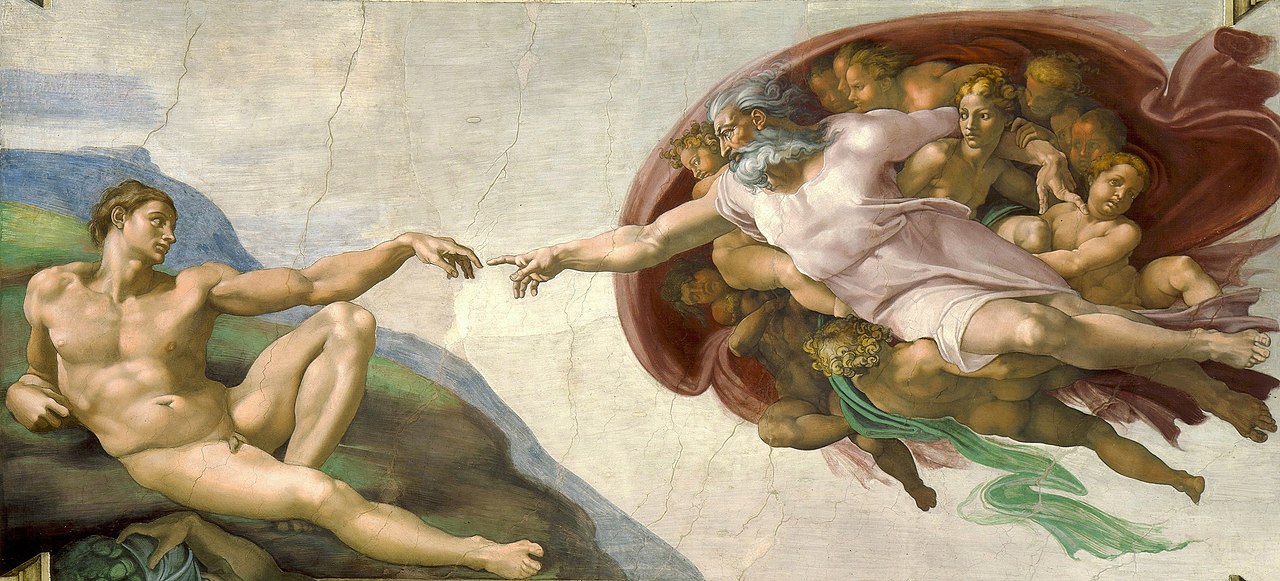
Michelangelo, Sistine Chapel Ceiling (1508-12)
Michelangelo painted the Creation of Adam and the Fall on the same ceiling, the whole arc from first touch to exile. The famous "creation" panel (the near-touching fingers) works because of the GAP: God reaches with energy, Adam reaches with lassitude. The tension between divine urgency and human passivity is in that two-inch space. The expulsion panel, less famous, shows the couple driven out by an angel, Eve looks back. That backward glance is the painting: you can't go back, but you can't stop looking.
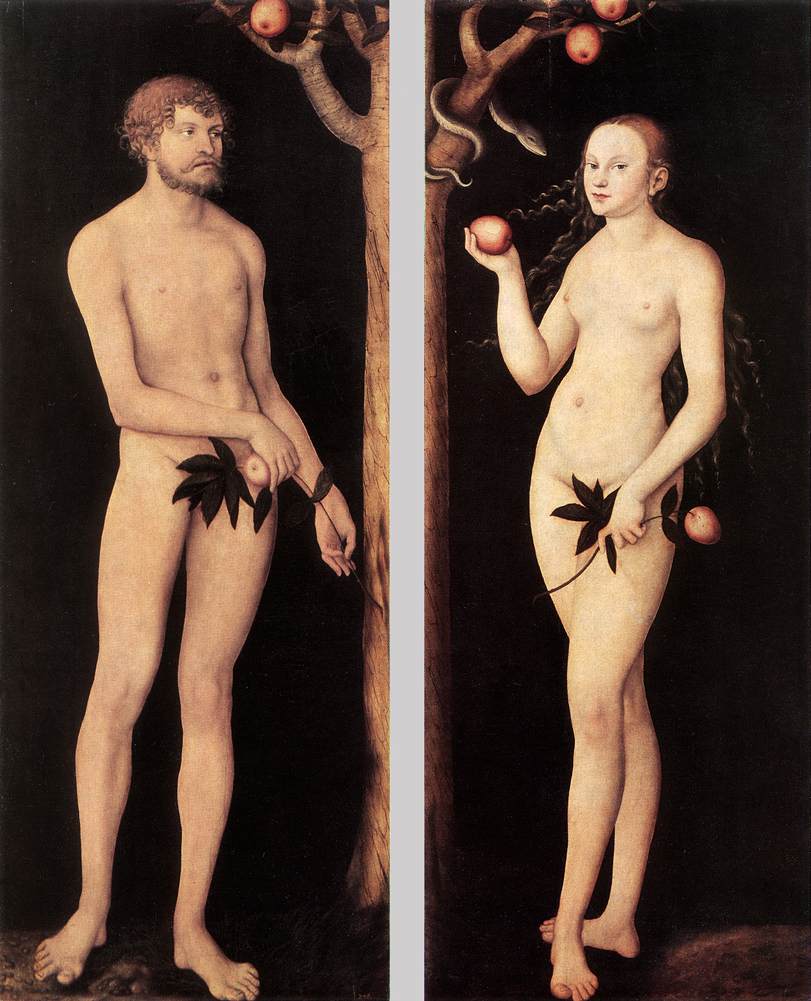
Lucas Cranach the Elder — "Adam and Eve" (1526)
Cranach painted the scene dozens of times, it was a bestseller. His versions are cooler, more decorative, almost fashion-plate: Eve stands contrapposto like a model, the serpent is coiled in the tree, Adam scratches his head in confusion. What Cranach understood that heavier painters missed: the Fall can be painted as seduction. The apple is beautiful. The garden is lush. The choice looks GOOD, that's why they make it. The horror comes later.
The Human Truth · 2026
Every human life has a Fall, a moment when you learn something that permanently divides your life into "before" and "after." The child who discovers their parents are flawed. The diagnosis that changes how you see your body. The betrayal that teaches you people can lie. The moment you realize the world is not safe. The Fall is not punishment, it's the price of growing up, of knowing, of being alive in a world where knowledge and pain arrive together.
For your painting: A teenager scrolling through their phone, seeing something that changes how they understand the world — innocence ending not in a garden but on a screen. Or: two people leaving an apartment for the last time, the door closing behind them. The paradise you can never return to is the relationship, the childhood, the time before you knew. Paint the DOOR, the threshold between the world where everything was fine and the world where it isn't.
Story 2
Cain & Abel
Sibling rivalry · Jealousy as murder · "Am I my brother's keeper?"
The Story
Adam and Eve's sons. Abel is a shepherd; Cain is a farmer. Both offer sacrifices to God. God accepts Abel's offering and rejects Cain's. No reason is given, the rejection feels arbitrary, which is the point. Cain, consumed by jealousy, kills his brother in a field. God asks: "Where is your brother?" Cain answers: "Am I my brother's keeper?" God marks Cain and sends him into exile, but also protects him from being killed.
Why Painters Use It
The first murder is motivated not by hatred but by envy, the feeling that someone else received what you deserved. This is the most relatable dark emotion in human experience. The story is also about the unbearable arbitrariness of who succeeds and who doesn't. And Cain's question — "Am I my brother's keeper?", is the foundational question of social responsibility. Every political argument about welfare, homelessness, and inequality is a version of this question.
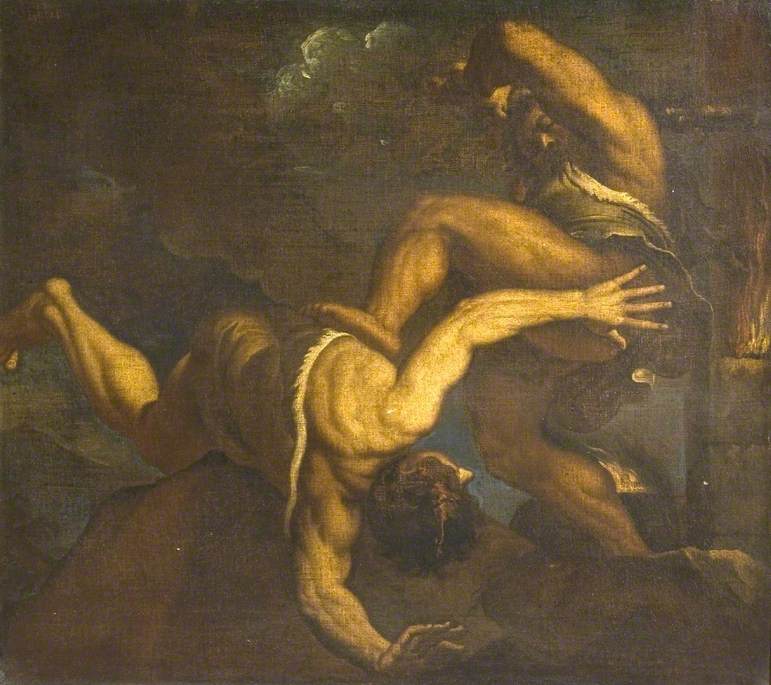
Titian, "Cain and Abel" (c. 1542-44)
Titian paints the murder mid-swing: Cain above, arm raised with a club, Abel beneath, twisting away. The bodies form a violent diagonal. What makes it more than an action scene: Cain's face isn't rage, it's anguish. He's already in pain before the blow lands. Titian understood that the real violence is internal. The brother is killing himself as much as his brother.
Rubens, "Cain Slaying Abel" (c. 1608-09)
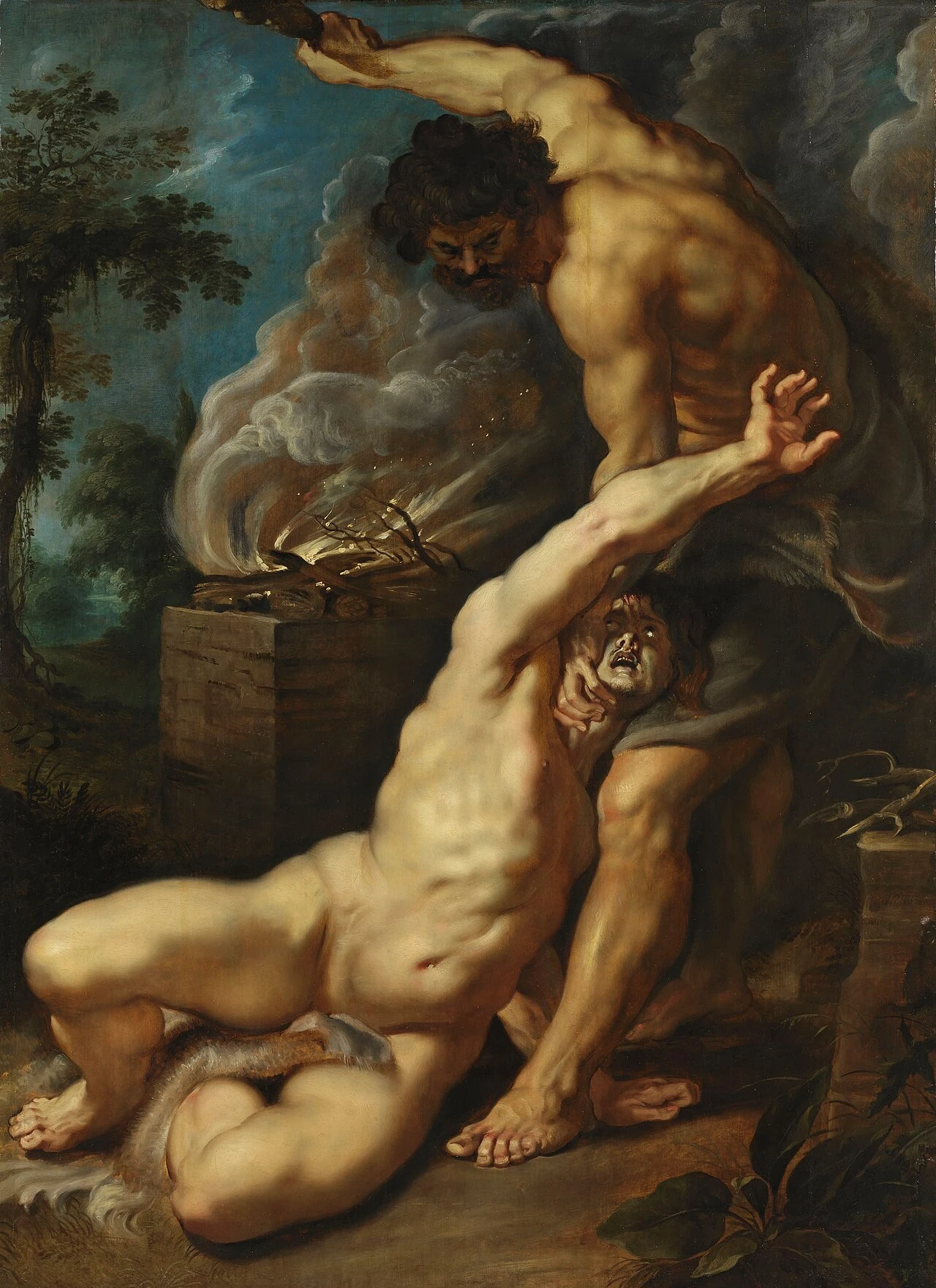
Rubens goes full Baroque: muscular bodies, dramatic foreshortening, Abel's pale body arched in death. But the detail that elevates it: Abel's offering (a lamb) is still smoldering on the altar in the background. The sacrifice that was accepted is still burning while the brother who offered it is being murdered. The irony is spatial — God's approval and human violence share the same frame.
Fernand Cormon, "Cain" (1880)
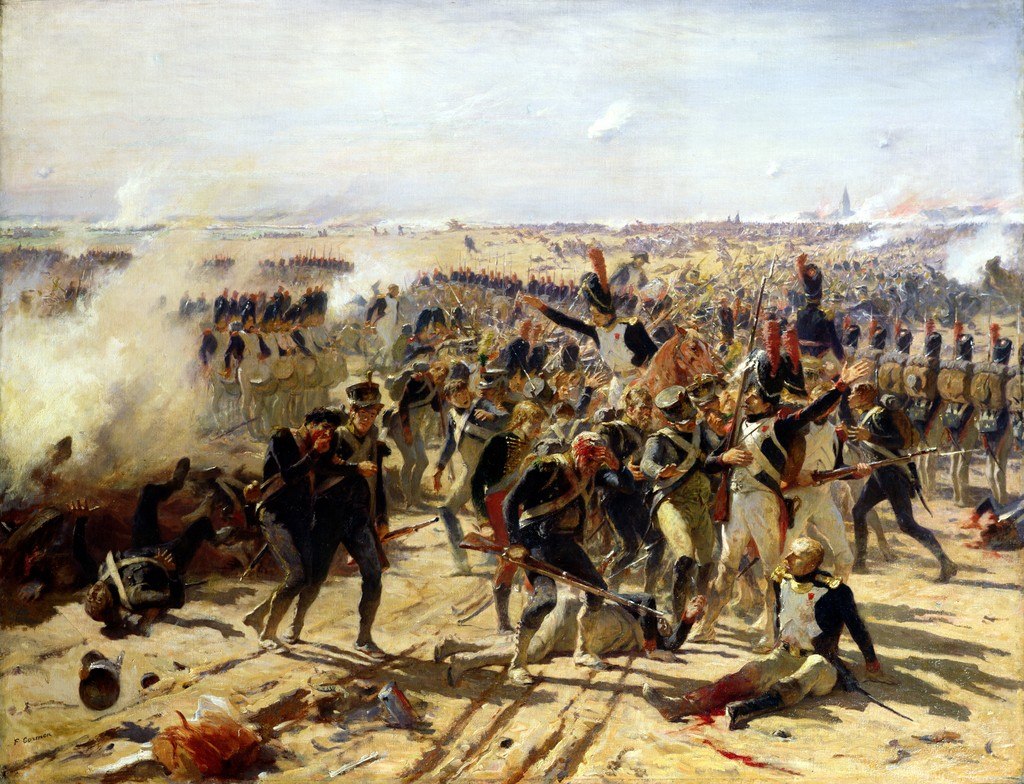
Cormon paints the AFTER, not the murder but the exile. Cain leads his family through a barren landscape, haunted, marked, carrying the weight. It's a migration painting: a family on the move with everything they own, driven by guilt into the wilderness. This is the version that resonates with modern displacement, refugees, exiles, anyone driven from home by something they did or something done to them.
The Human Truth · 2026
Envy is the emotion no one admits to. We'll confess anger, sadness, even hatred, but not the specific pain of watching someone else receive what we wanted. Cain's story is about the moment envy becomes action — the day you stop competing and start destroying. But it's also about the question that haunts every society: when someone suffers, is that your problem? "Am I my brother's keeper?" is the question asked by every person who walks past a homeless encampment, every voter deciding on social programs, every sibling who stopped calling.
For your painting: Two siblings at a family dinner, one radiating success, one radiating something darker. The space between them that used to be love. Or paint the AFTER: a person alone with the consequences of envy acted upon, the relationship destroyed, the field empty. The most honest version might be your own face, the moment you wished someone else would fail.
Story 3
The Sacrifice of Isaac
Obedience vs. love · The impossible command · Faith tested to destruction
The Story
God commands Abraham to take his son Isaac, the child he waited decades for, to a mountain and sacrifice him as a burnt offering. Abraham obeys. He builds an altar, binds Isaac, raises the knife. At the last instant, an angel stops him. A ram appears, caught in a thicket, and is sacrificed instead. God says: "Now I know you fear me."
Why Painters Use It
This is the most psychologically violent story in the Bible — a father preparing to kill his child because an authority told him to. Painters return to it because the moment of the raised knife contains EVERY emotion simultaneously: obedience, love, horror, faith, doubt. The son's face. The father's face. The knife between them. There is no story with higher emotional stakes in fewer elements. And the universal truth it carries: sometimes the people and institutions we trust most demand things from us that violate our deepest values. What do you do?
Caravaggio, "Sacrifice of Isaac" (1603)
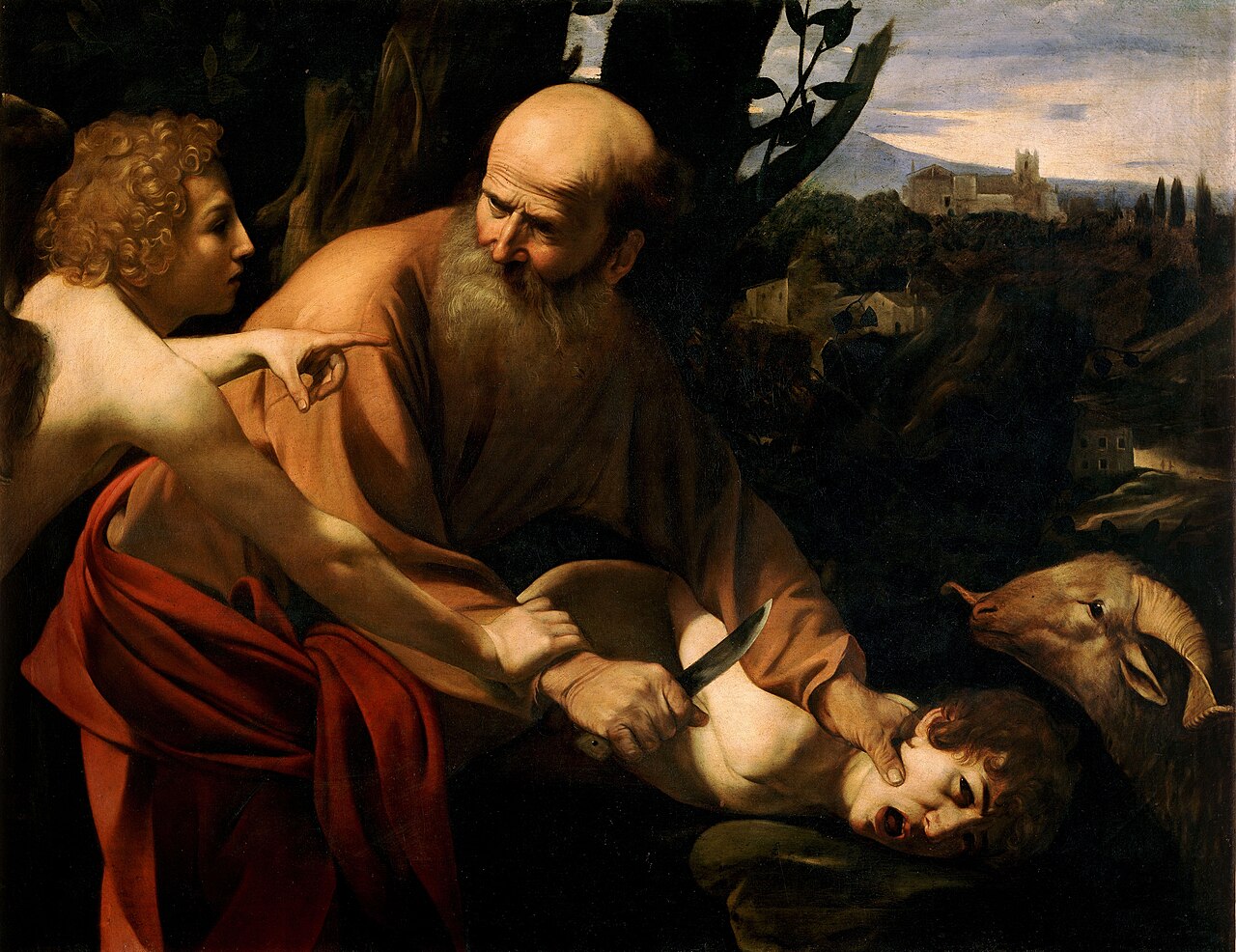
Isaac SCREAMS. His mouth is open, his eye is wild with animal terror. Abraham's hand presses his head down against the rock. The angel grabs Abraham's wrist, not gently, forcefully, like stopping someone from making a terrible mistake at the last possible second. Caravaggio makes the violence real: this isn't a theological allegory, it's a father with a knife and a child who is afraid to die. The painting works because it refuses to make the horror abstract.
Rembrandt, "The Sacrifice of Isaac" (1635)
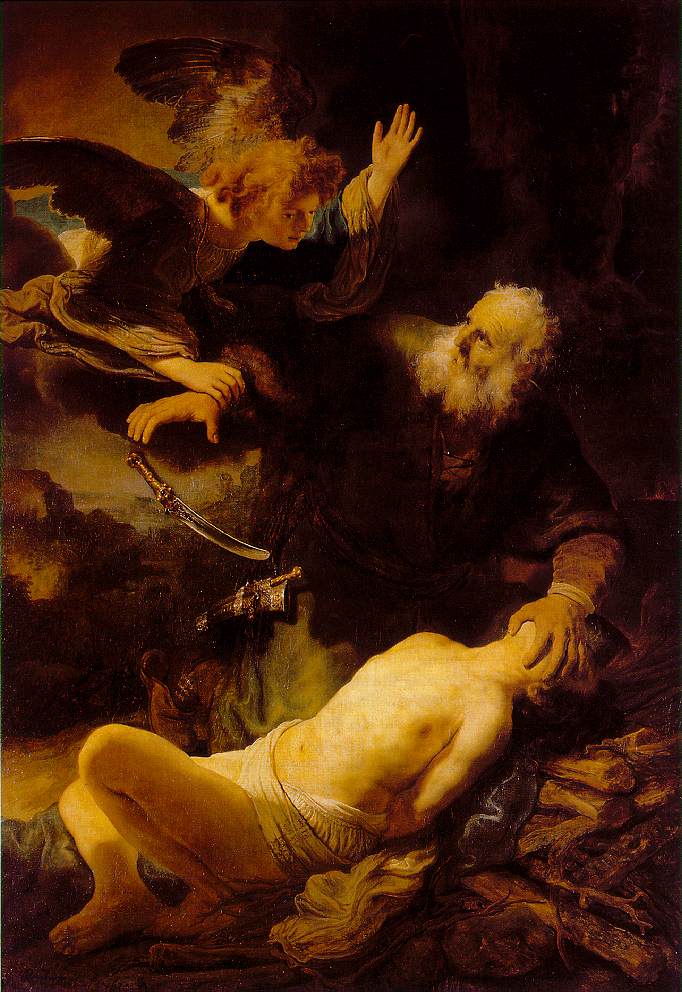
Rembrandt's version focuses on Abraham's HANDS. The angel catches his wrist and the knife falls, you can almost hear it clatter. Abraham's other hand covers Isaac's entire face, pushing it down. Is he forcing the boy into position, or is he covering the boy's eyes so he won't see the knife? Rembrandt leaves both readings open. That ambiguity — protective tenderness and violence in the same gesture, is devastating.
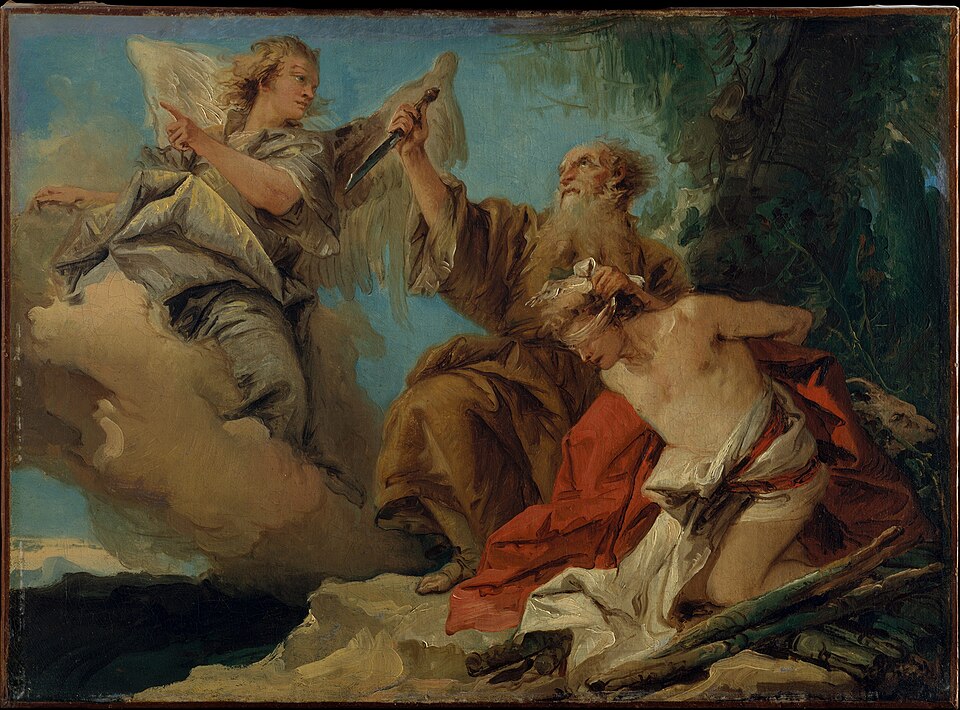
Tiepolo, "The Sacrifice of Isaac" (c. 1726-29)
Tiepolo brings Baroque theatricality: billowing robes, dramatic diagonals, the angel arriving from a burst of heavenly light. Where Caravaggio's version is dark and brutal, Tiepolo's is almost beautiful, the violence framed as divine spectacle. The contrast is instructive: same story, completely different emotional register. Tiepolo says God's intervention is magnificent. Caravaggio says it's barely in time.
The Human Truth · 2026
The deepest terror: being asked to sacrifice what you love most in service of something you believe in. Every parent who sends a child to war. Every person who gives up a relationship for a career, or a career for a relationship. Every time an authority, a government, a religion, a company, a cause — demands something that violates your deepest bonds. The story asks: is there a point where obedience becomes cruelty? And: what happens to you AFTER you raise the knife, even if the angel comes?
For your painting: A parent signing papers, divorce, deployment, institutionalization, that will hurt their child for a "higher purpose." The "knife" is any document, any decision, any action taken in the belief that the pain is necessary. Paint the hand: holding the pen, trembling, about to sign. The child is in the frame but looking away. The angel may or may not arrive.
Story 4
Joseph & His Brothers
Betrayal by family · Exile · Forgiveness after power
The Story
Joseph is his father's favorite, he gets the famous "coat of many colors." His brothers, consumed with jealousy, throw him into a pit and sell him into slavery. He ends up in Egypt, is imprisoned, but rises to become Pharaoh's right hand by interpreting dreams. Years later, famine drives his brothers to Egypt for food. They kneel before Joseph without recognizing him. He has absolute power over the men who destroyed his life. He weeps. He forgives them.
Why Painters Use It
The recognition scene, when Joseph reveals himself to the brothers who sold him — is one of the great dramatic moments in literature. It contains the question: what do you do when you have power over someone who hurt you? Revenge or mercy? Joseph chooses mercy, and the choice breaks him open ("he wept so loudly that the Egyptians heard him"). This is the blueprint for every forgiveness story ever told. It also carries the theme of the outcast who rises, the rejected one who becomes essential.
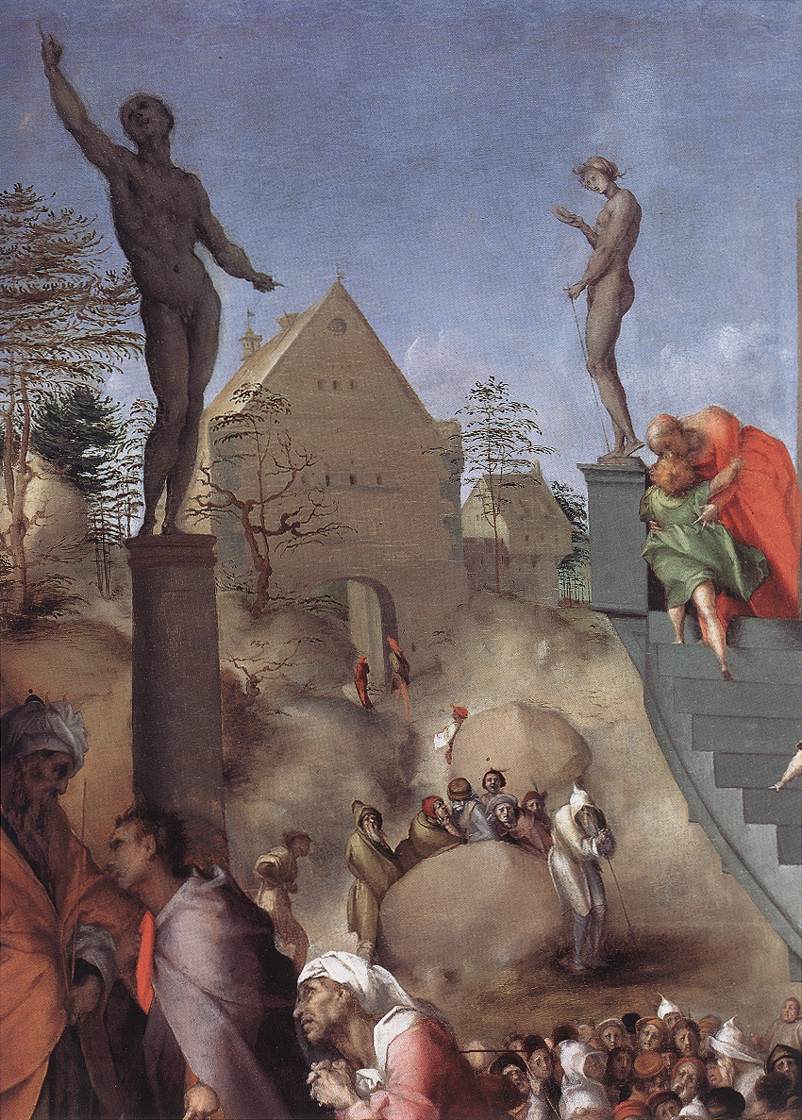
Pontormo, "Joseph in Egypt" (c. 1518)
A wild, almost surrealist composition, multiple moments of the story happen simultaneously on a swirling staircase. Figures climb, gesture, kneel, embrace. Pontormo abandons linear time and paints the FEELING of the Joseph story: the vertigo of reunion, the strangeness of meeting someone powerful who turns out to be your abandoned brother. The painting is disorienting on purpose.
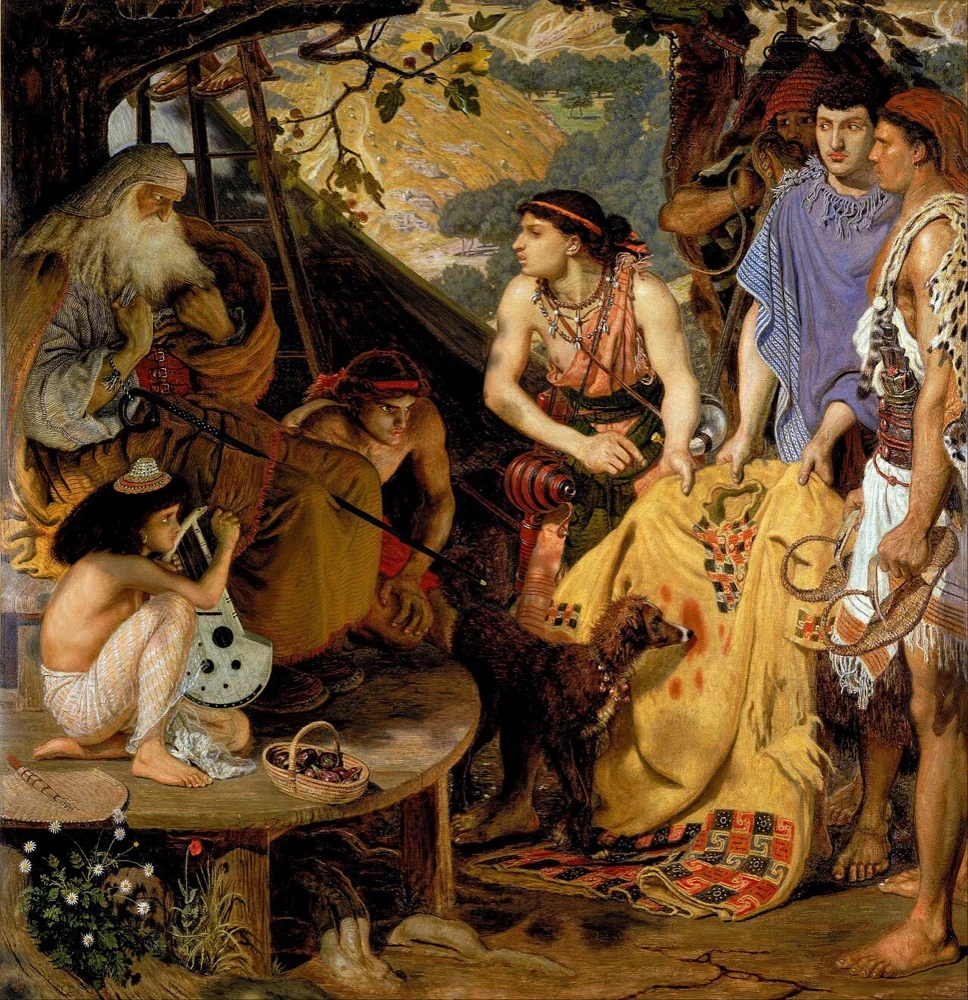
Ford Madox Brown, "The Coat of Many Colours" (1867)
Brown paints the moment BEFORE the betrayal: Jacob gives Joseph the famous coat while the other brothers watch from the margins. Their faces tell the whole future. The coat is bright, almost garish — the favoritism is visible, wearable, impossible to ignore. Brown understood that the violence starts here, at the dinner table, with a gift that says "you're my favorite." Every family feud begins with a version of this coat.
Rembrandt, sketches and etchings (various)
Rembrandt returned to Joseph obsessively in drawings and etchings. His favorite moment: the reveal, when Joseph says "I am your brother." In the sketches, the brothers' bodies collapse, knees buckling, hands rising to faces. Rembrandt drew the moment when power meets mercy and mercy wins. The bodies know before the minds catch up.
The Human Truth · 2026
Two universal truths in one story. First: the people closest to you can hurt you worst. Family betrayal isn't dramatic like a murder, it's the slow poison of favoritism, the coat given to one child and not the others, the silent message that one sibling matters more. Second: forgiveness from a position of power is the hardest kind. It's easy to forgive when you're weak. When you're strong enough to destroy the person who hurt you and you CHOOSE mercy instead, that's Joseph weeping before his brothers.
For your painting: A person at a family reunion or hometown return — successful now, facing the people who rejected them. The "coat of many colors" is whatever made you different enough to be resented: your talent, your sexuality, your ambition, your leaving. Paint the moment of recognition: the face of someone seeing who they wronged, and the power shifting in the room.
Story 5
Moses & The Exodus
Liberation · The weight of leadership · Wandering without a map
The Story
The Israelites are enslaved in Egypt. Moses, raised as Egyptian royalty but secretly Hebrew, is called by God (via a burning bush) to lead them out. He confronts Pharaoh ("Let my people go"), the plagues come, the Red Sea parts, and the people escape into the desert. But liberation turns out to be harder than slavery. The people complain, lose faith, worship a golden calf. Moses himself is barred from entering the promised land. Forty years of wandering. Freedom is not what they expected.
Why Painters Use It
The Exodus is the foundational liberation story in Western culture, every freedom movement from abolitionism to civil rights to modern protest has drawn on its imagery. But what makes it paintable is the DISILLUSIONMENT that follows liberation. The people are free, and they're lost. They were slaves with certainty; now they're free people with no direction. The universal truth: getting what you wanted (freedom, success, escape from a bad situation) is often the beginning of a harder problem, not the end of the story.
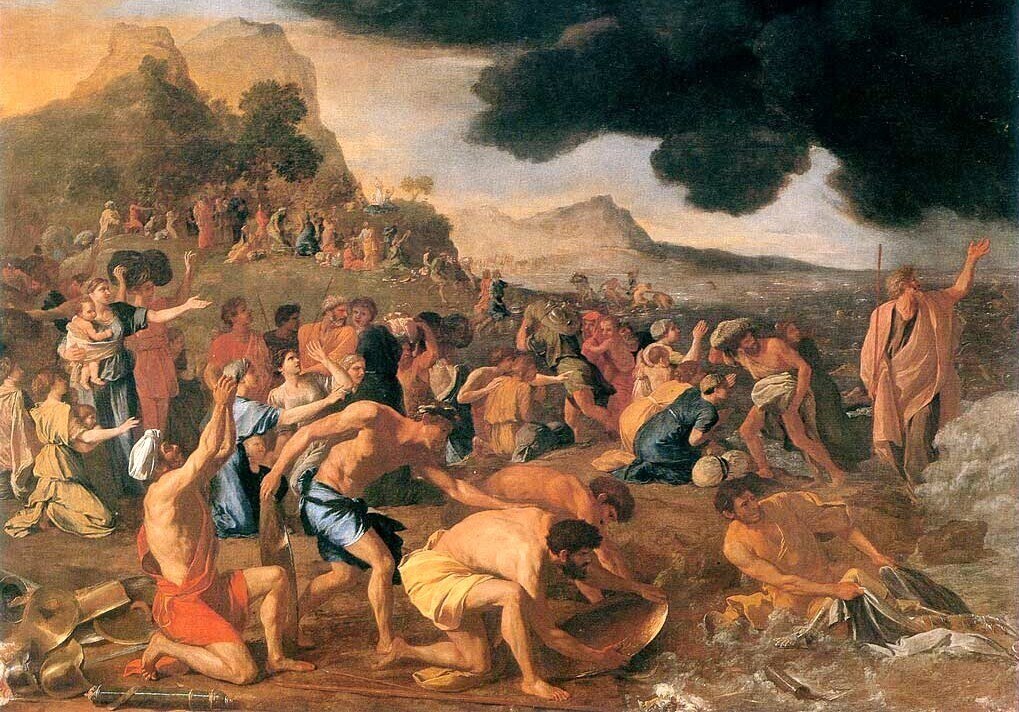
Nicolas Poussin — "The Crossing of the Red Sea" (1634)
Poussin paints the moment of maximum chaos: the sea parting, the Israelites surging through, the Egyptian army behind them. But look at the PEOPLE, they aren't triumphant. They're terrified, clutching children, looking back. Liberation in Poussin's hands looks like panic. He understood that freedom is not a celebration but a stampede, and the people being freed are as overwhelmed as the forces behind them.
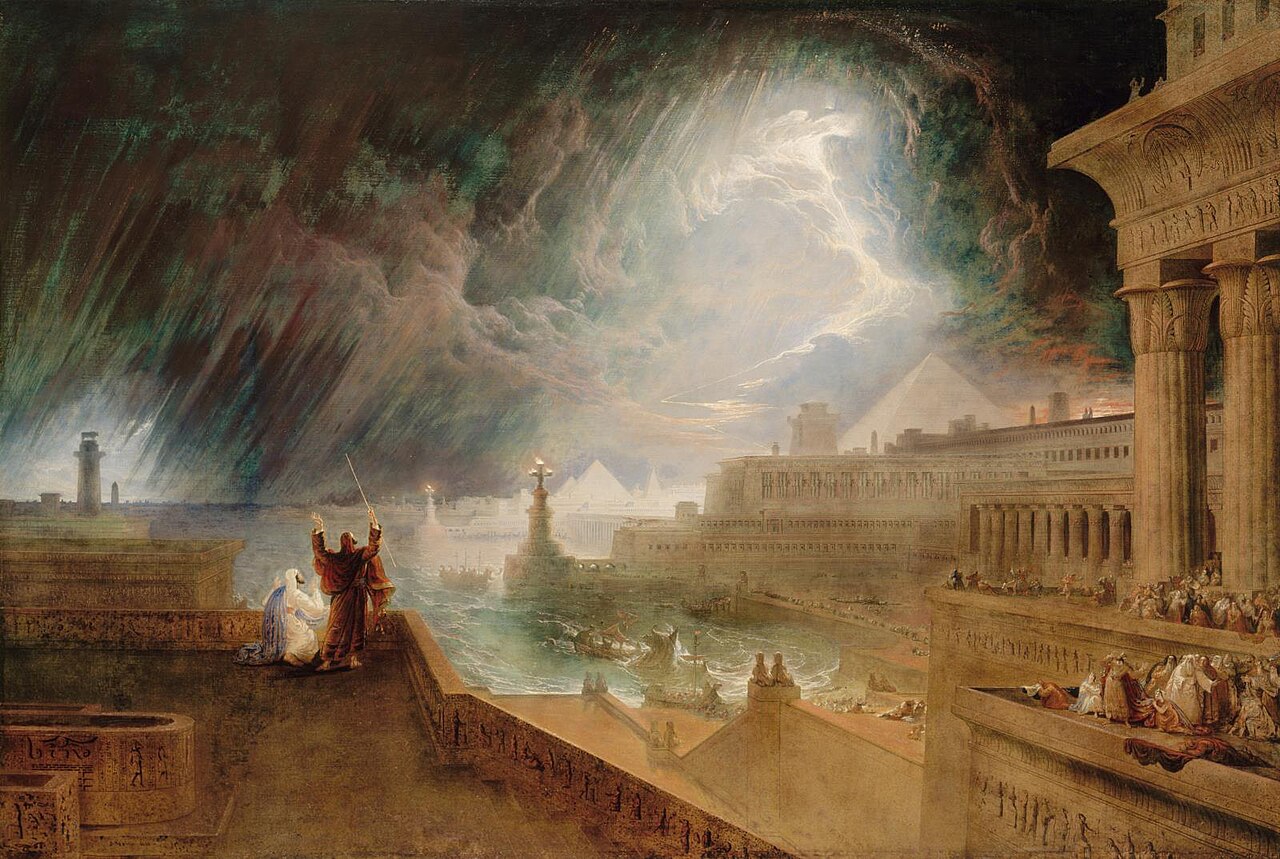
John Martin, "The Seventh Plague of Egypt" (1823)
Martin paints the plagues as cosmic events, tiny humans dwarfed by fire, hail, and darkness on an operatic scale. The sublime terror of the plagues is his subject: the moment when a power beyond human scale intervenes. Martin's genius was scale itself, his canvases are enormous, his skies are vast, his humans are specks. The message: liberation sometimes requires forces that are terrifying even to those being liberated.
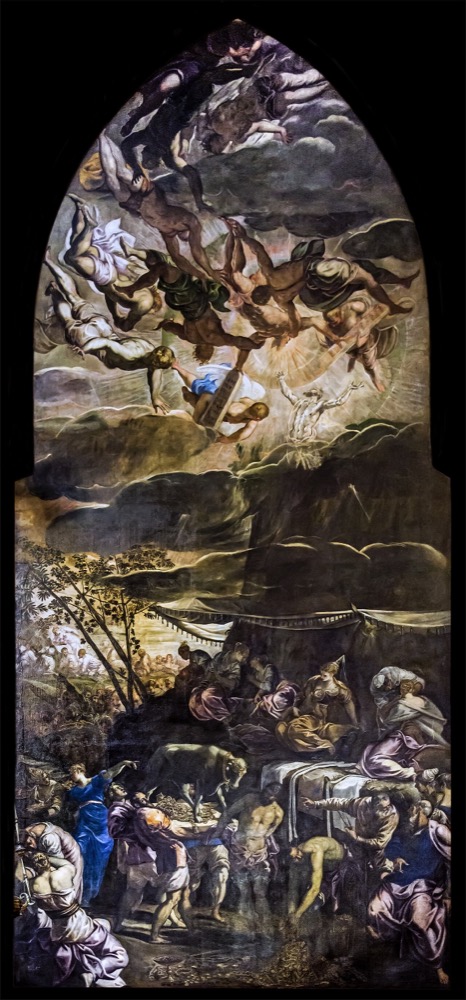
Tintoretto — "The Worship of the Golden Calf" (c. 1560)
The disillusionment chapter: the people, tired of waiting for Moses, build a golden idol and dance around it. Tintoretto paints the scene as a party, bodies moving, wine flowing, the calf gleaming. It looks like a celebration. It IS a celebration. That's the horror: they've traded liberation for a shiny object, and they're having a wonderful time. This is the Four Horsemen's Conquest applied to the Exodus, the crowd follows the bright thing.
The Human Truth · 2026
Liberation is not the end of suffering, it's the beginning of a different, harder kind. The person who leaves the abusive relationship discovers that freedom is lonely. The addict who gets clean discovers that sobriety requires building an entirely new life. The refugee who reaches the new country discovers that arrival is only the start. Moses's people spent 40 years wandering AFTER liberation, lost, complaining, worshipping golden calves because certainty (even false certainty) is more comfortable than freedom. This is the story of everyone who got what they wanted and found it wasn't what they expected.
For your painting: Someone standing in the doorway of their new life — the apartment after the shelter, the sobriety after rehab, the new country after the crossing. Paint the DESERT part: the disorientation of freedom, the face of someone who is no longer oppressed and has no idea what to do next. Or paint the golden calf: the thing people worship when they lose faith in the journey, the phone, the ideology, the substance, the easy answer.
Story 6
David & Goliath
The underdog · Courage against impossible odds · Violence as necessity
The Story
The Philistine army has a champion, Goliath, a giant in full armor. No Israelite soldier will face him. David, a teenage shepherd with no armor and no military training, volunteers. He refuses the king's armor ("I'm not used to this") and walks out with a sling and five stones. One stone. Goliath falls. David cuts off his head with Goliath's own sword.
Why Painters Use It
The most universally understood underdog story. But the paintable moment isn't the throw, it's the walk. The moment David steps forward, alone, toward something enormous, with inadequate tools. Every person who has started something they weren't "qualified" for understands this walk. Also: David's refusal of the king's armor is a profound statement about authenticity, "your tools don't fit me; I'll use my own."
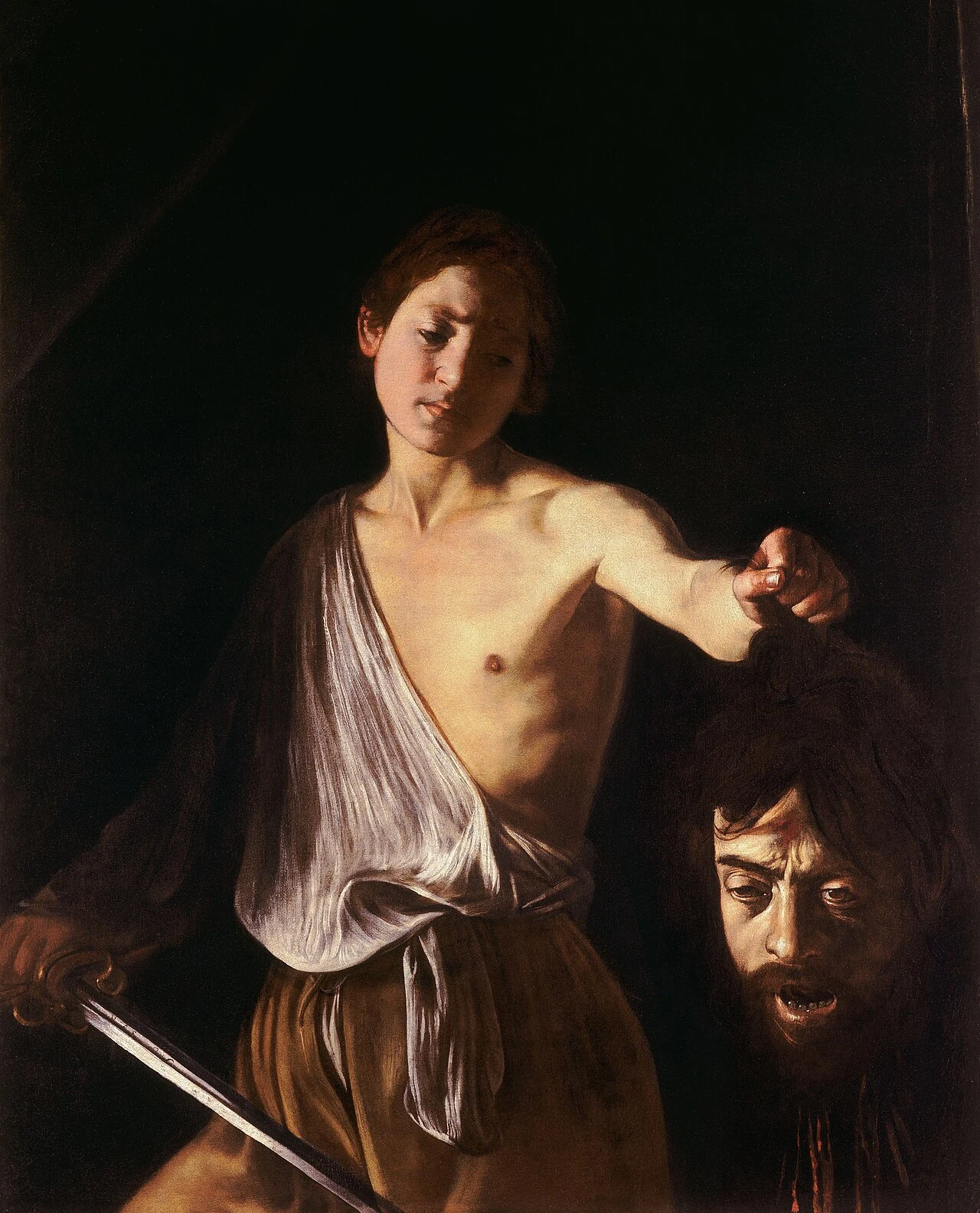
Caravaggio — "David with the Head of Goliath" (c. 1610)
The most psychologically complex version. David holds Goliath's severed head, but he's not triumphant. His expression is melancholy, almost sorrowful. And the head: it's Caravaggio's own face, painted as a self-portrait. The painter cast himself as the slain giant. The painting asks: what does victory cost the victor? David looks at the head the way you look at something you had to destroy and wish you hadn't.
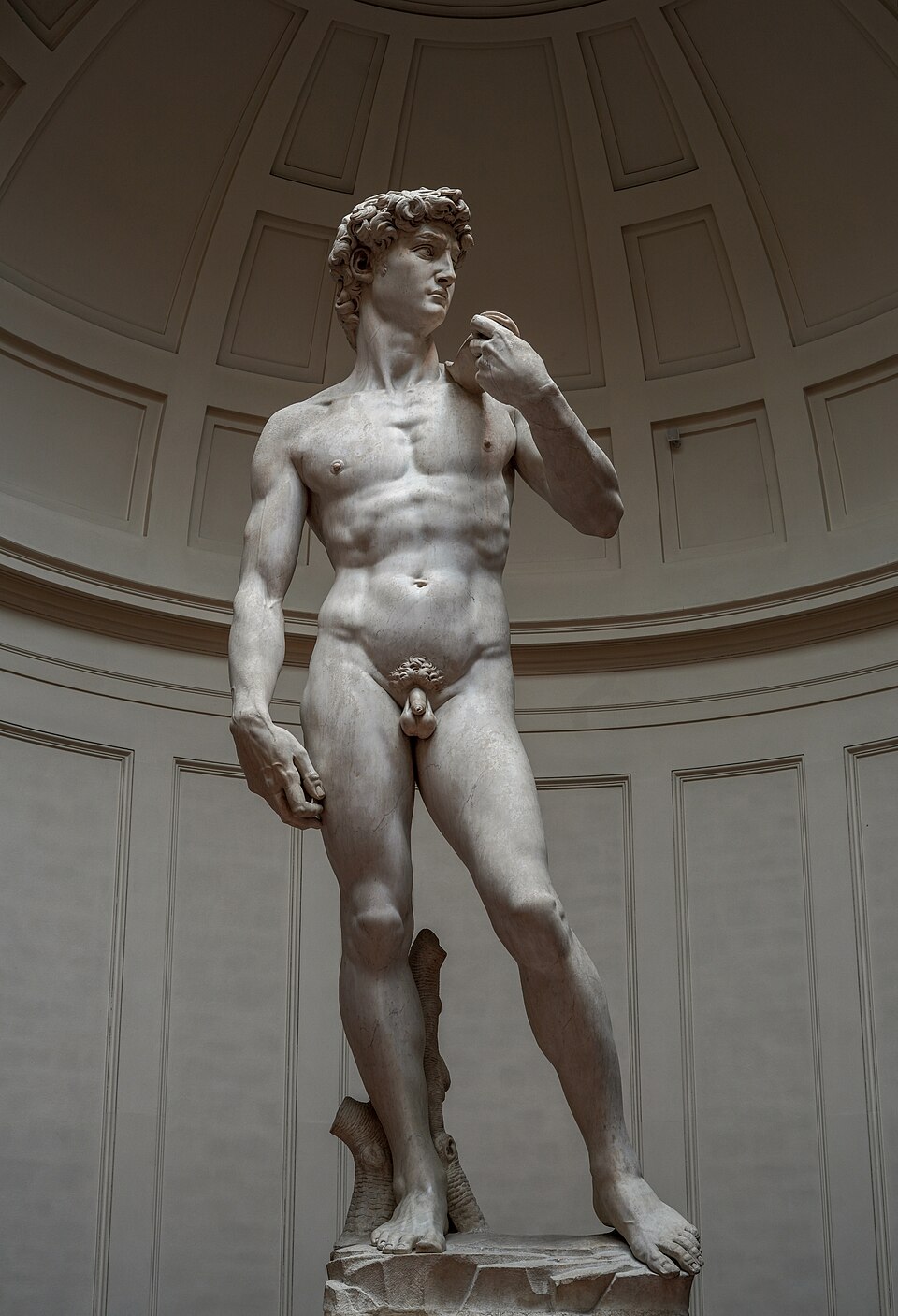
Michelangelo, "David" (1501-04, sculpture)
Every other David shows the aftermath, the hero with the head. Michelangelo shows the moment BEFORE: David coiled, alert, measuring the distance to Goliath. No weapon visible, no enemy in frame. Just a young man's body at maximum tension, about to act. The genius is choosing the moment of decision, not the moment of action. The viewer supplies the fight. The sculpture supplies the courage.
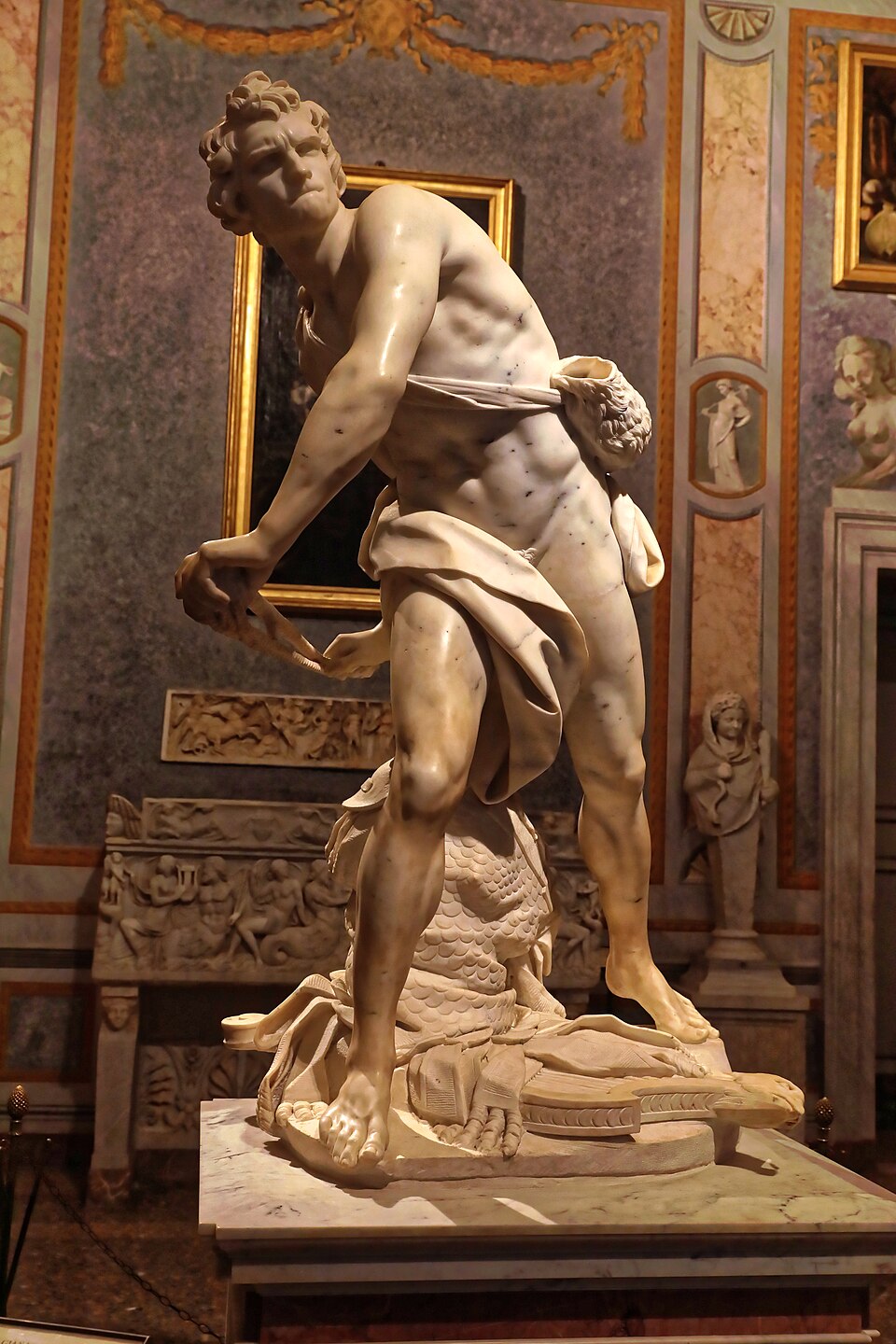
Bernini, "David" (1623-24, sculpture)
Bernini chose the instant of the throw — the body twisted, the sling pulled taut, the face grimacing with effort. Where Michelangelo's David is contemplative, Bernini's is pure physical action. The sculpture requires you to walk around it; it changes meaning from every angle. The lesson for painters: the same story, painted at a different instant, is a completely different painting. WHICH moment you choose is the painting.
The Human Truth · 2026
The underdog story works because EVERYONE has been David, facing something enormous with inadequate tools. But the deeper truth is David's refusal of Saul's armor: "I'm not used to this." He won't fight the giant using the giant's methods. He uses his own tools, a sling, a stone, a shepherd's accuracy, because authenticity is a form of power. Every person who succeeded by being themselves instead of imitating the establishment is David. Every person who was told "you're not qualified" and did it anyway is David.
For your painting: A person walking into a room where they don't belong, the first-generation student, the artist at the tech company, the young person at the old person's table. Paint the WALK, not the victory. The sling is whatever authentic skill they carry that the system doesn't recognize as a weapon. The Goliath is any institution that has forgotten that size isn't strength.
Story 7
Judith & Holofernes
Female courage · Violence as liberation · The beautiful and the terrible
The Story
Holofernes is an Assyrian general besieging the Jewish town of Bethulia. The town is about to surrender. Judith, a beautiful widow, walks into the enemy camp, charms Holofernes, gets invited to his tent for a banquet. He drinks himself unconscious. She takes his sword and cuts off his head. She walks out of the camp carrying his head in a bag, returns to Bethulia, and the town is saved.
Why Painters Use It
Painters are obsessed with this story because of the collision of beauty and violence — a beautiful woman doing something terrible for a righteous cause. Artemisia Gentileschi painted it twice, and her versions are among the most psychologically honest paintings in art history: Judith's face shows effort, determination, and revulsion simultaneously. The story asks: can a violent act be moral? And: what does it cost the person who performs it, even when it's necessary?
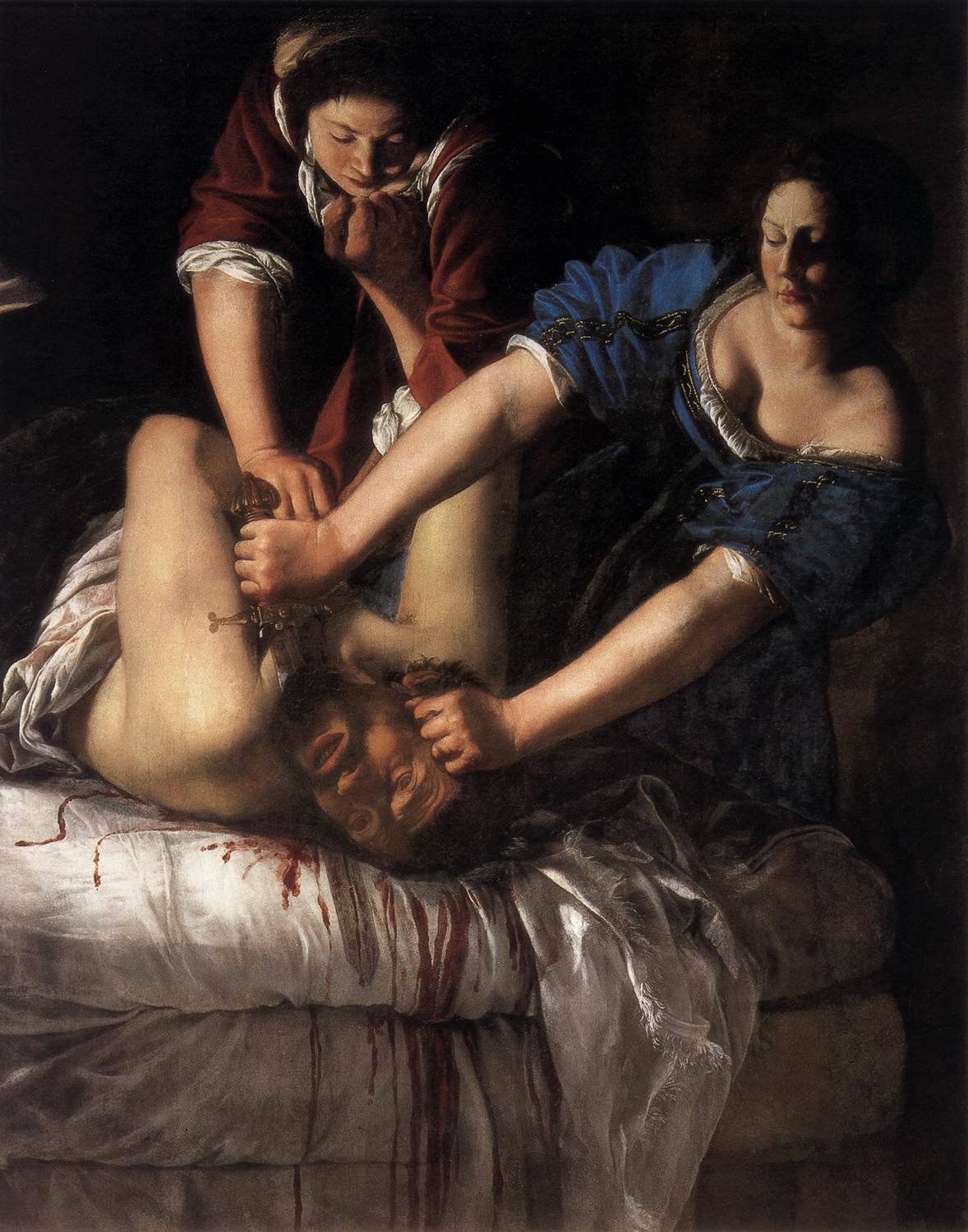
Artemisia Gentileschi, "Judith Slaying Holofernes" (c. 1620)
The definitive version, and one of the most visceral paintings in Western art. Judith grips Holofernes' hair, braces her arm, and SAWS through his neck. There's blood. The maid helps hold him down. Judith's face shows concentrated effort, not ecstasy and not horror, she's doing a job that needs doing. Gentileschi (herself a survivor of sexual assault by her painting teacher) painted this twice. The physical realism, the strength required, the resistance of flesh — makes every other version look like theater.
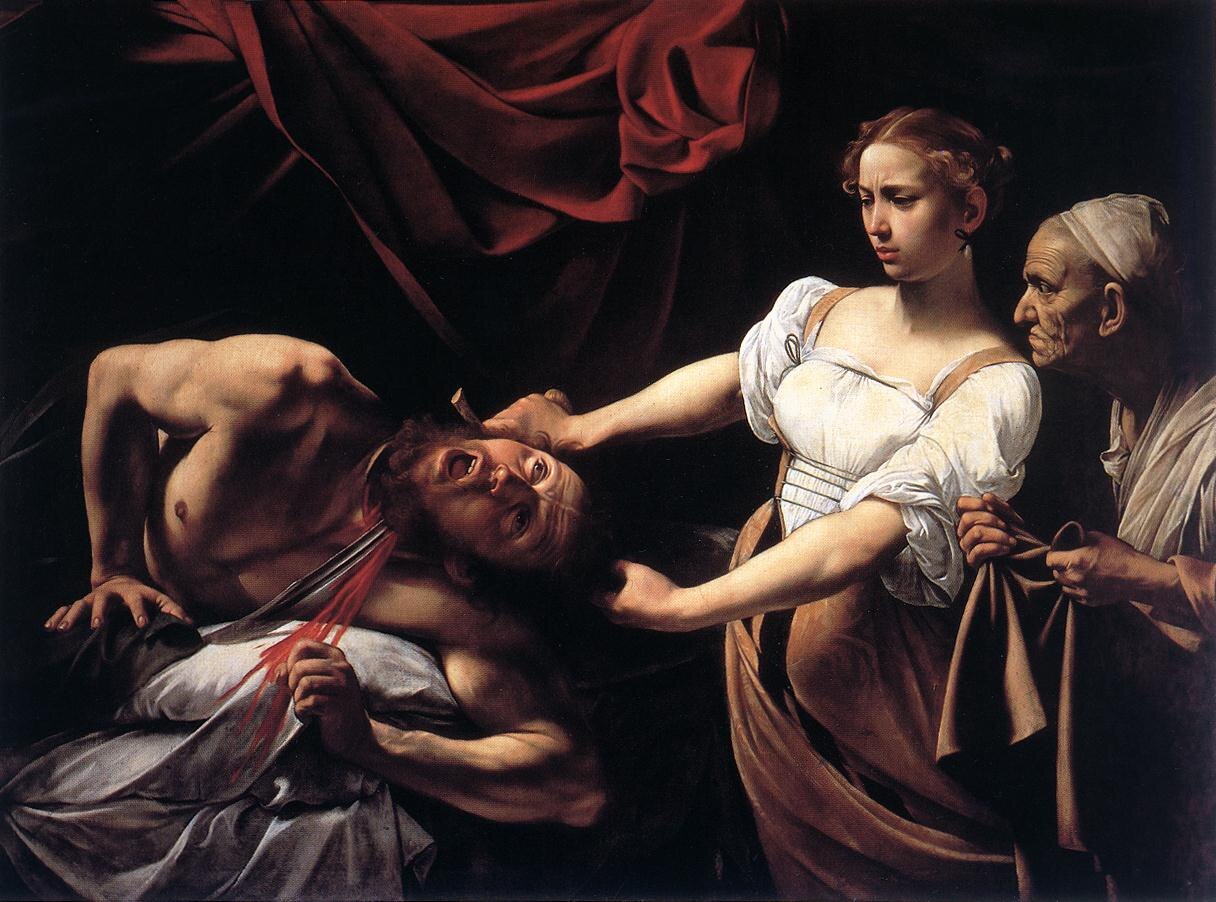
Caravaggio, "Judith Beheading Holofernes" (c. 1598-99)
Caravaggio's Judith is more hesitant, she leans away from the act, her face a mix of determination and revulsion. The contrast with Gentileschi's is instructive: Caravaggio painted a woman performing violence reluctantly. Gentileschi painted a woman performing it competently. The difference tells you everything about whose version is more honest about what this story means.
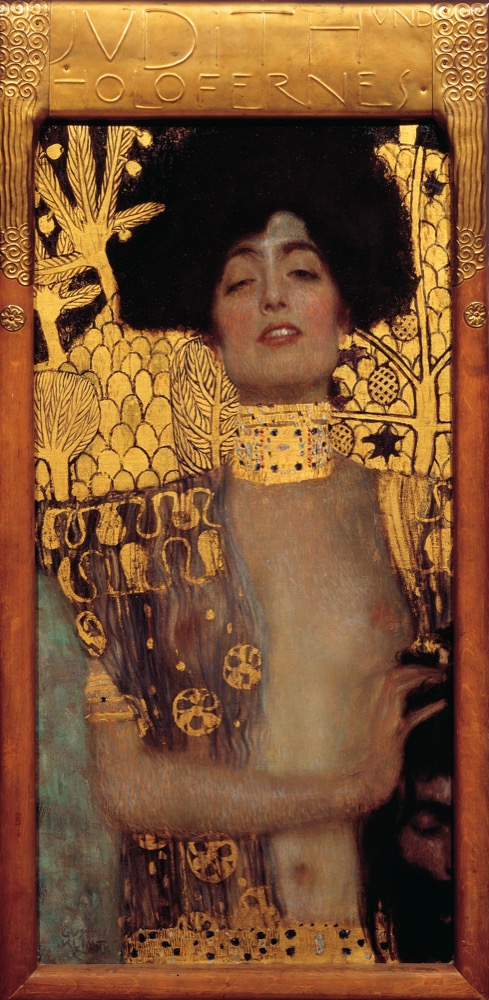
Klimt, "Judith I" (1901)
Klimt's Judith is sensual, half-lidded, holding Holofernes' head with an expression closer to post-coital satisfaction than battlefield grimness. The painting was so provocative that it was initially mistitled "Salome" because audiences couldn't reconcile the eroticism with the biblical heroine. Klimt understood something the moralists missed: Judith used her beauty as a weapon, and the story is ABOUT the entanglement of desire and violence. His painting doesn't sanitize that, it amplifies it.
The Human Truth · 2026
Sometimes the only way to stop a powerful person from destroying your community is to do something violent, irreversible, and morally ambiguous. Judith's story doesn't celebrate violence — it asks what violence COSTS the person who performs it, even when it's necessary. She saves her city, but she walks out of that tent carrying a head in a bag. She is not the same person who walked in. The story is about the price of necessary action, and about women as agents of that action, not victims of it.
For your painting: A woman who has just done something irrevocable to protect others, the whistleblower walking out of the hearing, the mother who called the police on her own son, the person who published the truth knowing it would destroy someone powerful. Paint her AFTER: walking away from the act, carrying the weight. Her face should show not triumph but the specific exhaustion of someone who did the right thing and it cost her everything.
Story 8
Job
Suffering without reason · Endurance · Arguing with God
The Story
Job is a good man. He's done nothing wrong. God allows Satan to test him by destroying everything: his wealth, his children, his health. Job sits in ashes, covered in sores. His friends tell him he must have sinned (he hasn't). His wife tells him to curse God and die. Job refuses, but he doesn't stay quiet. He argues with God. He demands an explanation. God eventually answers, not with an explanation, but with a display of cosmic power: "Where were you when I laid the foundations of the earth?" Job is humbled but never told WHY he suffered.
Why Painters Use It
Job is the story of suffering that has no meaning — and the refusal to pretend it does. His friends offer easy explanations ("you must deserve this"). Job rejects them. He insists on the truth: he's innocent and the suffering is unjust. This makes Job the patron saint of anyone who has suffered without reason, illness, accident, loss, and refused to accept a tidy narrative about "God's plan." The paintable moment is Job on the ash heap: stripped of everything, refusing to be silent.
Léon Bonnat, "Job" (1880)
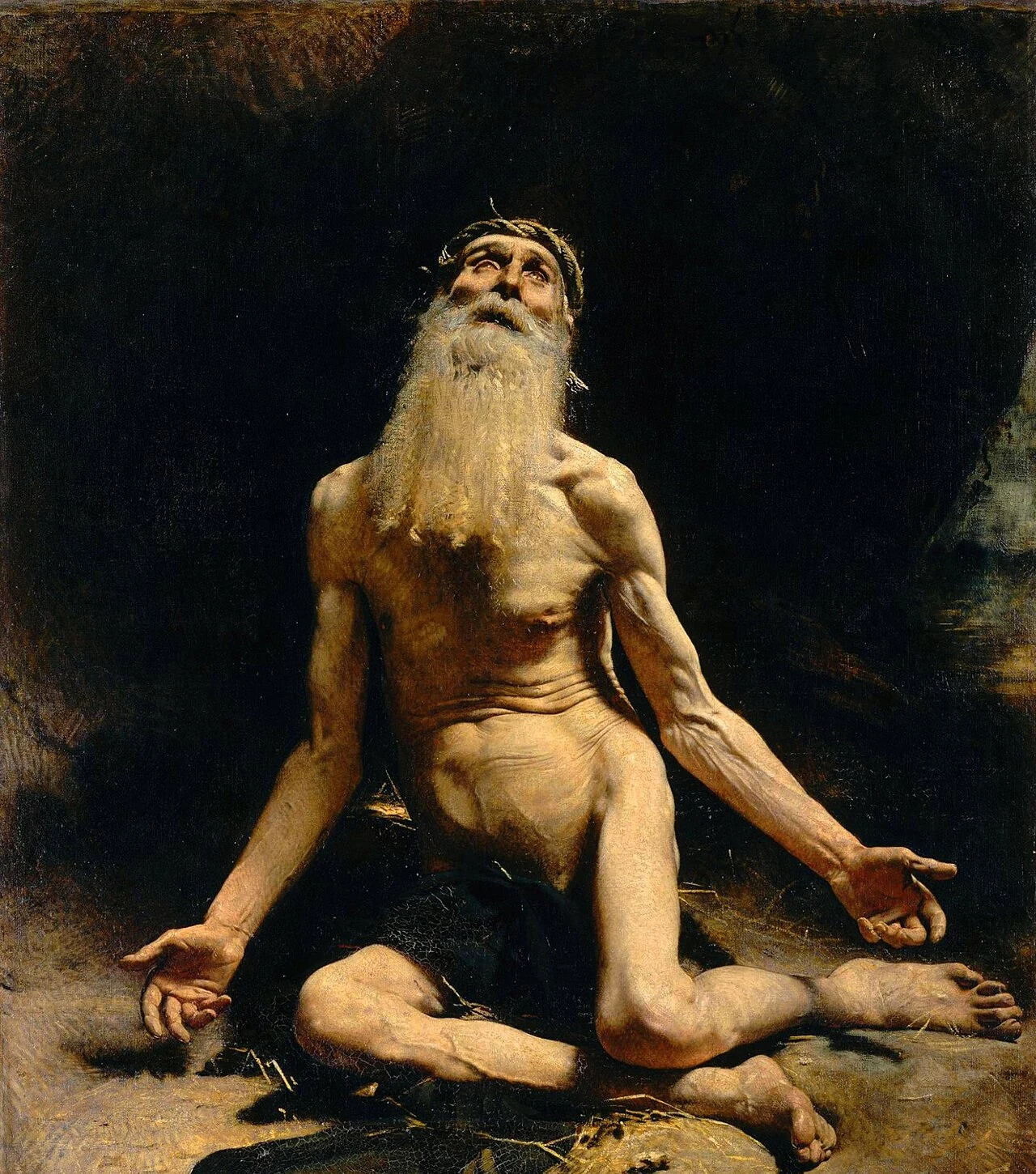
A masterpiece of physical suffering painted with academic precision. Job sits naked on the ground, skin erupting with sores, eyes raised to heaven, not in prayer but in accusation. The anatomy is unflinching: every rib visible, every sore rendered. Bonnat used the Salon technique (normally reserved for idealized nudes) to paint a destroyed body. The technical beauty of the rendering and the horror of the subject create an unbearable tension. Beauty serving ugliness.
Georges de La Tour — "Job and His Wife" (c. 1630s)
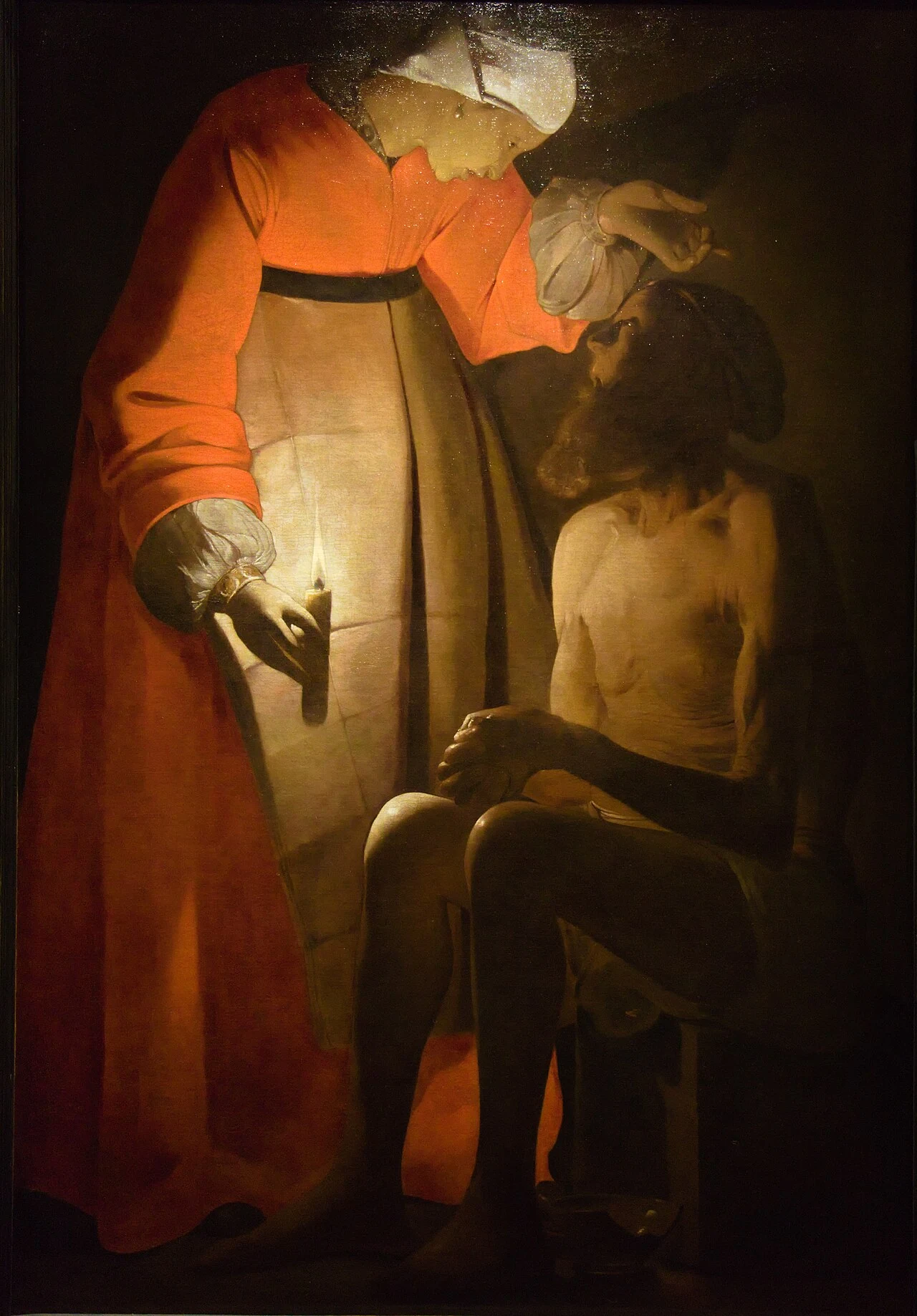
A candlelit scene: Job's wife stands over him, holding a candle, her face a mix of compassion and impatience. She's the one who told him to "curse God and die", she wanted his suffering to end, even if it meant giving up. La Tour paints her not as a villain but as someone who loves Job and can't bear to watch anymore. The candlelight makes the scene intimate, a private conversation between two people about whether to keep going.
William Blake, "Job" illustrations (1826)
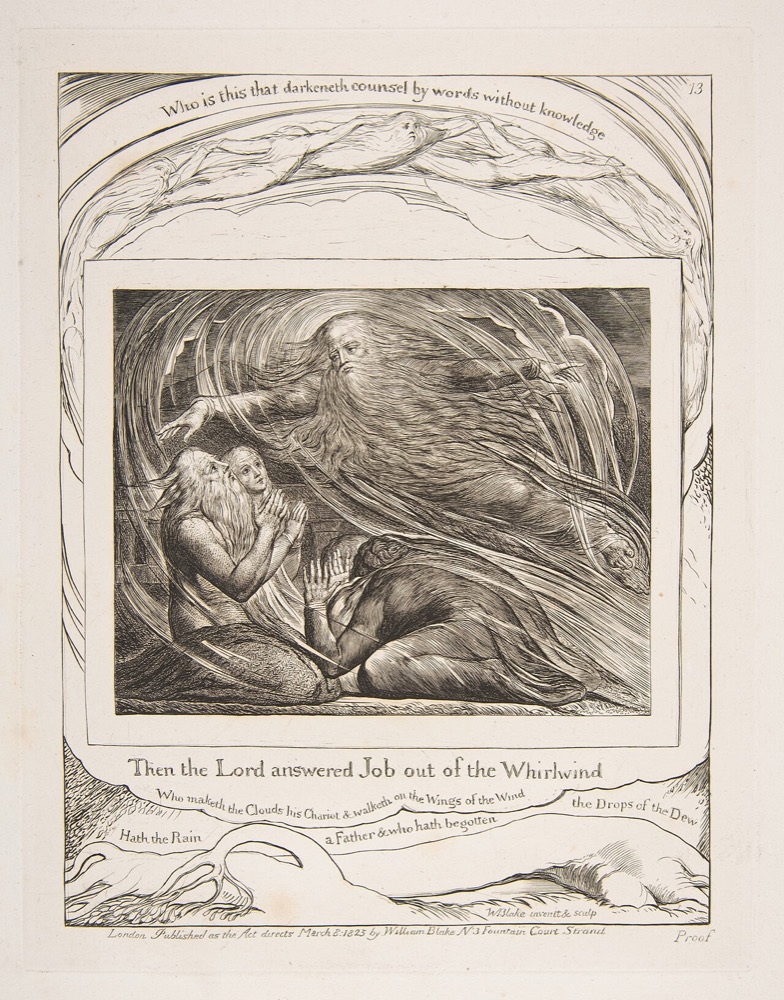
Blake made 22 engravings for the Book of Job, his late masterwork. The most powerful: the image of God answering Job from the whirlwind, arms spread, pointing at the cosmos. "Where were you when I laid the foundations of the earth?" Blake's God isn't comforting — He's VAST. The answer to suffering isn't an explanation; it's a confrontation with scale. Blake understood that the story's resolution isn't intellectual (there IS no explanation) but experiential: you encounter something so large that your suffering, while real, is placed in a context that dwarfs it.
The Human Truth · 2026
Job is the story for anyone who has suffered without deserving it, which is almost everyone, eventually. The illness that strikes the healthy person. The accident that changes a life in a second. The layoff after years of loyalty. Job's friends are the people who say "everything happens for a reason", the modern comforters who can't sit with meaningless suffering, who NEED it to make sense. Job's radical act is refusing to pretend. He says: I did nothing wrong. This is unjust. And no one, not even God, gives him a satisfying explanation.
For your painting: A person in a hospital waiting room, or sitting in the wreckage after a disaster, or alone after a diagnosis. The friends who offered explanations have left. The room is empty. The person remains — with their suffering and their refusal to lie about it. Paint the silence after the comforters leave. That silence is where honesty lives.
Story 9
Ruth & Naomi
Chosen loyalty · Immigrant's courage · Love beyond obligation
The Story
Naomi, a Jewish woman living in Moab, loses her husband and both sons. She decides to return to Bethlehem and tells her daughters-in-law to go back to their own families. One does. Ruth refuses: "Where you go, I will go; where you stay, I will stay. Your people will be my people, and your God my God." Ruth, a foreigner with no obligation to stay, chooses to follow Naomi into poverty and uncertainty, out of pure love.
Why Painters Use It
This is the most beautiful statement of voluntary loyalty in all of scripture, chosen family, not obligated family. Ruth has every reason to leave. She stays because she loves Naomi. The story is also the foundational immigrant narrative: Ruth goes to a foreign land where she's a stranger, gleans in fields for scraps, and eventually builds a life. She becomes an ancestor of King David and, in Christian tradition, of Jesus. The outsider who stays becomes essential to the lineage.
Philip Hermogenes Calderon, "Ruth and Naomi" (1886)
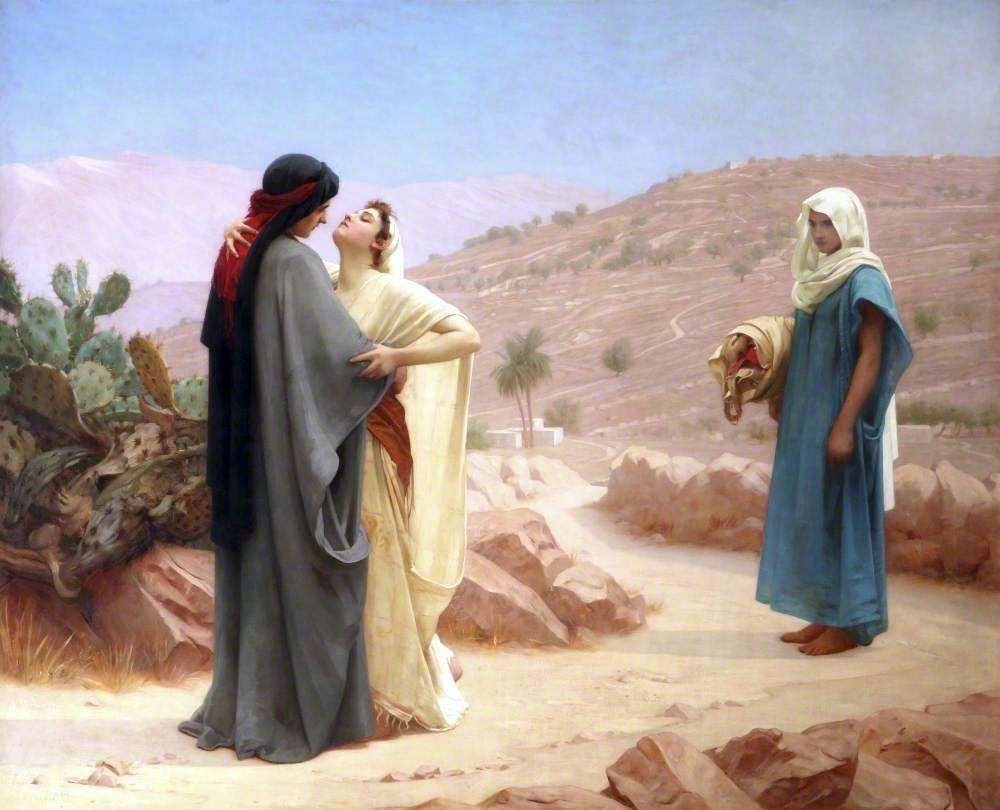
The definitive moment: Ruth clings to Naomi while Orpah (the other daughter-in-law) walks away in the background. The composition splits into two choices: stay or go. Ruth's body presses against Naomi's — not just emotionally but physically supporting the older woman. Orpah's retreating figure is small, already distant. Calderon paints the geometry of a decision: one figure moving toward, one moving away, and the person in the middle who is the reason for both.
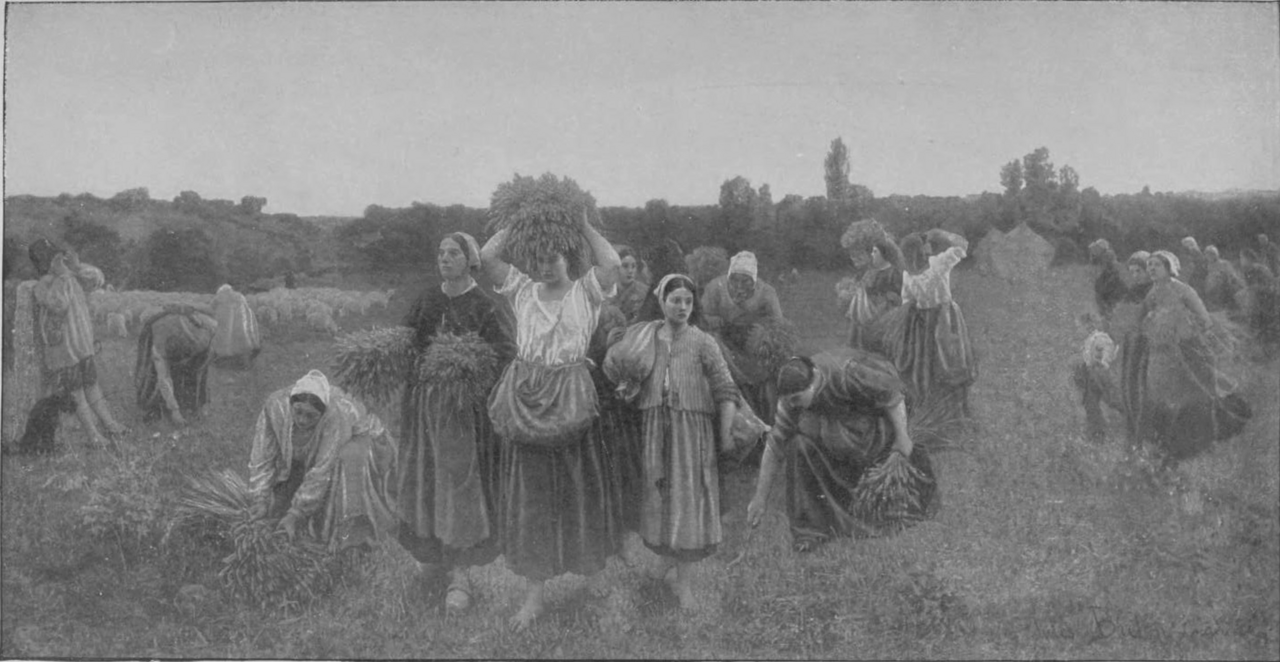
Jules Breton, "The Gleaner" (1877)
Not Ruth specifically, but the gleaning tradition that Ruth embodies: a solitary woman gathering leftover grain in a harvested field. Breton paints her at sunset, standing tall despite the humble work, dignified in her poverty. The painting is about the grace of surviving through labor that others consider beneath them. Ruth gleaned in Boaz's fields as a foreigner picking up scraps, and from that position of maximum vulnerability, she built a life.
James Tissot, "Ruth and Boaz" (c. 1896-1902)
Tissot painted the entire Bible in watercolor late in life, traveling to the Middle East for accuracy. His Ruth is sun-browned, working hard, realistic, not the idealized beauty of earlier versions. She gleens in actual light, with actual dust. Tissot brought a journalist's eye to biblical scenes, and the ordinariness of his Ruth — a real woman doing real work, is what makes her dignity visible.
The Human Truth · 2026
Chosen family is often stronger than blood family. Ruth's "where you go, I will go" is the vow of every friendship that outlasts the relationships it grew from, the friend who stays after the divorce, the caregiver who chooses to be there, the person who follows you into your worst chapter not because they have to but because they love you. Ruth is also the immigrant story: a foreigner who arrives with nothing, gleans leftover grain (the most humble labor), and builds a life through loyalty, work, and the willingness to start from zero.
For your painting: Two people at an airport, a border, a hospital door, one choosing to walk through it with the other when they could walk away. Or: a person gleaning in a modern field, the immigrant picking fruit, the day laborer waiting for work, the mother collecting cans. Paint the dignity in the labor and the love in the choosing.
Story 10
The Annunciation
The terrifying "yes" · Life interrupted · Saying yes to something you don't understand
The Story
The angel Gabriel appears to Mary — a young woman, probably a teenager, and tells her she will conceive a child by the Holy Spirit. She's afraid. She asks how this can be. Gabriel answers. And Mary says: "Let it be done to me according to your word." She says yes to something she doesn't understand, something that will upend her life, something she didn't ask for, and in that yes, everything changes.
Why Painters Use It
The Annunciation has been painted more times than almost any other biblical scene, not because of theology but because of the MOMENT. It's the instant a life changes direction. The composition is always two figures: the messenger and the receiver. Between them: a space that is the decision itself. Mary's body language varies painting by painting, humble acceptance, startled terror, quiet resolve, even resistance. Every version is a different answer to the question: what does it look like when a person says yes to something enormous?
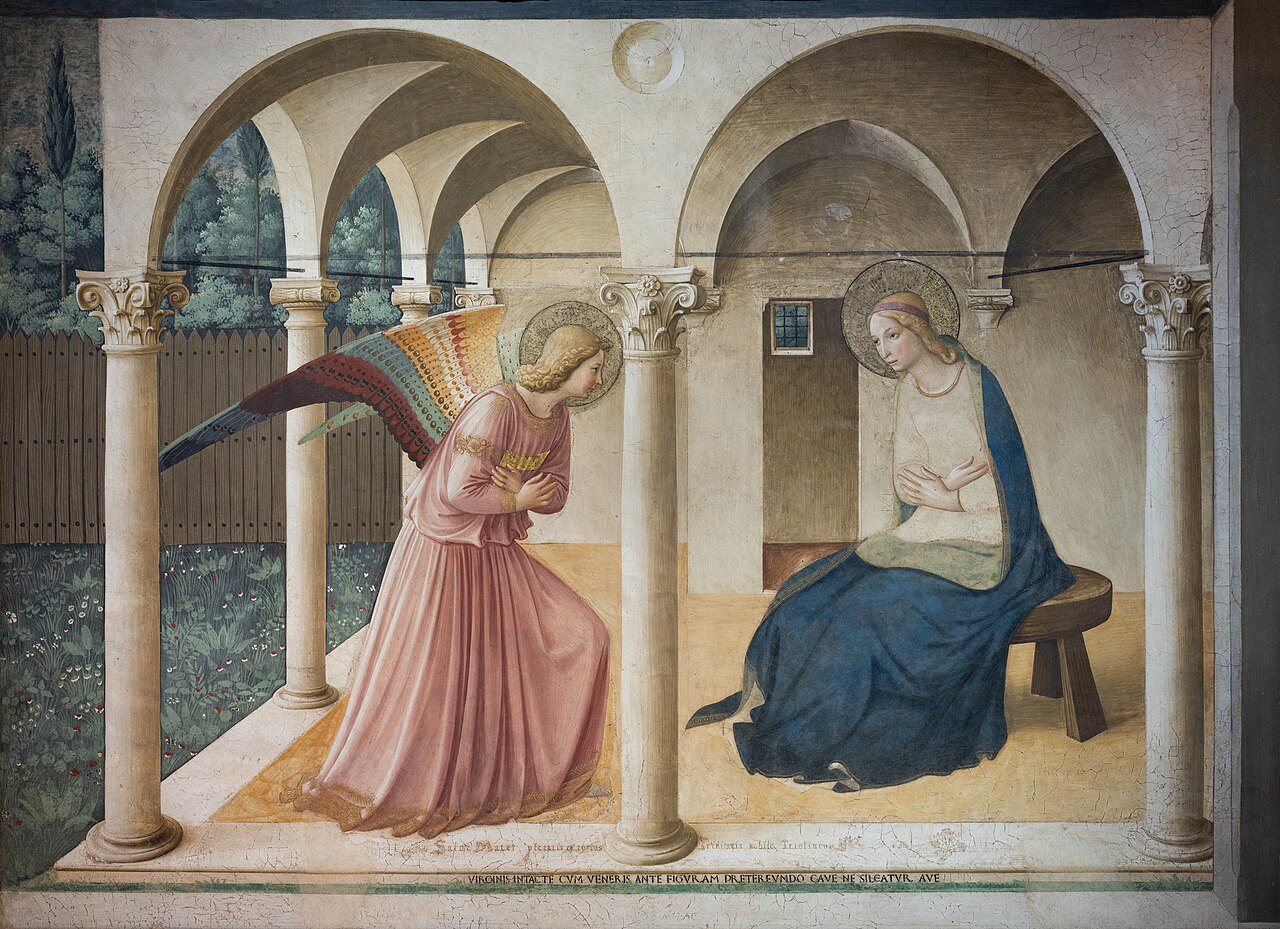
Fra Angelico — "The Annunciation" (c. 1440-45)
Pure serenity. The angel and Mary face each other under a loggia, both bowing slightly. Mary's hands are crossed on her chest, acceptance without resistance. The fresco is deliberately calm because Fra Angelico (a monk) painted the "yes" as inevitable, peaceful, ordained. This is the version where faith has no doubt. It's beautiful, and limited, because it removes the terror of the choice.
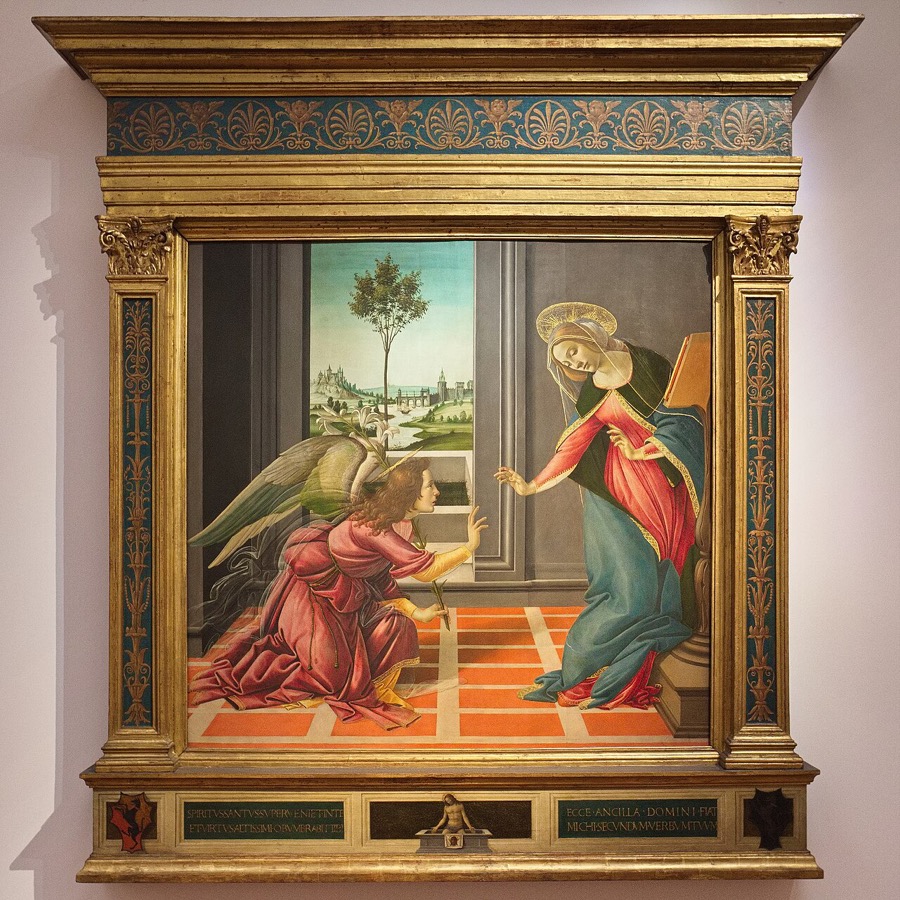
Botticelli, "The Annunciation" (1489)
Botticelli's Mary recoils. Her body bends backward, her hands rise as if to push the news away. The angel swoops in with dynamic energy, almost aggressive. This is the Annunciation as disruption: the news hits Mary like a wave, and her first instinct is to pull back. Botticelli paints the "yes" as something that comes AFTER the flinch, which makes it braver.
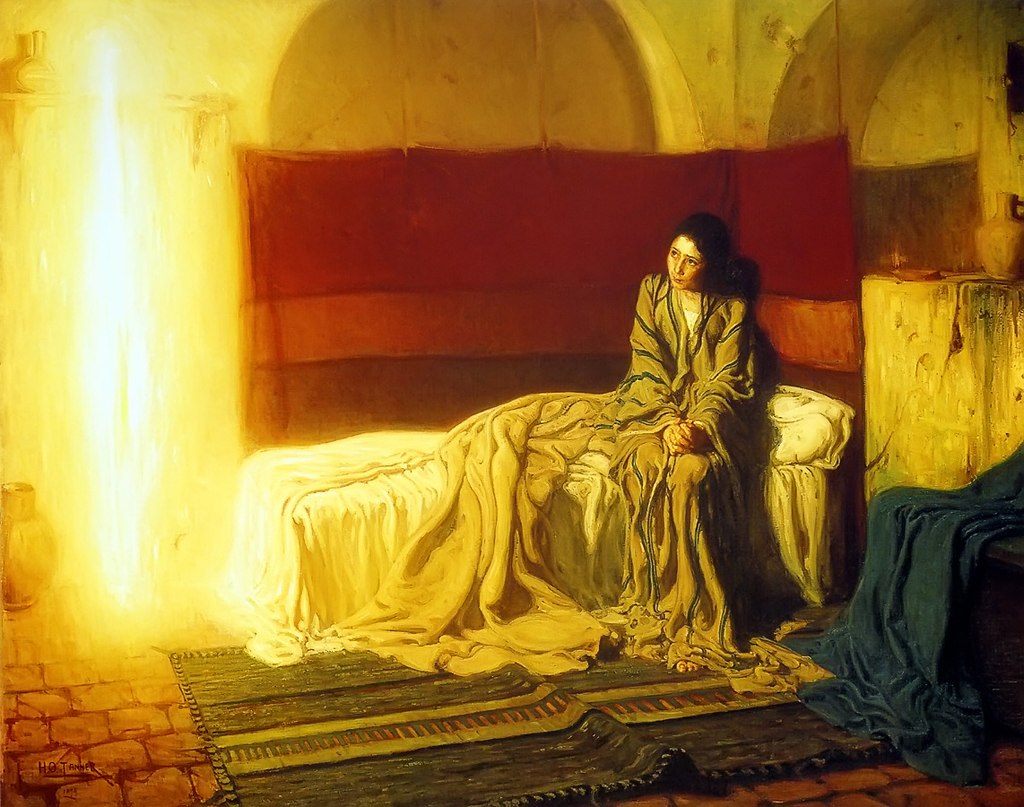
Henry Ossawa Tanner — "The Annunciation" (1898)
The most radical version. Mary is a real teenage girl, not idealized, not saintly, sitting on a rumpled bed in a plain room. The angel isn't a figure but a column of golden light. Tanner, an African American painter working in Paris, stripped every convention and asked: what would this actually look like? A young woman alone in her room, visited by something she can't explain. The painting feels like a photograph of a miracle. It's the version that makes the story real.
The Human Truth · 2026
Life pivots on moments of "yes." The pregnancy test. The phone call. The offer letter. The diagnosis. The knock on the door. Mary's Annunciation is the archetype of every moment when something arrives, uninvited, enormous, terrifying, and you have to decide whether to accept it. The courage isn't in the doing. The courage is in the saying YES before you understand what you're saying yes to. Every parent, every immigrant, every person who started something bigger than themselves has lived this moment.
For your painting: A person in the instant between hearing and deciding — the pregnancy test in hand, the acceptance letter on the screen, the phone still at the ear. Paint the SPACE between the news and the response. Tanner's version (a real teenager on a rumpled bed, the angel as a column of light) is the template: strip away everything except a person and the thing that just changed their life.
Story 11
The Prodigal Son
Homecoming · Unconditional mercy · The resentment of the "good" one
The Story
A man has two sons. The younger demands his inheritance early (essentially saying "I wish you were dead"), leaves home, and wastes everything on reckless living. He ends up broke, starving, feeding pigs. He decides to go home and beg to be a servant. But his father sees him coming from far off, runs to him (a dignified patriarch RUNNING, this shocked the original audience), embraces him, and throws a feast. The older brother, who stayed loyal and worked hard, is furious: "I did everything right and you never threw a party for me."
Why Painters Use It
The return is one of the most painted scenes in Western art because it contains THREE psychologies in one frame: the broken son who doesn't deserve mercy, the father who gives it anyway, and the "good" brother who resents the mercy. Most people identify with the prodigal, but the painting gets interesting when you realize you might be the older brother, the one who did everything right and still feels cheated. The story is about whether love is earned or given, and neither answer is comfortable.
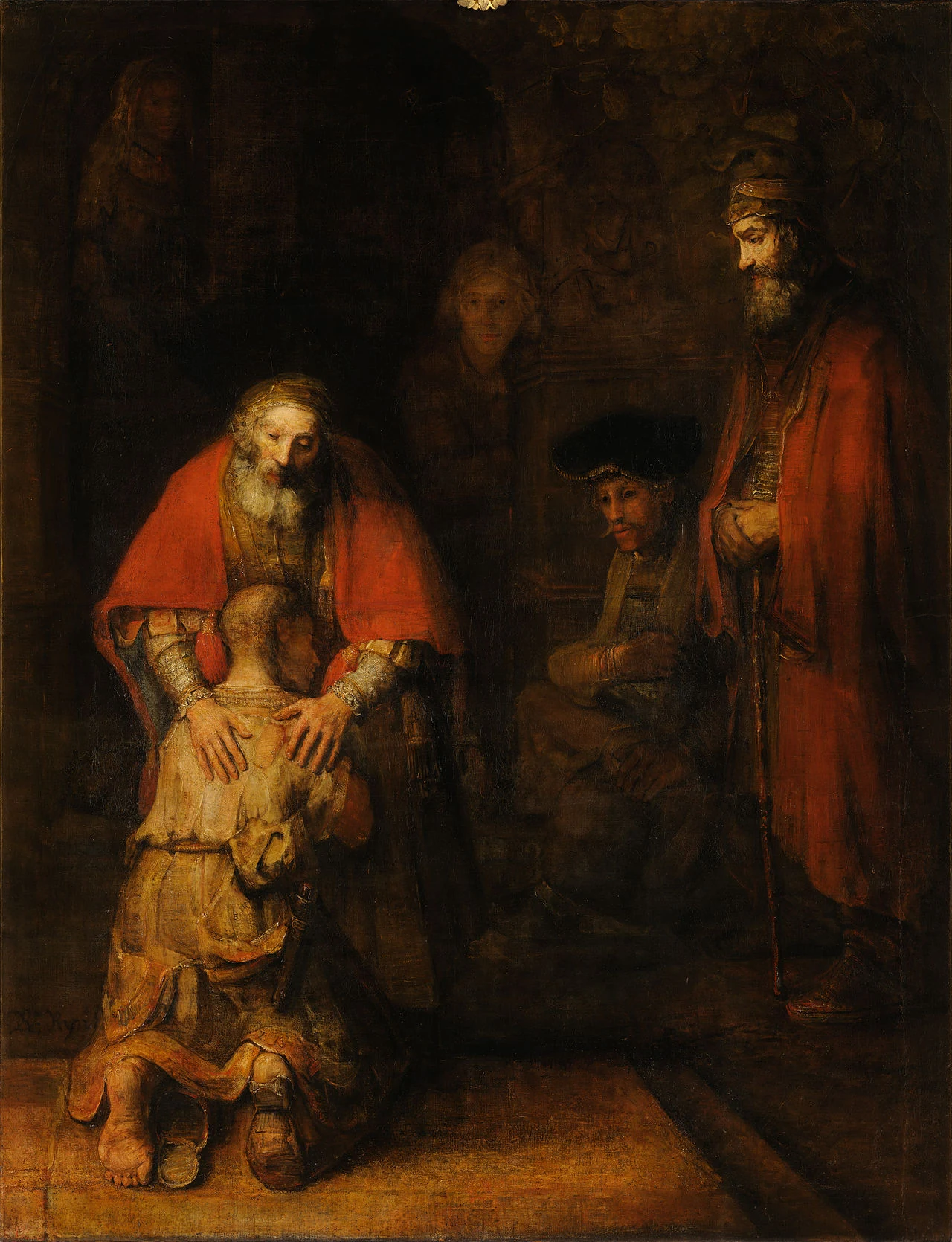
Rembrandt, "Return of the Prodigal Son" (c. 1669)
Arguably the greatest painting of mercy ever made, and Rembrandt's last major work. The son kneels, head pressed against his father's chest, shoes worn through, scalp shaved (a sign of degradation). The father's hands rest on the son's back — and look carefully: one hand is large and strong (masculine), the other is smaller and gentle (feminine). Rembrandt gave the father the hands of both a father and a mother. The surrounding figures watch from shadow: the older brother stands rigid at the right edge, his face unreadable. The light falls only on the embrace. Everything else is darkness. Mercy is the only source of illumination.
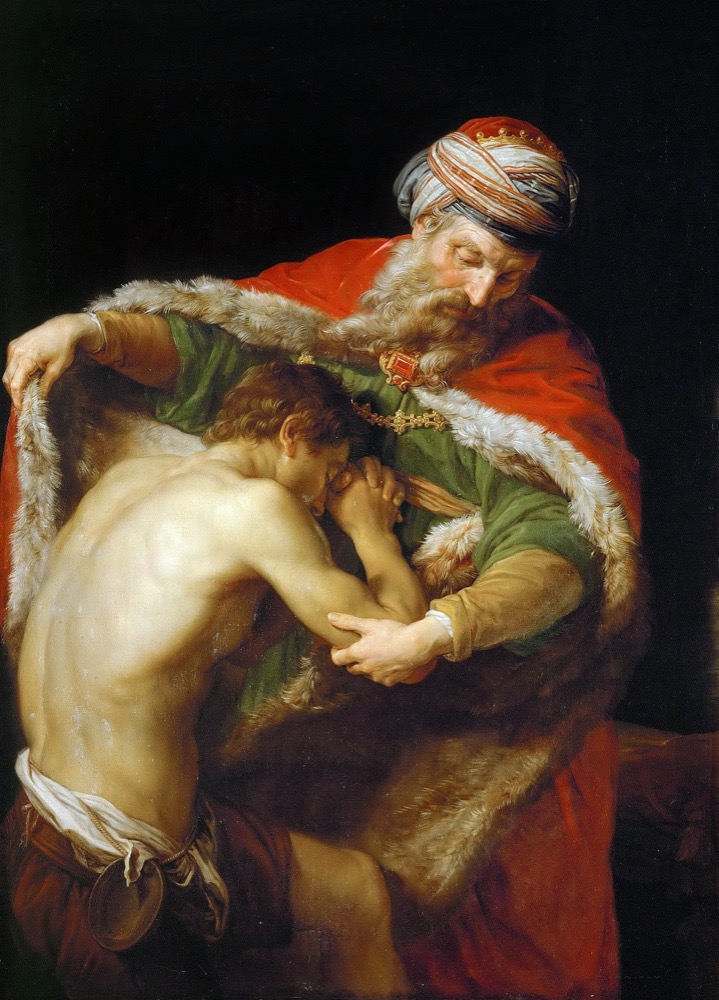
Pompeo Batoni, "Return of the Prodigal Son" (1773)
Where Rembrandt's version is dark and interior, Batoni's is bright and theatrical, the father in rich robes, the son half-naked, servants rushing to bring a new garment. Batoni paints the celebration: the feast being prepared, the ring being brought. It's the AFTER to Rembrandt's DURING. The comparison is useful: same story, completely different emotional register. Rembrandt paints the private moment of forgiveness; Batoni paints the public restoration of dignity.
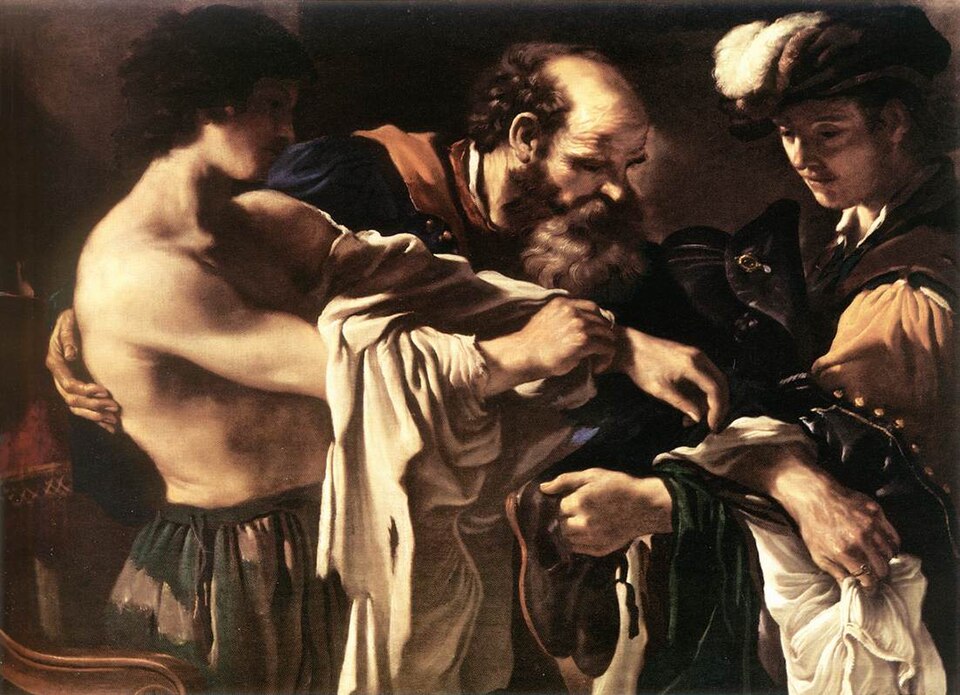
Guercino, "The Return of the Prodigal Son" (1619)
Guercino paints the moment of physical contact: the father's arms around the kneeling son, their bodies merged. The dog, wagging, excited — is the emotional truth-teller: it doesn't judge, it just recognizes someone coming home. Guercino's palette is warm, almost golden. Where Rembrandt's version is about mercy in darkness, Guercino's is about mercy in warmth. The homecoming as sunlight.
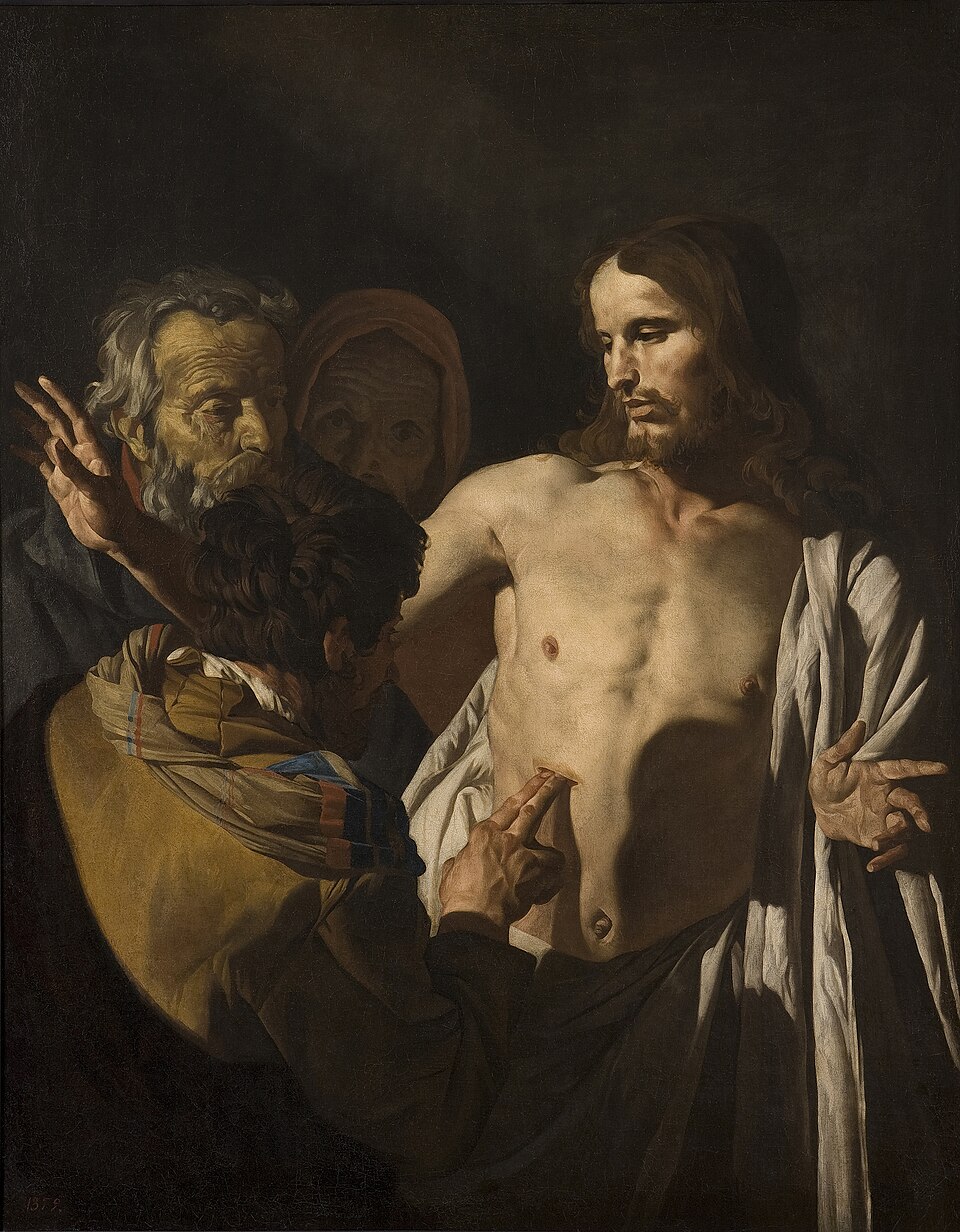
Matthias Stomer, "The Incredulity of St. Thomas" (c. 1641-49)
Stomer, a Caravaggist working in candlelight, paints the scene with a single light source that illuminates Christ's chest and Thomas's reaching hand. The other figures are in deep shadow, witnesses to a private act of verification. The candlelight makes the wound-touching feel intimate, almost surgical. In Stomer's version, doubt isn't a public challenge, it's a private, tender investigation conducted in near-darkness.
The Human Truth · 2026
Three people, three experiences of the same love. The prodigal knows undeserved mercy, the relief of being accepted after failing spectacularly. The father knows unconditional love — the choice to run toward the person who hurt you. The older brother knows the injustice of grace, the rage of watching someone get forgiven for things you'd never be forgiven for. Most people identify with the prodigal. The honest painting shows you're the older brother: the one who did everything right and still feels cheated when someone else receives love they didn't earn.
For your painting: A doorway. Someone standing in it, returned from rehab, prison, estrangement, years of silence. A parent moving toward them. And the sibling watching from the kitchen, arms crossed, face holding everything. Three figures, three expressions, one threshold. Paint all three psychologies. The painting's tension is in the third figure, the one who stayed.
Story 12
Saul Becomes Paul
Radical transformation · The persecutor becomes the advocate · Being knocked off your path
The Story
Saul is a zealot, a Pharisee who hunts down and imprisons Christians. He's on the road to Damascus, carrying arrest warrants, when a blinding light knocks him to the ground. A voice: "Saul, Saul, why do you persecute me?" He's struck blind for three days. When his sight returns, he's a different person. He takes the name Paul and becomes the most important advocate for the faith he was trying to destroy. The man who held coats at the stoning of Stephen becomes the man who writes most of the New Testament.
Why Painters Use It
The conversion on the road to Damascus is the archetype of sudden, total transformation — the person who was going one direction getting knocked flat and sent the other way. It's not gradual growth. It's rupture. Painters love the physical image: a man thrown from his horse by light. But the deeper subject is what happens inside someone who realizes they've been completely wrong about the most important thing in their life. The certainty that was driving them turns out to be the thing that was blinding them.
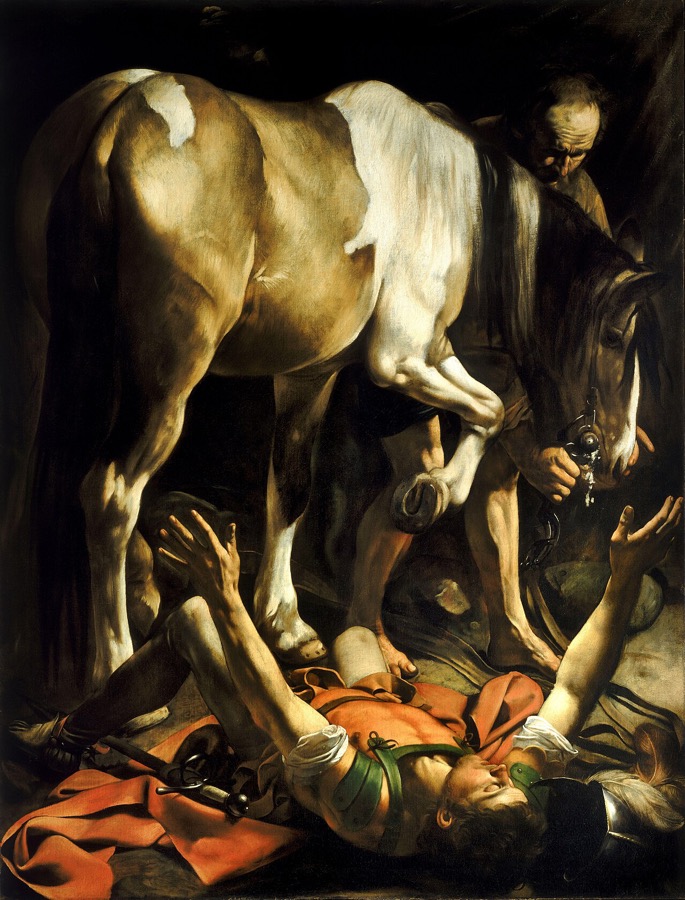
Caravaggio, "Conversion on the Way to Damascus" (1601)
The most daring composition: the HORSE dominates the painting, its massive body fills the upper half. Saul is on the ground beneath it, arms outstretched, eyes closed, bathed in light from outside the frame. There's no visible angel, no voice, no sky opening. Just a man knocked flat by something invisible. The groom holds the horse, unbothered, the miracle is invisible to everyone except Saul. Caravaggio understood that transformation is a private event that happens in public, and nobody around you knows it's happening.
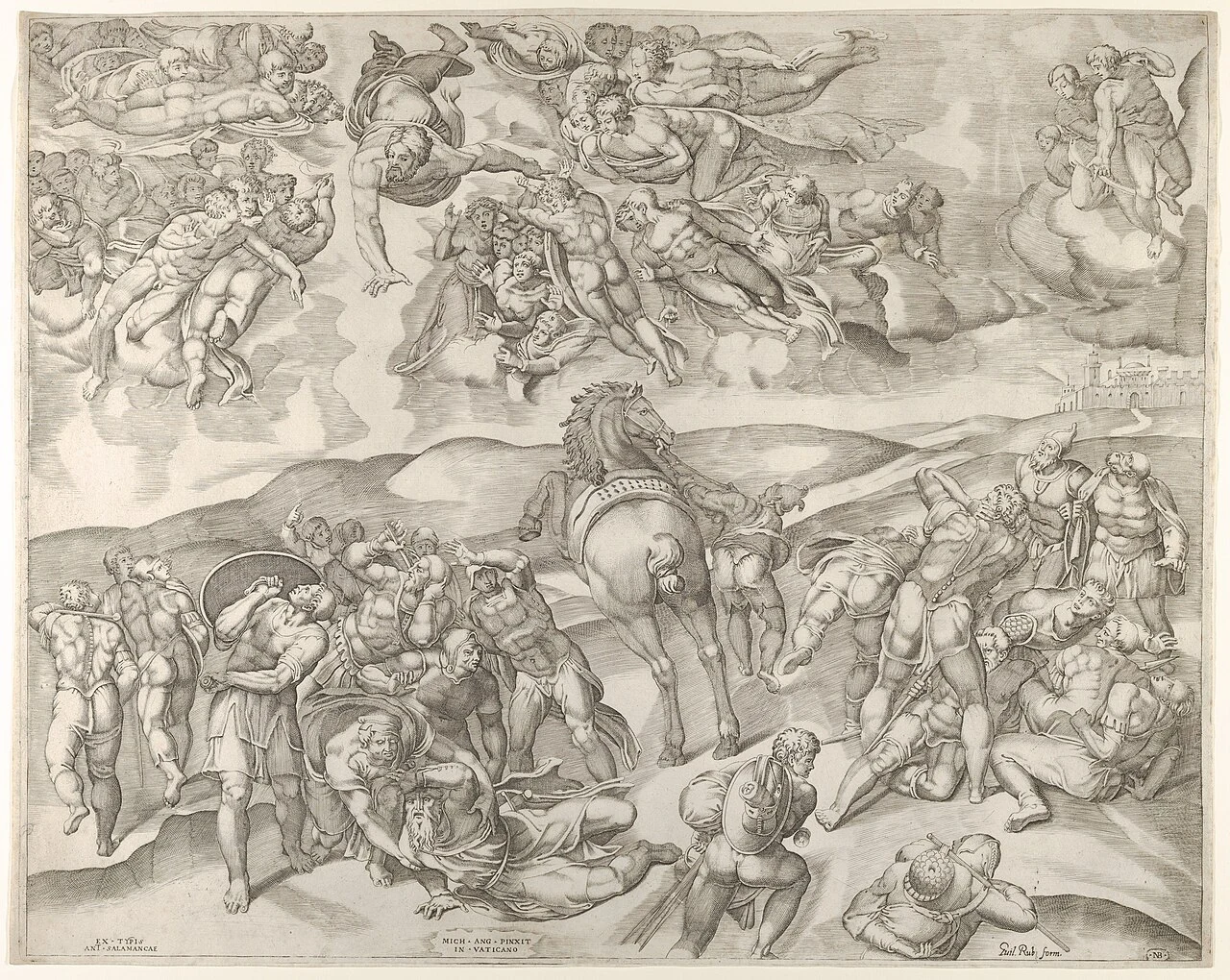
Michelangelo, "Conversion of Saul" (1542-45)
Michelangelo's version in the Pauline Chapel is cosmic: Christ descends from heaven in a shaft of light, surrounded by angels, while soldiers scatter and the horse rears. Saul is an old man (Michelangelo was 67), face-down, overwhelmed. Where Caravaggio's version is intimate and mysterious, Michelangelo's is LOUD — the entire cosmos reorganizing itself around one man's transformation. Both are true: transformation can feel like a private whisper or a cosmic earthquake.

Rubens, "The Conversion of St. Paul" (c. 1610-12)
Rubens paints the maximum-action version: horse rearing, soldiers tumbling, Saul falling, light exploding. It's cinematic, physical, violent. But the detail that makes it a Rubens and not just an illustration: Saul's body is caught MID-FALL. He's between the horse and the ground, between his old identity and his new one, suspended in the air for one instant. The transformation is literally in progress, he hasn't landed yet.
The Human Truth · 2026
Transformation is violent. It doesn't happen gradually, it happens when everything you believed is shattered in an instant. The political partisan who suddenly sees the other side. The doctor who becomes a patient. The prosecutor who realizes the system they serve is broken. Saul's conversion isn't about finding God, it's about the experience of being COMPLETELY WRONG about the most important thing in your life. The light that knocks him down isn't divine — it's the light of recognition. The ground rushing up to meet him is the floor of every certainty he built his identity on.
For your painting: A person on the ground, literally or metaphorically knocked flat. The old certainty shattered, the new understanding not yet formed. Paint the BETWEEN: no longer who they were, not yet who they'll become. Blind. On the road. The horse (Caravaggio's genius) is enormous above them, the momentum of their old life still moving while they've stopped.
Story 13
The Good Samaritan
Mercy from the "wrong" person · Who is my neighbor? · Compassion across tribal lines
The Story
A man is robbed and beaten and left for dead on the road. A priest walks by, sees him, crosses to the other side. A Levite (a temple official) does the same. Then a Samaritan comes along. Samaritans were despised by the Jewish audience hearing this story, they were the "other," the wrong tribe, the enemy. The Samaritan stops, tends the wounds, puts the man on his own donkey, pays for his care at an inn. Jesus' question: "Which of these three was a neighbor to the man?"
Why Painters Use It
The story's power comes from WHO helps and WHO doesn't. The "right" people (the priest, the Levite — the respectable, religious, same-tribe people) walk past. The "wrong" person (the Samaritan, the outsider, the enemy) stops. This story is about compassion that crosses tribal boundaries and the failure of those who should have helped. In 2026, substitute any group identity for "Samaritan" and the story updates itself instantly.
Rembrandt, "The Good Samaritan" (1633, etching)
Rembrandt chose the arrival at the inn, the practical aftermath of compassion. The Samaritan lifts the wounded man from his donkey while the innkeeper watches. It's not the dramatic rescue; it's the unsexy follow-through: paying for the room, doing the logistics of care. Rembrandt understood that mercy is not the moment of pity but the work that comes after.
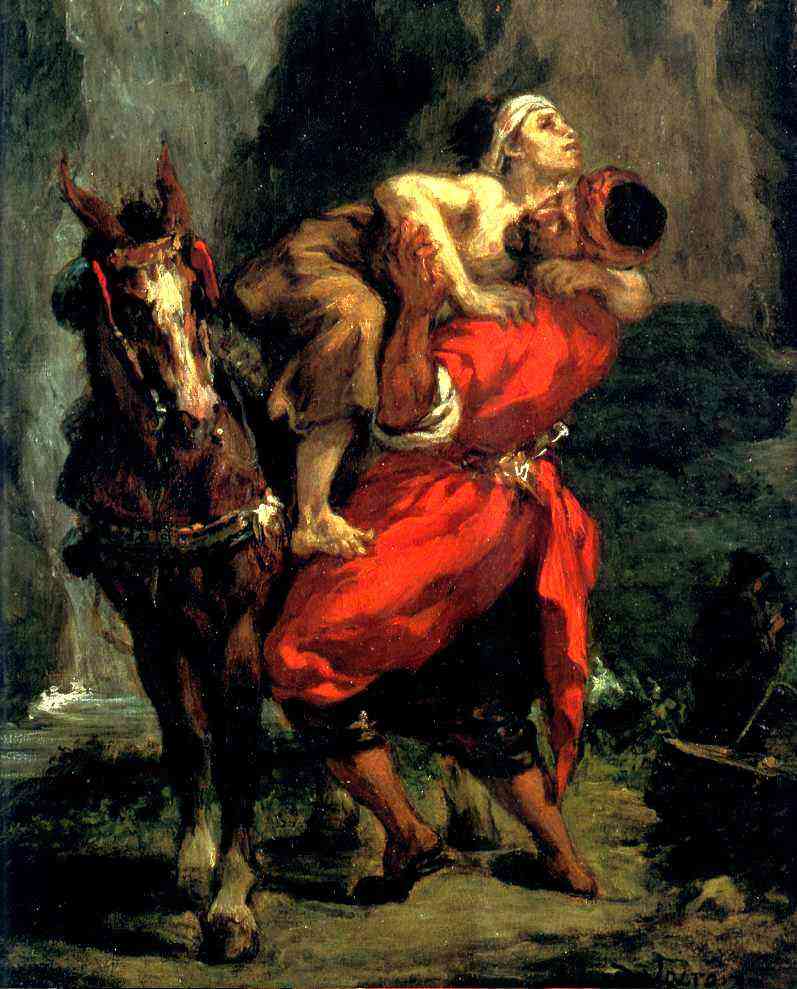
Delacroix — "The Good Samaritan" (1849)
Delacroix paints the physical labor of mercy: the Samaritan strains to lift the wounded man onto the horse, muscles engaged, body braced. This is compassion as EFFORT. It's heavy. It costs the Samaritan something, energy, time, money, risk. Delacroix doesn't sentimentalize the act; he shows what it takes from the body of the person who chooses to help.
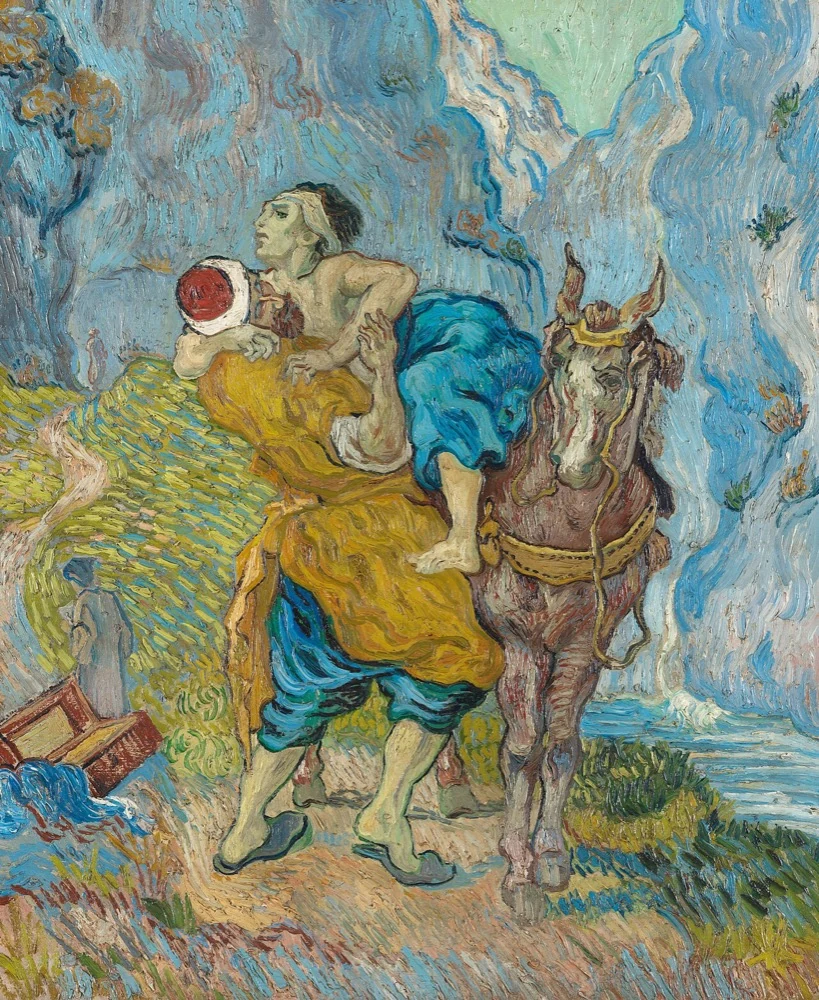
Van Gogh, copy after Delacroix (1890)
Van Gogh copied Delacroix's version from the asylum at Saint-Rémy, translating it into his swirling brushwork and heightened color. Why did a man in a mental institution choose to copy THIS painting? Because Van Gogh identified with the wounded man, and with the hope that someone might stop. The copy becomes autobiography: a painter in crisis, painting someone being rescued.
The Human Truth · 2026
The story isn't really about the Samaritan. It's about the priest and the Levite, the "good" people who walked past. They had reasons. They were busy. They had obligations. They didn't want to get involved. They thought someone else would stop. This is the most common moral failure in human history: not cruelty, but avoidance. The Samaritan's radicalism isn't that he's kind — it's that he's kind across a tribal boundary, to someone his community told him to hate. Compassion that only extends to "your people" isn't compassion. It's tribalism with a gentle face.
For your painting: Someone on a sidewalk. The people who walk past, in suits, in activewear, looking at phones. The person who stops is from the "wrong" group. This is the Seattle deep dive's Variant 4 (The Walk Past) seen through biblical eyes. The painting asks: who actually stopped? And: which figure in the painting are you?
Story 14
The Pietà
A parent holding their dead child · Grief beyond words · Love that outlasts death
The Story
After the crucifixion, Jesus' body is taken down from the cross and placed in his mother Mary's arms. She holds him, the baby she nursed, the child she raised, the man she watched die. The Pietà isn't a biblical scene (it's not described in the Gospels). It's an image the tradition invented because it NEEDED it, the image of a mother's grief over her child's body.
Why Painters Use It
The Pietà is the most universal image of grief in Western art. You don't need to be Christian to understand a parent holding a dead child. The form itself, one figure cradling another — carries the emotion without any theological knowledge. This is why it has been adapted endlessly: the soldier and the fallen comrade, the EMT and the overdose victim, the parent at the hospital. The composition IS the meaning. Anywhere one person holds another who is broken, you're painting a Pietà.
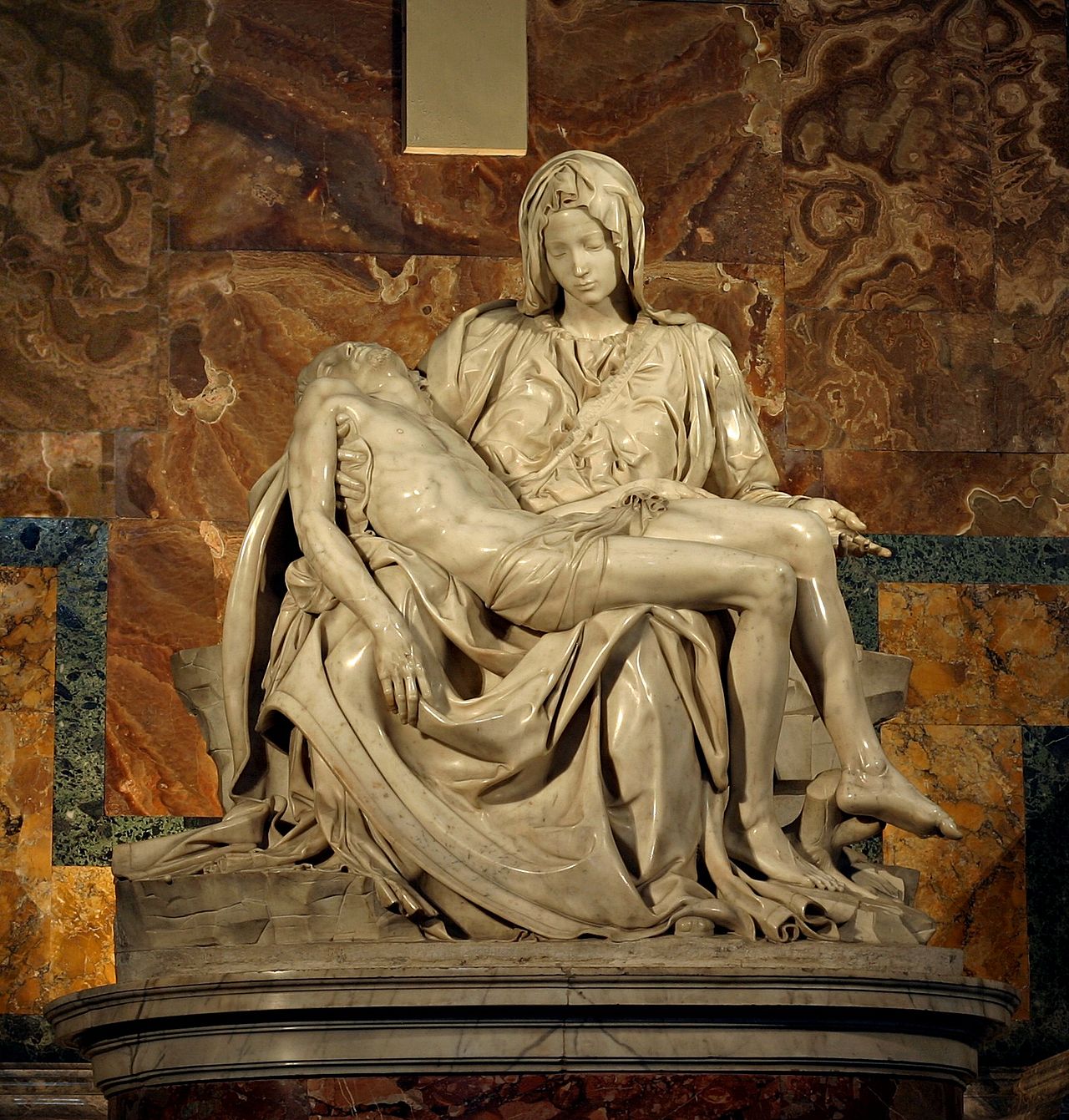
Michelangelo, "Pietà" (1498-99, sculpture)
The definitive version. Mary holds the body of Christ across her lap, but she's impossibly young, younger than her son. Michelangelo explained: "Do you not know that chaste women stay fresh much longer?" But the real reason is emotional, not theological: the youth makes her grief more devastating. She looks like she could be his sister, his bride. The body is limp in a way that only dead bodies are, Michelangelo studied anatomy to get the specific weight of death right. Every limb hangs without resistance.

Bouguereau, "Pietà" (1876)
Where Michelangelo's Mary is calm and beautiful, Bouguereau's is DESTROYED. Her head is thrown back, eyes red, mouth open. Angels surround her but she's beyond comfort. Bouguereau had just lost his own son when he painted this — the grief is autobiographical. The technical perfection (this is Bouguereau at his most skilled) makes the rawness worse: every tear, every swollen eyelid, rendered with masterful precision. Beauty serving devastation.
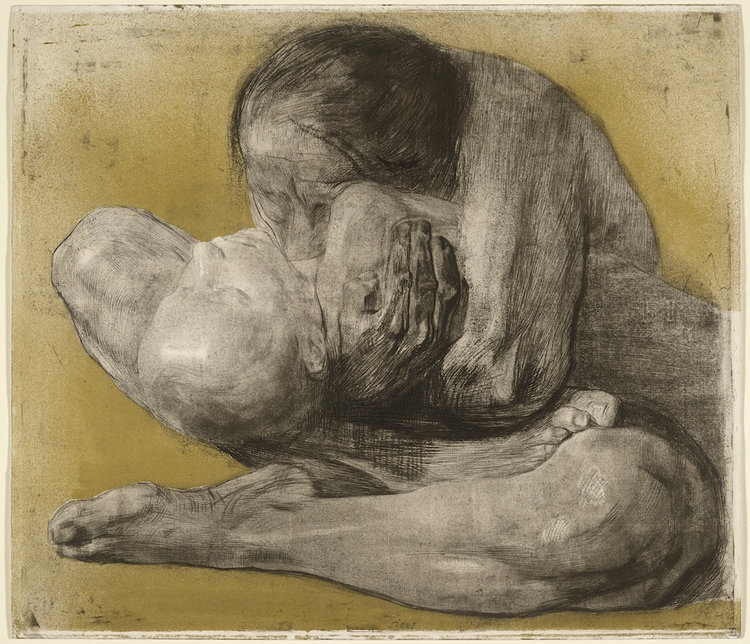
Käthe Kollwitz, "Woman with Dead Child" (1903, etching)
Kollwitz strips the Pietà to its essence: a mother clutching a dead child to her chest, face buried in the body. No setting, no angels, no cross. Just the two bodies and the grip. Kollwitz made her own body the model, she photographed herself holding her son (alive, posing) to get the posture right. The etching is nearly abstract in its reduction: grief as a single shape, a mother curled around an absence.
The Human Truth · 2026
The Pietà is the most universal image in art because it requires no context, a person holding someone they love who is broken or dead. You don't need to know who Jesus is. You don't need to be religious. You need to have loved someone who suffered, and to have held them knowing you couldn't fix it. Every parent at a hospital bedside. Every EMT cradling an overdose. Every person who has held another person while they cried. The Pietà isn't Christian. It's human. It's the shape your body makes when the person you love is destroyed and all you can do is hold them.
For your painting: See the Seattle deep dive's Variant 6 for the modern Pietà transposed to Third Avenue. Or: any scene of one person holding another, the parent at the ICU, the friend at the funeral, the stranger who stops. The composition is always the same: one body supporting another. The technique (Bouguereau's raw grief, Kollwitz's stripped-to-essence) is what makes each version new.
Story 15
Doubting Thomas
Needing proof · The courage to doubt · Touch as knowledge
The Story
After the resurrection, Jesus appears to the disciples — but Thomas isn't there. When they tell him, he says: "Unless I see the nail marks in his hands and put my finger where the nails were, I will not believe." A week later, Jesus appears again and says to Thomas: "Put your finger here; see my hands. Stop doubting and believe." Thomas touches the wound.
Why Painters Use It
Thomas is the patron saint of skeptics, the person who needs evidence, not testimony. In a world of misinformation, fake images, and manufactured reality, Thomas's insistence on physical proof feels more relevant than ever. The painting moment is the touch: a finger entering a wound. Caravaggio painted it with an almost medical precision, it's intimate, uncomfortable, necessary. The painting asks: what does it take to believe something? How much proof is enough?
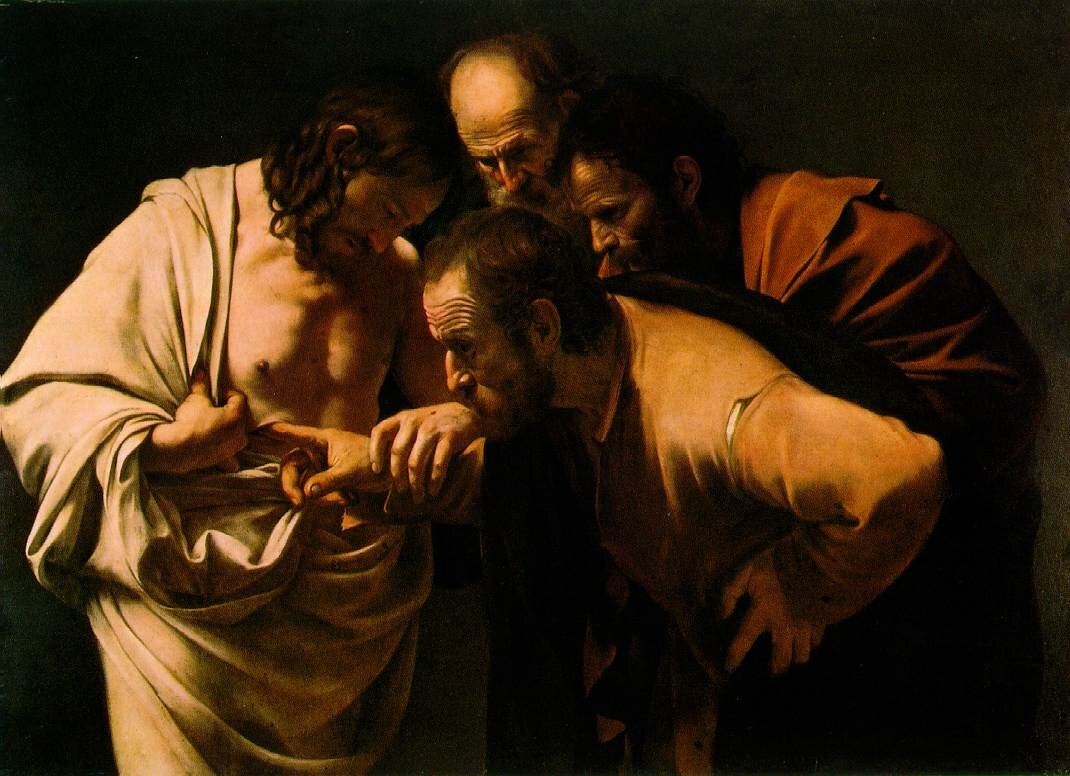
Caravaggio, "Incredulity of Saint Thomas" (c. 1602)
Three heads crowd in to watch as Thomas pushes his finger into the wound in Christ's side. The intimacy is almost medical, the skin parts, the finger enters, the other disciples lean in with a mixture of fascination and horror. Caravaggio made doubt PHYSICAL. You can feel the texture of the wound. The painting argues that belief isn't intellectual — it's bodily. You have to touch the thing to know it's real. In the age of screens and deepfakes, this painting has never been more relevant.
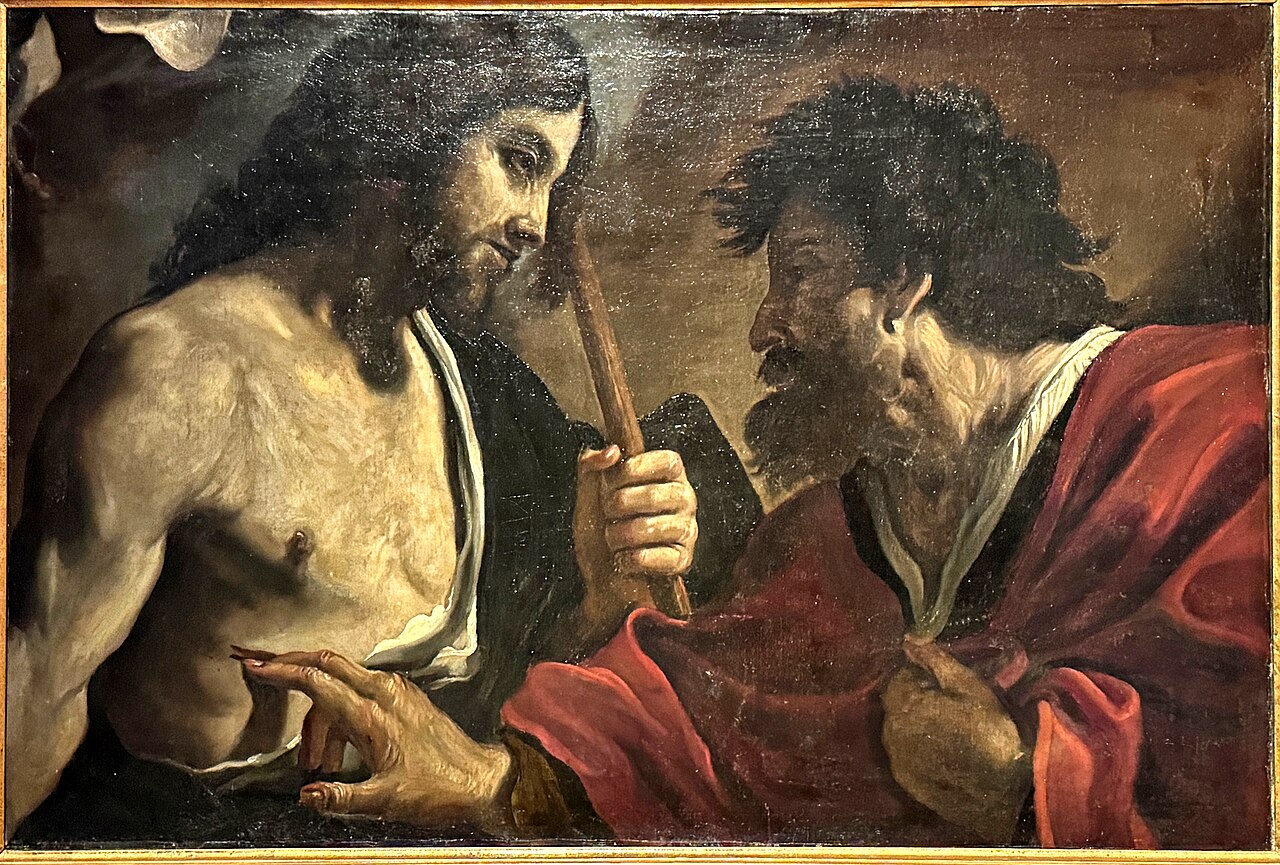
Guercino, "The Incredulity of Saint Thomas" (1621)
Guercino's version is gentler: Christ guides Thomas's hand toward the wound. The gesture is tender, teacher leading student, not confrontation. Thomas's face shows not skepticism but awe. Guercino paints doubt not as a failure of faith but as the beginning of deeper understanding. The painting says: doubting is how you get to knowing. The hand that reaches toward the wound is the hand of someone who cares enough to verify.
The Human Truth · 2026
We live in the age of Thomas. Everything is mediated, screens, algorithms, curated feeds, and the hunger for something REAL, something you can touch and verify, has never been more intense. Thomas isn't weak for doubting. He's honest. He refuses to believe based on other people's testimony. He needs his own experience. In 2026, when AI generates images of things that never happened and news is indistinguishable from fiction, Thomas's finger in the wound is the most radical act possible: demanding physical proof in a world of digital illusion.
For your painting: A person reaching past a screen to touch something real — the hand extending through or around the device toward actual flesh, actual texture, actual presence. Or: a person visiting a place they've only seen online, a disaster zone, a city, a person, and the moment their hand makes contact with reality. Paint the gap between the screen and the skin. That gap is where Thomas lives.
Story 16
The Last Supper
The last gathering · Betrayal at the table · Breaking bread before the end
The Story
Jesus shares a final meal with his twelve disciples. He knows he will be arrested and killed. He knows one of them, Judas, will betray him. He breaks bread: "This is my body." He pours wine: "This is my blood." He says: "One of you will betray me." Every person at the table reacts differently. The meal continues. They eat together, knowing it's the last time.
Why Painters Use It
Thirteen people at a table, each with a different relationship to the same piece of devastating news — this is the ultimate group psychology painting. Leonardo's version is history's most famous painting for good reason: each disciple is painted in a distinct emotional state (shock, denial, grief, guilt, confusion, anger), all radiating from the same center. The compositional challenge, making thirteen figures readable, each psychologically distinct, unified by a single moment, is one of the hardest problems in painting. The universal truth: every "last gathering" you've attended (the last family dinner before a death, the last team meeting before a layoff, the last party before the world changed) is a version of this scene.
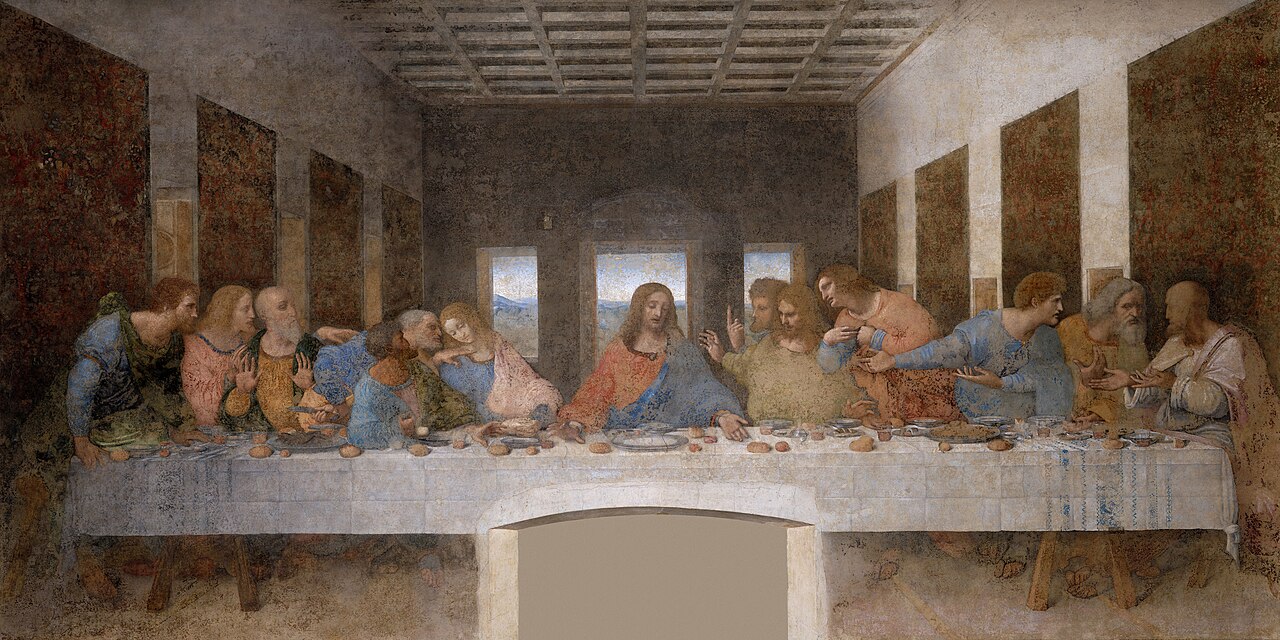
Leonardo da Vinci, "The Last Supper" (1495-98)
The most famous painting composition in history. Jesus sits at center, arms open. The words "one of you will betray me" have just landed. The twelve disciples react in four groups of three, each group a different emotional chord: shock, denial, accusation, grief. The genius is that Leonardo staged it as a theatrical WAVE, the announcement radiates outward from Christ like a shockwave, and each group catches it differently. The table is parallel to the picture plane, putting the viewer in the room. You're the thirteenth person.
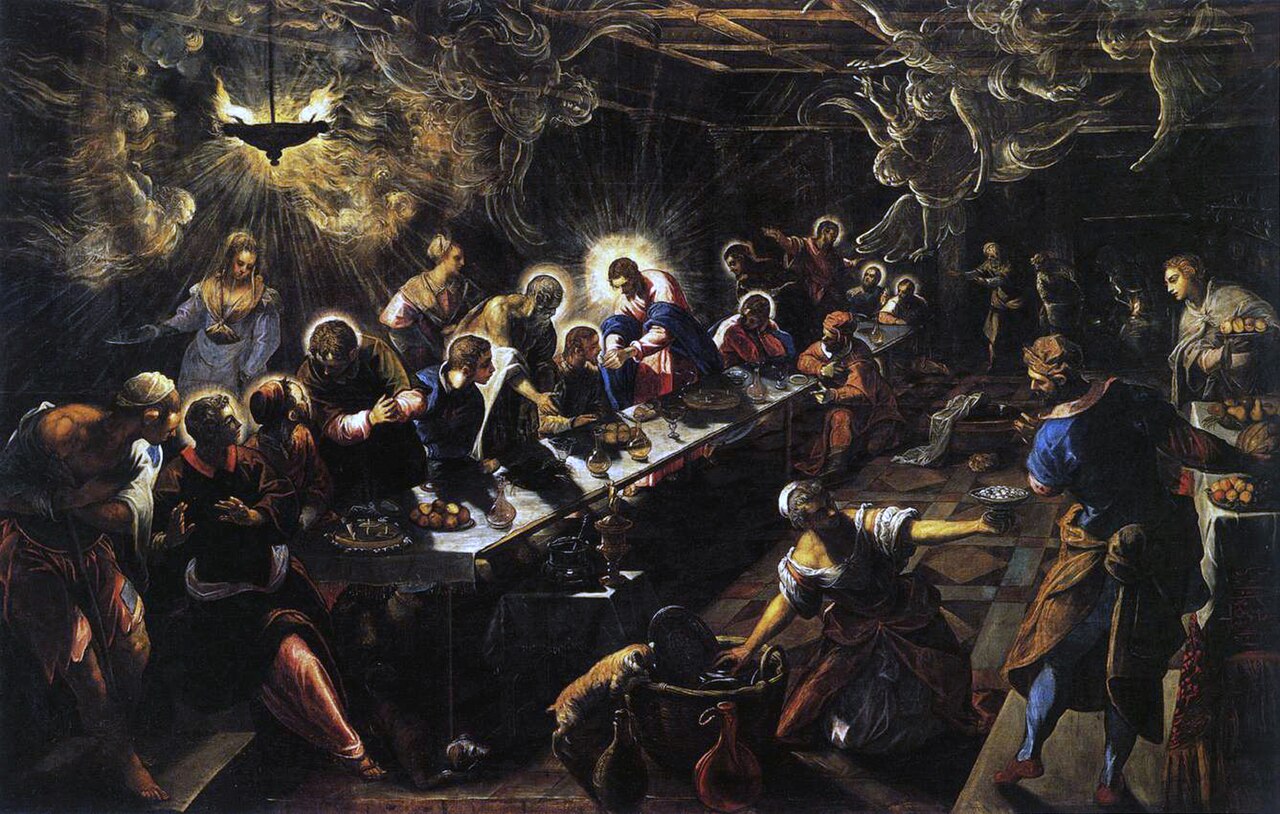
Tintoretto — "The Last Supper" (1592-94)
Where Leonardo's composition is symmetrical and still, Tintoretto's is diagonal and chaotic. The table cuts across the canvas at an angle. Servants move. Angels swirl overhead in smoke. Light sources multiply, candles, halos, a lantern. Tintoretto paints the Last Supper not as a posed moment but as a real meal in a real tavern, interrupted by something supernatural. The domesticity makes the sacred more shocking, not less.
Image needed
(see downloads)
Emil Nolde, "The Last Supper" (1909)
Nolde explodes the scene into Expressionist color: green faces, red shadows, yellow light. The figures crowd the frame, pressed together, eyes enormous. The painting feels feverish, claustrophobic, urgent. Nolde strips away all Renaissance dignity and paints the emotional REALITY of knowing you're about to lose someone, the heat, the closeness, the desperate attempt to hold the moment. It's a fever dream of a farewell dinner.
The Human Truth · 2026
Every gathering has a last time. The last family dinner before the divorce is announced. The last team meeting before the layoff. The last Thanksgiving before someone dies. You often don't know it's the last time while it's happening, but sometimes you do. And the knowledge transforms the meal: every bite is heavier, every joke lands different, every silence holds something unsaid. The Last Supper is the template for every gathering where the people at the table know something terrible is coming and choose to eat together anyway.
For your painting: A table set. Food served. People seated. Everyone knows something the scene doesn't say. The composition challenge is Leonardo's: thirteen distinct psychologies responding to the same unspoken knowledge. Who is in denial? Who is grieving already? Who is performing normalcy? And who is Judas — the one who will cause the ending? Paint the silence inside the conversation. The food that no one is really tasting.
Story 17
The Crucifixion
Unjust suffering · The cost of truth-telling · Death as sacrifice
The Story
Jesus is arrested, tried by religious and political authorities, sentenced to death. He's beaten, forced to carry a cross through the city, and crucified between two criminals. He's on the cross for hours. A crowd watches, some mocking, some grieving, some indifferent. He dies. The sky darkens.
Why Painters Use It
The crucifixion has been painted more than any other scene in human history, not just because of its religious significance, but because it contains the purest image of innocent suffering witnessed by others. A person is publicly destroyed while the world watches. Some watch in agony (Mary, John). Some watch in satisfaction (the authorities). Some watch in indifference (the soldiers gambling for his clothes). The crucifixion is a template for every scene of public suffering: the execution, the humiliation, the person destroyed for being inconvenient. It's also a question: where in the crowd are you?
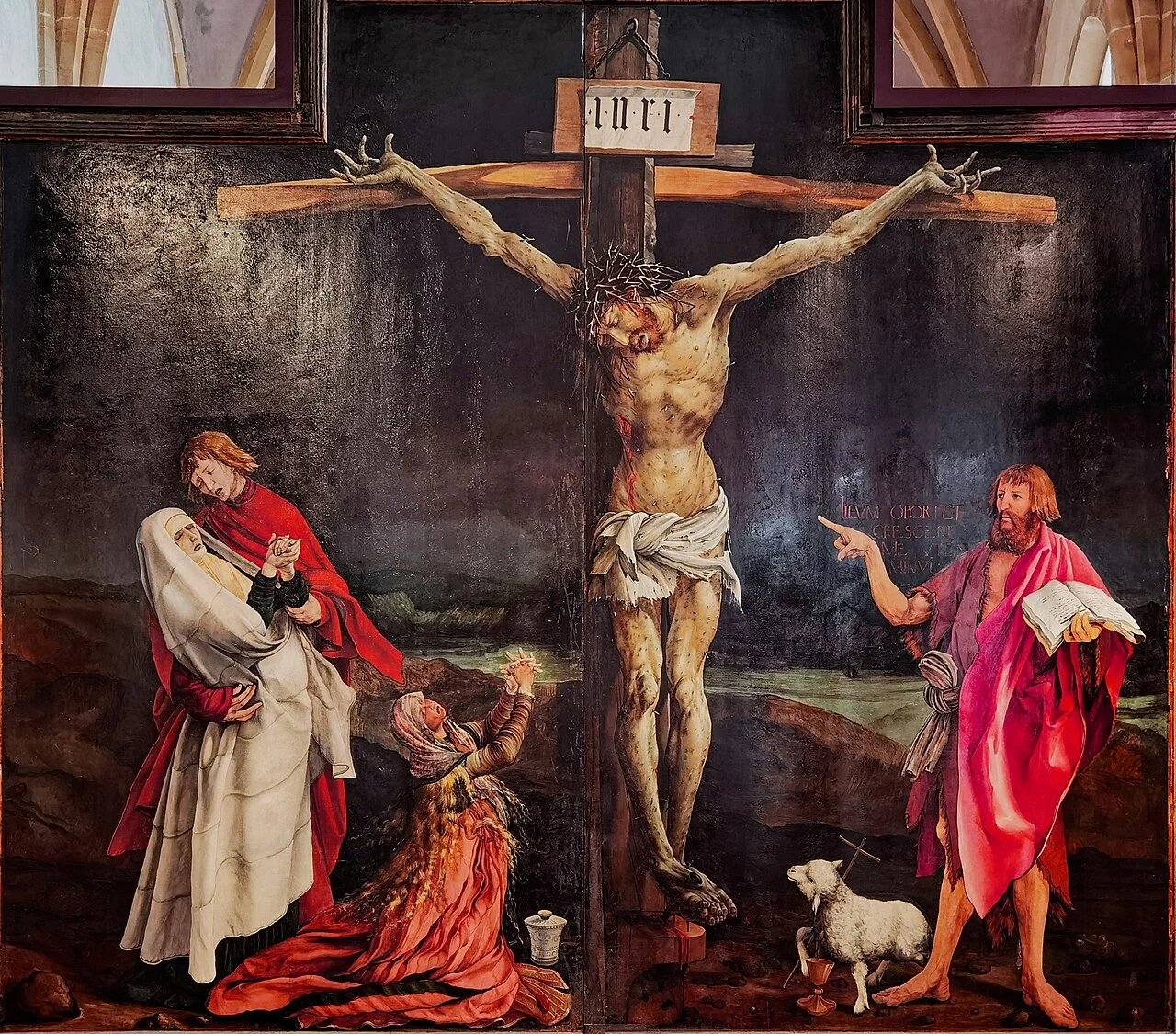
Grünewald, Isenheim Altarpiece (c. 1512-16)
The most physically brutal crucifixion ever painted, and deliberately so. Grünewald painted it for a hospital that treated patients with skin diseases. Christ's body is covered in sores, wounds, splinters. The skin is green-grey. The fingers splay in agony. Grünewald made Christ's suffering IDENTICAL to his audience's suffering. The patients looked at this and saw themselves. That's the radical move: making the sacred body as damaged as the viewer's body. No idealization. No distance. The God suffers exactly as you do.
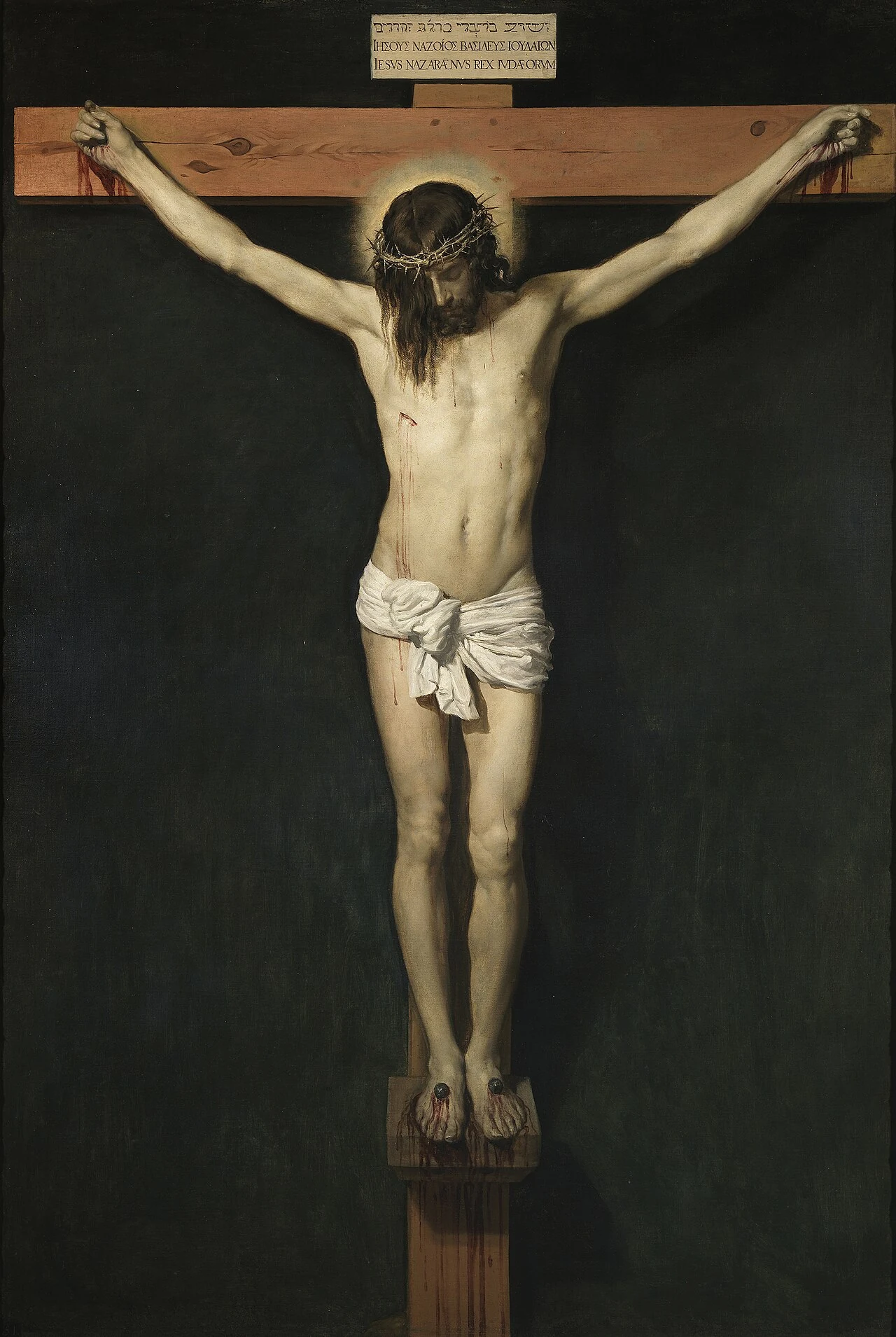
Velázquez — "Christ Crucified" (c. 1632)
The opposite of Grünewald: quiet, almost serene, against a dark background. The body hangs with anatomical precision, the weight is real, the muscles are real, but there's no violence, no blood, no crowd. Just a body and darkness. Velázquez removed everything except the essential image and painted it with photographic naturalism. The simplicity is the power. No distraction. Just death, observed with total honesty.
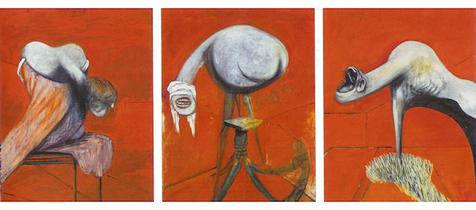
Francis Bacon, "Three Studies for Figures at the Base of a Crucifixion" (1944)
Bacon took the crucifixion and removed Christ entirely, leaving only the suffering, abstracted into screaming, contorted, barely-human forms. Painted at the end of WWII, these figures carry the weight of industrial-scale horror. Bacon proved that the crucifixion's emotional content (innocent suffering, public spectacle, the body as site of violence) survives even when every religious element is stripped away. The form persists because the feeling persists.
The Human Truth · 2026
Public destruction of an innocent person, witnessed by a crowd that is simultaneously horrified, entertained, and complicit. This is not just a religious image — it's the template for every public shaming, every cancellation, every trial by media, every person destroyed on a platform while strangers watch. The crucifixion asks: where in the crowd are YOU? Are you Mary (grieving, helpless)? The soldiers (following orders, indifferent)? The thieves (suffering alongside, for different reasons)? Or the crowd, watching, judging, scrolling to the next thing?
For your painting: The cross is any platform where someone is publicly destroyed. The crowd is the comment section, the press conference, the viral video's viewers. Paint the WATCHERS, their faces, their phones, their distance. Grünewald's approach (make the suffering unbearable to look at) or Velázquez's (make it quiet, almost peaceful, devastating in its simplicity). The question the painting asks the viewer: you're watching. What does that make you?
Story 18
The Empty Tomb
Impossible hope · The morning after the worst · Absence as presence
The Story
Three days after the crucifixion, women come to the tomb to anoint the body. The stone is rolled away. The tomb is empty. An angel (or a young man in white) says: "He is not here. He has risen." The women's reactions range from terror to joy to confusion. Mary Magdalene, weeping outside the tomb, encounters a figure she mistakes for a gardener, it's Jesus. He says her name. She recognizes him.
Why Painters Use It
Forget the theology for a moment. The paintable truth here is: the morning after you thought everything was over, when something impossible happens. The empty space where the worst thing was supposed to be. The body that isn't there. The story works not because of the miracle but because of the SEQUENCE: total despair → empty tomb → impossible hope. The composition problem is unusual: how do you paint an absence? The subject of the painting is a person who isn't there. The emotional content is carried entirely by the faces of those who discover the emptiness.
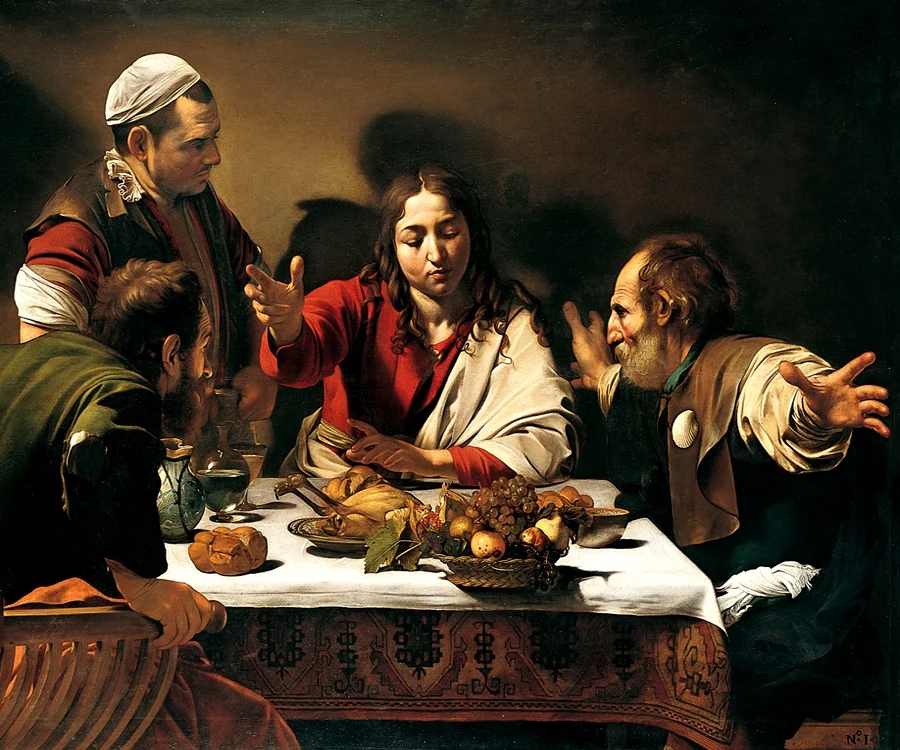
Caravaggio, "Supper at Emmaus" (1601)
Not the tomb but the dinner table: two disciples eating with a stranger who turns out to be the risen Christ. The moment of recognition is explosive — one disciple grips the table edge, the other flings his arms wide. The innkeeper stands baffled. Caravaggio paints the instant a face goes from "stranger" to "oh my God, it's YOU." The still life on the table (a basket of fruit teetering on the edge) mirrors the psychological tipping point. The whole world is about to fall off the table.
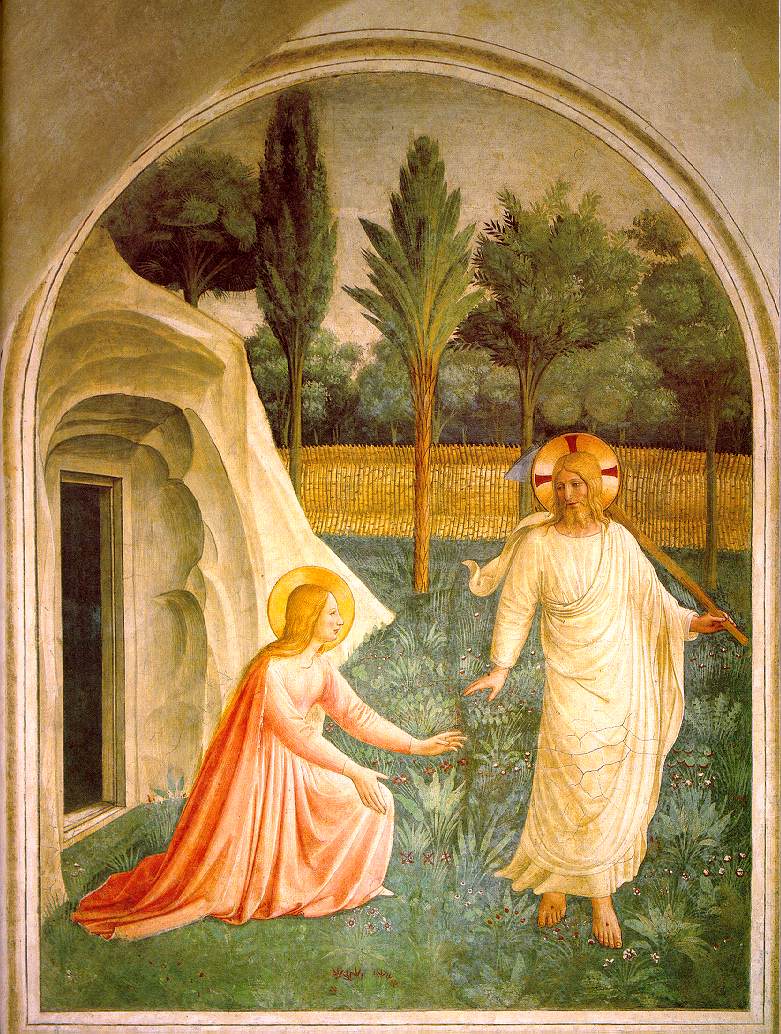
Fra Angelico, "Noli Me Tangere" (c. 1440-42)
"Don't touch me", Christ says to Mary Magdalene in the garden. She reaches for him; he draws back. Fra Angelico paints this in a garden of impossible flowers, delicate and luminous. The space between their hands is the painting: the person you love is here but you can't hold them. They're present but already leaving. Fra Angelico painted grief's cruelest variant: the person comes back, but only to say goodbye.
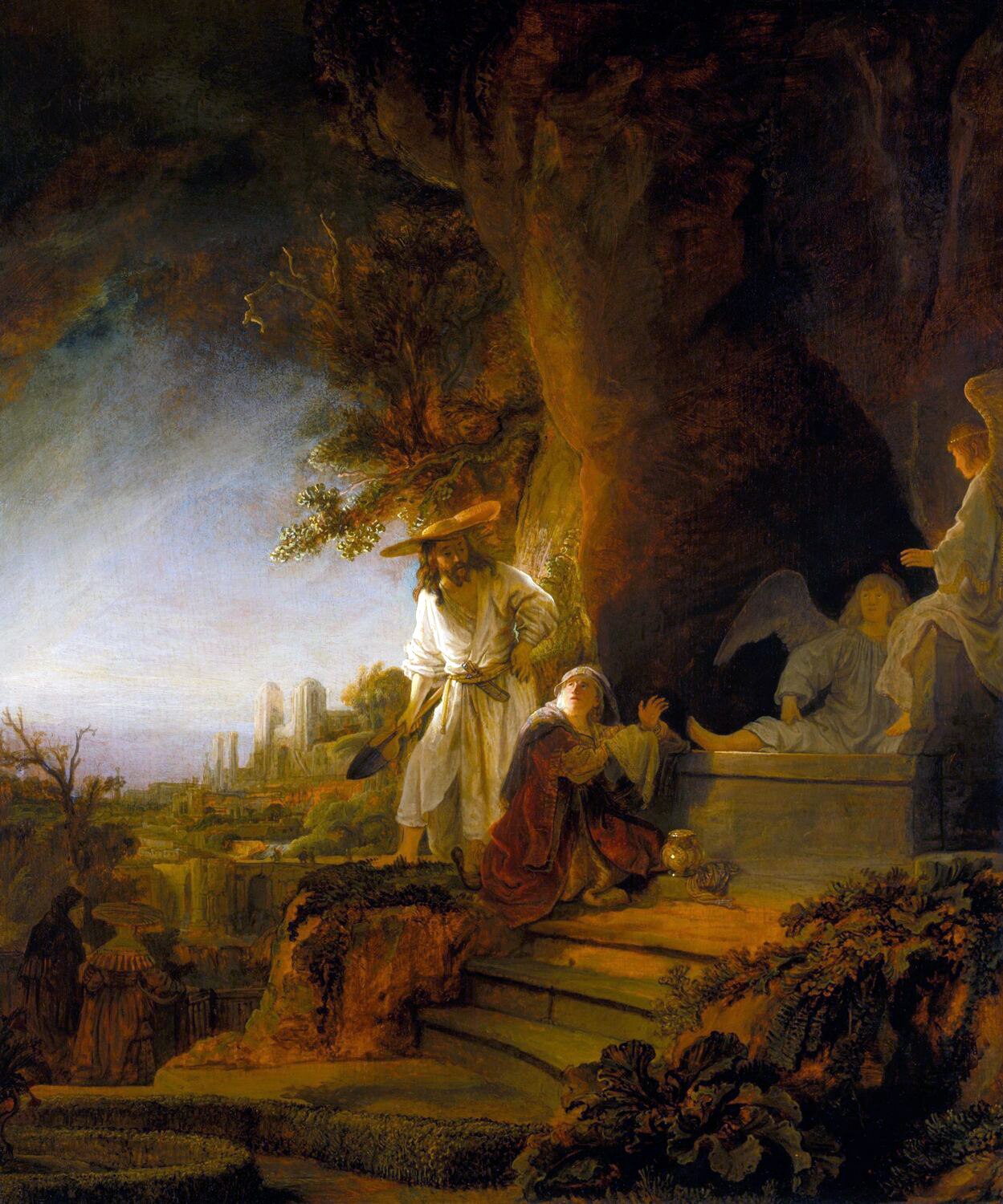
Rembrandt, "The Risen Christ Appearing to Mary Magdalene" (1638)
Rembrandt paints Mary Magdalene on her knees, face turned up, recognizing the gardener as Jesus. The light comes from Christ's figure, he IS the light source. The tomb behind them is a dark cave. Rembrandt's genius: he paints the exact transition from grief to impossible joy. Mary's body is still in mourning posture (kneeling, collapsed) but her face has already shifted. The body hasn't caught up to what the eyes have seen.