How Great Painters Found Their Subjects
There is no system. But there are real stories about how real painters arrived at the work that defined their careers. These stories are more useful than any framework because they show the messy, indirect, often accidental process by which a subject finds a painter, or a painter stumbles into a subject and recognizes it.
Sargent chased a moment of light for two years
"Carnation, Lily, Lily, Rose" (1885-86) started because Sargent saw lanterns in a garden at dusk during a boating trip on the Thames. He spent the next two years trying to paint that specific quality of light, the few minutes each evening when the lanterns glow warm against the fading blue sky. He could only paint for about twenty minutes per session, at exactly the right time. He changed models (the original children's family moved away). He replanted the garden. He moved the easel. Two years for twenty minutes of light.
Sargent didn't start with "I want to make a painting about the innocence of childhood." He started with: that light. The subject emerged from the observation. The meaning accrued over two years of devotion to a visual phenomenon.
What to take from this: If something catches your eye, a specific quality of light, a particular gesture, a scene that makes you pause, chase it. Don't wait until you understand why it matters. The understanding comes from the painting, not before it.
Millet moved to the country and painted his neighbors
Jean-François Millet didn't set out to become "the painter of peasant life." He moved to Barbizon in 1849 to escape Paris — it was cheaper, and his family was growing. He painted what he saw: the people around him working, praying, resting. He painted them for twenty years, the same subjects over and over, gleaners, sowers, shepherds, women carrying water.
The paintings became universal not because Millet aimed at universality, but because he looked at the same small world so long and so carefully that he saw through the specific to the eternal. "The Gleaners" isn't a painting about three specific women in a field near Barbizon. It's a painting about the dignity of labor that will be true for as long as humans work. But it got there by being, first, absolutely specific.
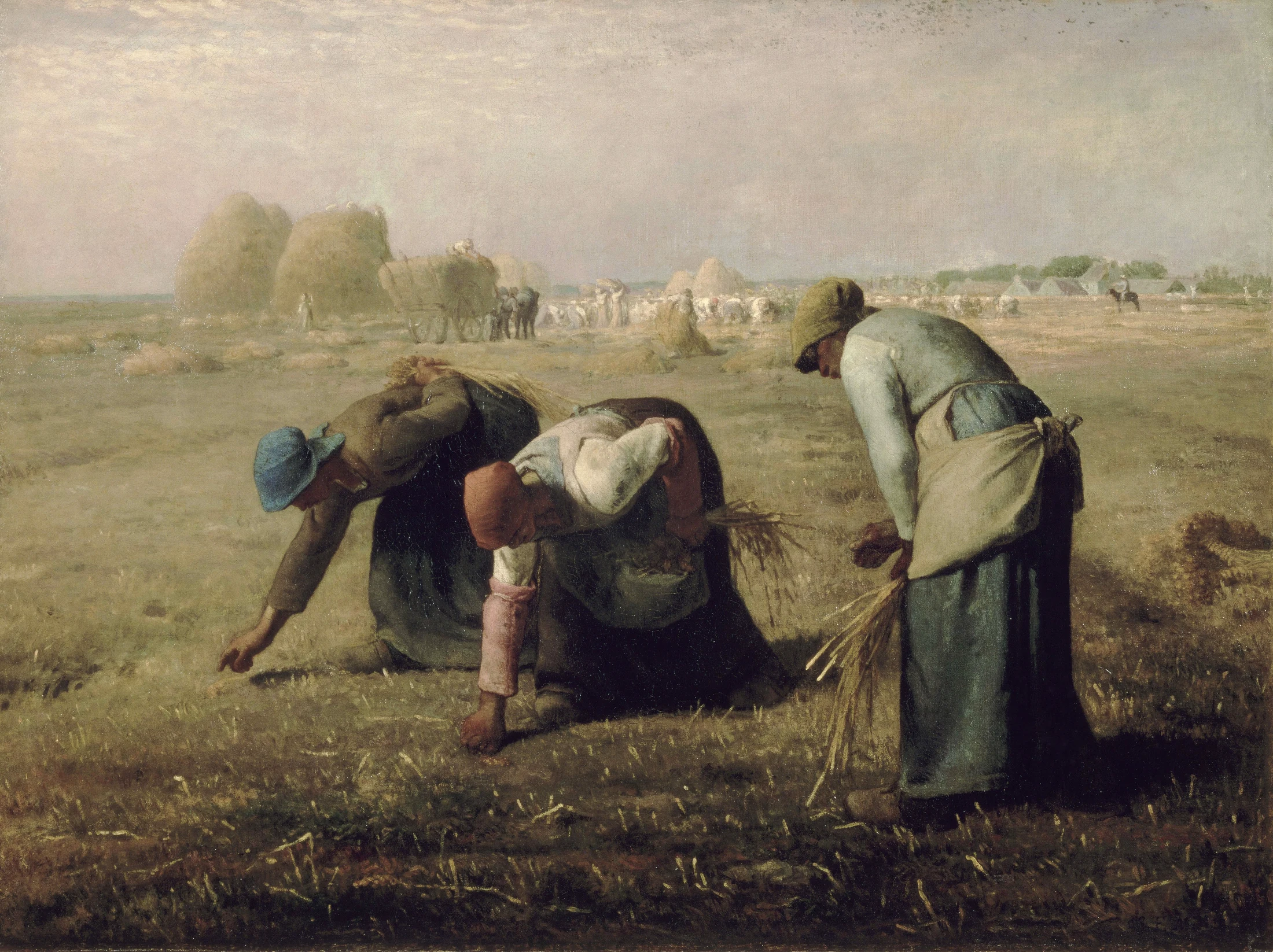
What to take from this: You don't need to travel the world to find a subject. You need to look at your own world with enough patience that the surface burns away and the structure shows. Millet's advice, paraphrased: paint what's in front of you, over and over, until you understand it.
Repin traveled for years before he could paint the Volga
Ilya Repin first saw barge haulers on the Volga in 1868, as a student. He was shocked, men yoked like animals, pulling ships. He tried to paint it immediately. The results were bad, melodramatic, preachy, exactly the kind of "social commentary" that deadens art.
He went back. He traveled the Volga in 1870, spending months with the haulers. He sketched individual faces. He learned their names, heard their stories. One old man had been a priest. One young man still had energy and defiance. One was simply broken. The painting that emerged in 1873 isn't a political statement about labor exploitation, it's eleven individual portraits of eleven specific human beings, each carrying the same rope and each feeling it differently.
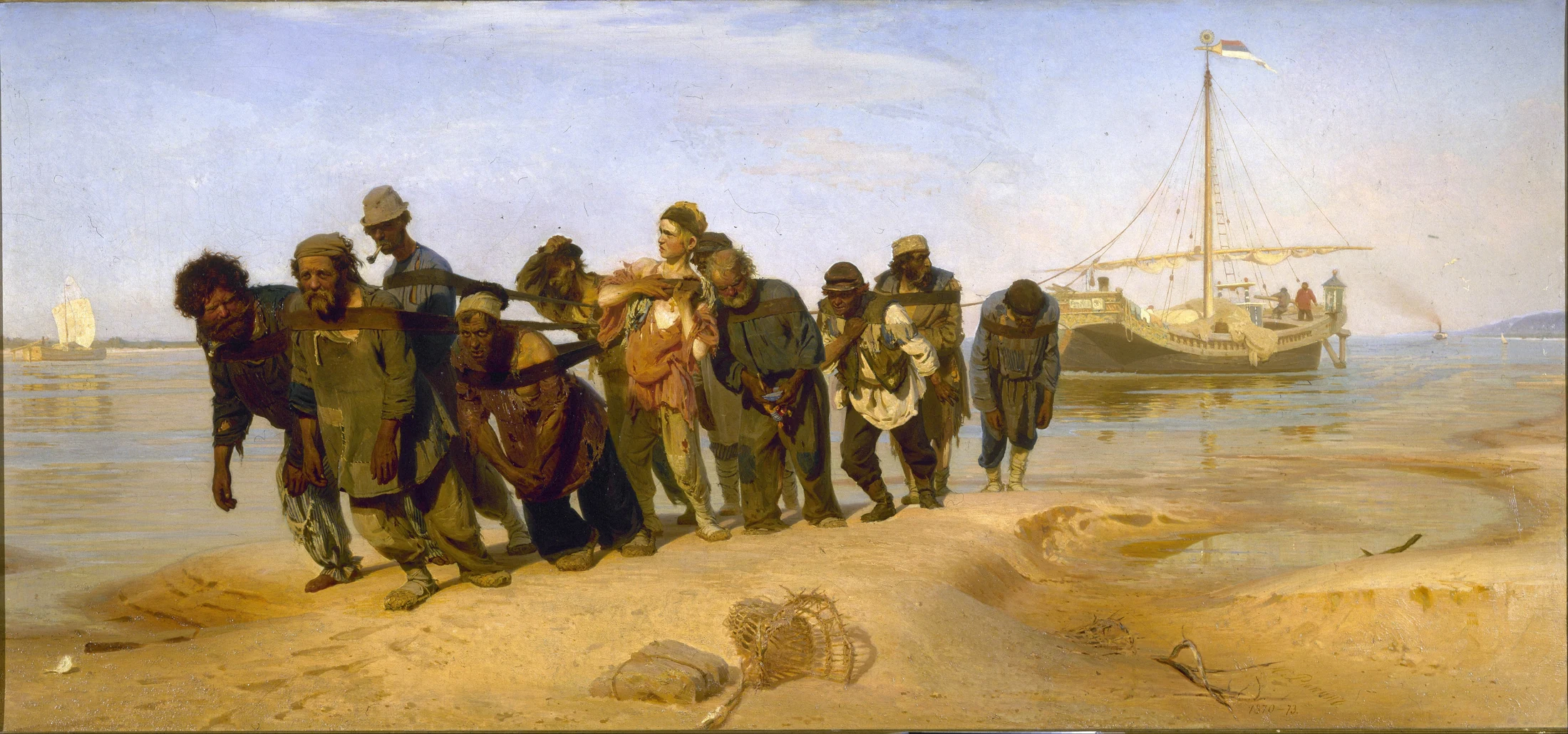
What to take from this: Your first response to a subject is almost never the right one. The first version is the cliché — the version anyone would paint. The masterwork version comes from going back, spending time, and seeing the individuals within the topic. "Isolation" is a cliché. The specific way YOUR neighbor sits on her porch every evening and watches the street and never waves, that's a painting.
Wyeth looked out the same window for decades
Andrew Wyeth lived in Chadds Ford, Pennsylvania, and Cushing, Maine. Two places. His entire career. He painted the same fields, the same houses, the same people, Helga Testorf, the Olson family, his own property, for fifty years. He didn't travel. He didn't seek exotic subjects. He went deeper into the world he already knew.
"Christina's World" (1948) came from watching his neighbor Christina Olson crawl across a field. She had a degenerative muscular condition that left her unable to walk. She refused a wheelchair. Wyeth had known her for years before the painting, it wasn't a snapshot of a stranger. It was the distillation of years of watching a specific person's specific form of dignity.
What to take from this: Depth beats breadth. You don't need more subjects. You need to know your subjects better. The painting that will define your career might be in a scene you've already seen a hundred times and haven't yet really looked at.
Cassatt painted her family and changed art history
Mary Cassatt didn't have access to the subjects male painters used — the nude model, the barroom, the battlefield. She painted what she could see: her mother, her sister, her nieces, women in domestic settings. She could have seen this as a limitation. Instead, she looked at the mother-child relationship with an intensity no one had brought to it before and found a universe there.
"The Child's Bath" isn't sentimental. It's almost clinical in its observation, the specific angle of the child's foot, the mother's practical grip, the way the water catches light in the basin. Cassatt elevated the domestic by refusing to romanticize it. She painted it with the same compositional rigor and observational precision that male painters brought to history and mythology.
What to take from this: Your "limitation", the small world you actually have access to, might be your subject. Don't apologize for painting what you know. Paint it with enough intensity and precision that the viewer sees it the way you do: as extraordinary.
What These Stories Have in Common
Five painters, five different eras, five different approaches. But they share three things:
1. They all started with looking, not thinking. None of them began with a theme or concept. Sargent began with light. Millet began with proximity. Repin began with shock. Wyeth began with years of acquaintance. Cassatt began with access. The "meaning" of the painting came after the looking, not before.
2. They all spent time with their subject before painting it. Sargent: two years. Repin: five years. Millet: twenty years. Wyeth: decades. Cassatt: a lifetime. The masterwork is never the first attempt. It's the version that comes after you know the subject so well that you see past the obvious to the essential.
3. They all painted something specific, and it became universal. Not "labor" but three women in a field near Barbizon. Not "longing" but one woman crawling across one field in Maine. Not "motherhood" but one woman washing one child's feet in one basin. The universal enters the painting through the specific, never the other way around.
For us in the studio, right now, with a ranked list of 73 pain points and the ambition to make masterworks: this means the library in the next section isn't a set of finished ideas. It's a starting point. The specific painting concept that will become YOUR masterwork will come from taking one of these directions and then doing what Sargent, Millet, Repin, Wyeth, and Cassatt all did: looking longer, going deeper, and getting more specific than anyone else would bother to.